Results by title
58 books match the query '1865-1950' and 3 start with a
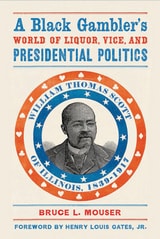
A Black Gambler’s World of Liquor, Vice, and Presidential Politics
William Thomas Scott of Illinois, 1839–1917Bruce L. Mouser
University of Wisconsin Press, 2014
William Thomas Scott (1839–1917) was an entrepreneur and political activist from East Saint Louis and Cairo, Illinois, who in 1904 briefly became the first African American nominated by a national party for president of the United States before his scandalous past forced him to step aside. A free man before the Civil War, Scott was a charismatic hustler who built his fortune through both vice trades and legal businesses including hotels, saloons, and real estate. Publisher and editor of the Cairo Gazette and an outspoken advocate for equal rights, he believed in political patronage and frequently rebelled against political bosses who failed to deliver, whether they were white, black, Republican, or Democrat.
Scott helped build the National Negro Liberty Party to forward economic, political, and legal rights for his race. But the hustling that had brought him business success proved his undoing as a national political figure. He was the NNLP's initial presidential nominee, only to be replaced by a better-educated and more socially acceptable candidate, George Edwin Taylor.
Scott helped build the National Negro Liberty Party to forward economic, political, and legal rights for his race. But the hustling that had brought him business success proved his undoing as a national political figure. He was the NNLP's initial presidential nominee, only to be replaced by a better-educated and more socially acceptable candidate, George Edwin Taylor.
[more]
An Irish-American Odyssey
The Remarkable Rise of the O'Shaughnessy BrothersColum Kenny
University of Missouri Press, 2014
The O’Shaughnessy brothers’ story takes place between 1860 and 1950 in Illinois, Missouri, New York, and Ireland. They were the children of an impoverished immigrant who fled the famine in Ireland and his Irish-American wife.An Irish-American Odysseyis the tale of this first-generation immigrant family’s struggle to assimilate into American society, highlighting their perseverance and determination to seize opportunities and surmount obstacles, all the while establishing a legacy for their own descendants in American art, advertising, journalism, and public service.
TIME magazine called James O’Shaughnessy “the best in the business” of advertising, and he became the first chief executive of the American Association of Advertising Agencies. Earlier, he was a “star” reporter at the Chicago Tribune, and James and Francis were centrally involved in founding and maintaining the Irish Fellowship Club. Francis was also the first graduate of the University of Notre Dame to be invited to deliver its annual commencement address, while Martin was the first captain of Notre Dame’s official basketball team. An attorney, John represented the alleged victim in a notorious “white slavery” case. Thomas (“Gus”) became the leading Gaelic Revival artist in America as well as a promoter of Italian-American heritage, campaigning successfully to have Columbus Day enacted a public holiday.
The remarkable rise of the O’Shaughnessy brothers proves the American dream is attainable.
[more]
August Reckoning
Jack Turner and Racism in Post–Civil War AlabamaWilliam Warren Rogers Sr.
University of Alabama Press, 2004
An important story of one man’s life, lived with courage and principle
During the decades of Bourbon ascendancy after 1874, Alabama institutions like those in other southern states were dominated by whites. Former slave and sharecropper Jack Turner refused to accept a society so structured. Highly intelligent, physically imposing, and an orator of persuasive talents, Turner was fearless before whites and emerged as a leader of his race. He helped to forge a political alliance between blacks and whites that defeated and humiliated the Bourbons in Choctaw County, the heart of the Black Belt, in the election of 1882. That summer, after a series of bogus charges and arrests, Turner was accused of planning to lead his private army of blacks in a general slaughter of the county whites. Justice was forgotten in the resultant fear and hysteria.
During the decades of Bourbon ascendancy after 1874, Alabama institutions like those in other southern states were dominated by whites. Former slave and sharecropper Jack Turner refused to accept a society so structured. Highly intelligent, physically imposing, and an orator of persuasive talents, Turner was fearless before whites and emerged as a leader of his race. He helped to forge a political alliance between blacks and whites that defeated and humiliated the Bourbons in Choctaw County, the heart of the Black Belt, in the election of 1882. That summer, after a series of bogus charges and arrests, Turner was accused of planning to lead his private army of blacks in a general slaughter of the county whites. Justice was forgotten in the resultant fear and hysteria.
[more]