Results by title
5 books match the query '1865-1951'
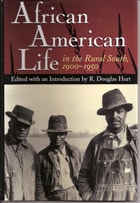
African American Life in the Rural South, 1900-1950
Edited with an introduction by R. Douglas Hurt
University of Missouri Press, 2003
Archipelagoes of My South
Episodes in the Shaping of a Region, 1830–1965J. Mills Thornton III
University of Alabama Press, 2016
A collection of essays representing forty-five years of reflection on the central problems of southern history bound together by a common concern with defining the crucial interaction of race and class in the formation of southern politics and life
“The tourist archipelagoes of my South / are prisons, too, corruptible” writes the poet Derek Walcott. While Walcott refers to the islands of the Caribbean, the analogous idea of a land made into solitary islands by an imprisoned and inherited corruption is historian J. Mills Thornton III’s American South. The captivating essays in Archipelagoes of My South: Episodes in the Shaping of a Region, 1830–1965 address this overarching and underlying narrative of Alabama politics and the history of the South.
Highlighting events as significant as the role of social and economic conflict in the southern secession movement, various aspects of Reconstruction, and the role of the Ku Klux Klan in the politics of the 1920s, Thornton draws from various points in the southern past in an effort to identify and understand the sources of the region’s power. Moreover, each essay investigates its subject matter and peels back layers with an aim to clarify why the enormous diversity of the southern experience makes that power so great, all the while allowing the reader to see connections that would not otherwise be apparent.
Archipelagoes of My South gathers previously uncollected essays into a single volume covering the entire length and breadth of Thornton’s career. The author’s principal concerns have always been the arc of regional evolution and the significance of the local. Thus, the mechanisms of political and social change and the interrelationships across eras and generations are recurring themes in many of these essays.
Even those who have spent their entire lives in the South may be unaware of the fractured layers of history that lie beneath the landscape they inhabit. For those southern residents who seek to comprehend more of their own past, this landmark compilation of essays on Alabama and southern history endeavors to provide illumination and enlightenment.
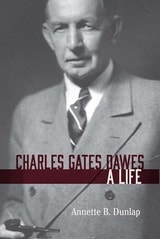
Charles Gates Dawes
A LifeAnnette B. Dunlap
Northwestern University Press, 2016
Charles Gates Dawes: A Life is the first comprehensive biography of an American in whose fascinating story contemporary readers can follow the struggles and triumphs of early twentieth-century America and Europe.
Dawes is most known today as vice president of the United States under Calvin Coolidge, but he also distinguished himself and his hometown of Evanston, Illinois, on the world stage with the 1925 Nobel Peace Prize. This engrossing biography traces how, when the punitive armistice that ended the First World War resulted in a disabled, restive Germany, Dawes’s diplomatic legerdemain averted war through a renegotiation of Germany’s debt repayments.
Dawes’s diplomatic and political achievements, however, were only the illustrious capstones to a multifaceted career that included military service, law, finance, and business on the local, state, national, and global stages. In every arena of his life, he combined the social graces of the Gilded Age with the spirit of service of the Progressive Era.
Despite his life of disciplined service, Dawes was an ebullient and irrepressible figure. Dawes’s salty language was often colorful fodder for tabloid and magazine writers of his era. In this captivating biography, Annette B. Dunlap recounts the story of an original American who enlightened and enlivened his world.
This book was published in cooperation with the Evanston History Center and with generous support from the Tawani Foundation.
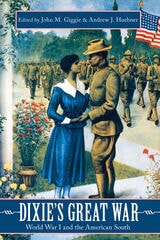
Dixie's Great War
World War I and the American SouthEdited by John M. Giggie and Andrew J. Huebner
University of Alabama Press, 2021
Examining the First World War through the lens of the American South
How did World War I affect the American South? Did southerners experience the war in a particular way? How did regional considerations and, more generally, southern values and culture impact the wider war effort? Was there a distinctive southern experience of WWI?
Scholars considered these questions during “Dixie’s Great War,” a symposium held at the University of Alabama in October 2017 to commemorate the centenary of the American intervention in the war. With the explicit intent of exploring iterations of the Great War as experienced in the American South and by its people, organizers John M. Giggie and Andrew J. Huebner also sought to use historical discourse as a form of civic engagement designed to facilitate a community conversation about the meanings of the war.
Giggie and Huebner structured the panels thematically around military, social, and political approaches to the war to encourage discussion and exchanges between panelists and the public alike. Drawn from transcriptions of the day’s discussions and lightly edited to preserve the conversational tone and mix of professional and public voices, Dixie’s Great War: World War I and the American South captures the process of historians at work with the public, pushing and probing general understandings of the past, uncovering and reflecting on the deeper truths and lessons of the Great War—this time, through the lens of the South.
This volume also includes an introduction featuring a survey of recent literature dealing with regional aspects of WWI and a discussion of the centenary commemorations of the war. An afterword by noted historian Jay Winter places “Dixie’s Great War”—the symposium and this book—within the larger framework of commemoration, emphasizing the vital role such forums perform in creating space and opportunity for scholars and the public alike to assess and understand the shifting ground between cultural memory and the historical record.
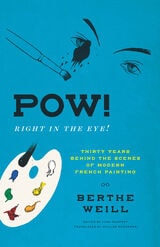
Pow! Right in the Eye!
Thirty Years behind the Scenes of Modern French PaintingBerthe Weill
University of Chicago Press, 2022
Berthe Weill, a formidable Parisian dealer, was born into a Jewish family of very modest means. One of the first female gallerists in the business, she first opened the Galerie B. Weill in the heart of Paris’s art gallery district in 1901, holding innumerable exhibitions over nearly forty years. Written out of art history for decades, Weill has only recently regained the recognition she deserves.
Under five feet tall and bespectacled, Weill was beloved by the artists she supported, and she rejected the exploitative business practices common among art dealers. Despite being a self-proclaimed “terrible businesswoman,” Weill kept her gallery open for four decades, defying the rising tide of antisemitism before Germany’s occupation of France. By the time of her death in 1951, Weill had promoted more than three hundred artists—including Henri Matisse, Pablo Picasso, Amedeo Modigliani, Diego Rivera, and Suzanne Valadon—many of whom were women and nearly all young and unknown when she first exhibited them.
Pow! Right in the Eye! makes Weill’s provocative 1933 memoir finally available to English readers, offering rare insights into the Parisian avant-garde and a lively inside account of the development of the modern art market.