Results by title

12 books match the query '1868-'
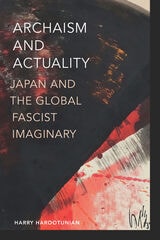
cover of Archaism and Actuality: Japan and the Global Fascist Imaginary

Archaism and Actuality

Japan and the Global Fascist Imaginary

Harry Harootunian

Duke University Press, 2023
In Archaism and Actuality eminent Marxist historian Harry Harootunian explores the formation of capitalism and fascism in Japan as a prime example of the uneven development of capitalism. He applies his theorization of subsumption to examine how capitalism integrates and redirects preexisting social, cultural, and economic practices to guide the present. This subsumption leads to a global condition in which states and societies all exist within different stages and manifestations of capitalism. Drawing on Japanese philosophers Miki Kiyoshi and Tosaka Jun, Marxist theory, and Gramsci’s notion of passive revolution, Harootunian shows how the Meiji Restoration of 1868 and its program dedicated to transforming the country into a modern society exemplified a unique path to capitalism. Japan’s capitalist expansion in the nineteenth and twentieth centuries, rise as an imperial power, and subsequent transition to fascism signal a wholly distinct trajectory into modernity that forecloses any notion of a pure or universal development of capitalism. With Archaism and Actuality, Harootunian offers both a retheorization of capitalist development and a reinterpretation of epochal moments in modern Japanese history.
[more]
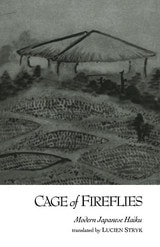
cover of Cage Of Fireflies: Modern Japanese Haiku

Cage Of Fireflies

Modern Japanese Haiku

Lucien Stryk

Ohio University Press, 1993

Haiku at its best is an art in which the poet takes a natural, most ordinary event, and without fuss, ornament or inflated words makes of it a rare moment — sparely rendered, crystallized into a microcosm which reveals transcendent unity. Small wonder haiku has a growing audience throughout the world.

In all arts — music, painting, dance, theatre — change has come with that startling moment of dissatisfaction when the artist upends complacency, shocks the old to its foundations, and emerges with clear vision. He has had the courage to rescue his art from dullness. Two of Japan’s “Great Four” of haiku, Basho (1644-94) and Shiki (1862-1902), were such revolutionaries, albeit two hundred years apart. Before Basho, haiku was but a pleasant occupation for the idle. He set about transforming it with such success that experts to this day agree that his were the first true haiku.

Shiki, who lived into the 20th century, was passionate in his attempt to salvage haiku from its past, sending out shock waves by dismissing virtually all earlier work, including most of Basho’s. He saw it as his mission to make a difference — to let nothing, not even the most revered, stand in the way. He proclaimed, “A poem has no meaning. It is feeling alone.” And he practiced what he preached.

Autumn wind:
gods, Buddha—
lies, lies, lies.


These modern Japanese poets, many of whom are translated here into English for the first time, learned as much from Basho as from Shiki, and from Buson (1715-83) and Issa (1763-1827), the “Great Four.” Yet in a sense they are followers of Shiki, in spite of the harshness of his views and the impossibly high standards he demanded. They were forced to reckon with him, became willing participants in a heated dialogue with him. They had to: his spirit dominated the age. Stryk captures that spirit here, in this Cage of Fireflies.
[more]
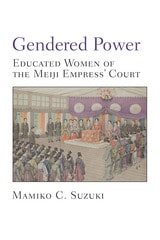
cover of Gendered Power: Educated Women of the Meiji Empress' Court

Gendered Power

Educated Women of the Meiji Empress' Court

Mamiko C. Suzuki

University of Michigan Press, 2019

Gendered Power sheds light on the sources of power for three prominent women of the Meiji period: Meiji Empress Haruko; public speaker, poet, and diarist Nakajima Shoen; and educator and prolific author Shimoda Utako. By focusing on the role Chinese classics (kanbun) played in the language employed by elite women, the chapters focus on how Empress Haruko, Shoen, and Shimoda Utako contributed new expectations for how women should participate in a modernizing Japan. By being in the public eye, all three women countered criticism of and commentary on their writings and activities, which they parried by navigating gender constraints. The success or failure as women ascribed to these three figures sheds light on the contradictions inhabited by them during a transformative period for Japanese women.  
 
By proposing and interrogating the possibility of Meiji women’s power, the book examines contradictions that were symptomatic of their struggles within the vast social, cultural, and political transformations that took place during the period. The book demonstrates that an examination of that conflict within feminist history is crucial in order to understand what radical resistance meant in the face of women-centered authority.

 
[more]
cover of Japan's Holy War: The Ideology of Radical Shinto Ultranationalism

Japan's Holy War

The Ideology of Radical Shinto Ultranationalism

Walter A. Skya

Duke University Press, 2009

Japan’s Holy War reveals how a radical religious ideology drove the Japanese to imperial expansion and global war. Bringing to light a wealth of new information, Walter A. Skya demonstrates that whatever other motives the Japanese had for waging war in Asia and the Pacific, for many the war was the fulfillment of a religious mandate. In the early twentieth century, a fervent nationalism developed within State Shintō. This ultranationalism gained widespread military and public support and led to rampant terrorism; between 1921 and 1936 three serving and two former prime ministers were assassinated. Shintō ultranationalist societies fomented a discourse calling for the abolition of parliamentary government and unlimited Japanese expansion.

Skya documents a transformation in the ideology of State Shintō in the late nineteenth century and the early twentieth. He shows that within the religion, support for the German-inspired theory of constitutional monarchy that had underpinned the Meiji Constitution gave way to a theory of absolute monarchy advocated by the constitutional scholar Hozumi Yatsuka in the late 1890s. That, in turn, was superseded by a totalitarian ideology centered on the emperor: an ideology advanced by the political theorists Uesugi Shinkichi and Kakehi Katsuhiko in the 1910s and 1920s. Examining the connections between various forms of Shintō nationalism and the state, Skya demonstrates that where the Meiji oligarchs had constructed a quasi-religious, quasi-secular state, Hozumi Yatsuka desired a traditional theocratic state. Uesugi Shinkichi and Kakehi Katsuhiko went further, encouraging radical, militant forms of extreme religious nationalism. Skya suggests that the creeping democracy and secularization of Japan’s political order in the early twentieth century were the principal causes of the terrorism of the 1930s, which ultimately led to a holy war against Western civilization.
[more]
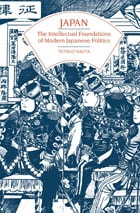
cover of Japan: The Intellectual Foundations of Modern Japanese Politics

Japan

The Intellectual Foundations of Modern Japanese Politics

Tetsuo Najita

University of Chicago Press, 1980

Historians have long been aware of the richness and complexity of the intellectual history of modern Japanese politics. Najita's study, however, is the first in a Western language to present a consistent and broad synthesis of this subject. Najita elucidates the political dynamics of the past two hundred years of Japanese history by focusing on the interplay of restorationism and bureaucratism within the context of Japan's modern revolution, the Meiji Restoration.
[more]
cover of Queer Subjects in Modern Japanese Literature: Male Love, Intimacy, and Erotics, 1886–2014

Queer Subjects in Modern Japanese Literature

Male Love, Intimacy, and Erotics, 1886–2014

Stephen D. Miller, Editor

University of Michigan Press, 2022

Queer Subjects in Modern Japanese Literature: Male Love, Erotics, and Intimacy, 1886–2014 is an anthology of translated Japanese literature about men behaving lovingly, erotically, and intimately with other men. Covering more than 125 years of modern and contemporary Japanese history, this book aims to introduce a diverse array of authors to an English-speaking audience and provide further context for their works. While no anthology can comprehensively represent queer Japanese literature, these selections nonetheless expand our understanding of queerness in Japanese culture.
[more]
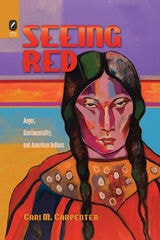
cover of Seeing Red: Anger, Sentimentality, and American Indians

Seeing Red

Anger, Sentimentality, and American Indians

Cari M. Carpenter

The Ohio State University Press, 2008
In Seeing Red, Cari M. Carpenter examines anger in the poetry and prose of three early American Indian writers: S. Alice Callahan, Pauline Johnson, and Sarah Winnemucca. In articulating a legitimate anger in the late nineteenth century, the first published indigenous women writers were met not only with stereotypes of “savage” rage but with social proscriptions against female anger. While the loss of land, life, and cultural traditions is central to the Native American literature of the period, this dispossession is only one side of the story. Its counterpart, indigenous claims to that which is threatened, is just as essential to these narratives. The first published American Indian women writers used a variety of tactics to protest such dispossession. Seeing Red argues that one of the most pervasive and intriguing of these is sentimentality.
 
Carpenter argues that while anger is a neglected element of a broad range of sentimental texts, it should be recognized as a particularly salient subject in early literature written by Native American women. To date, most literary scholars—whether they understand sentimentality in terms of sympathetic relations or of manipulative influence—have viewed anger as an obstacle to the genre. Placing anger and sentimentality in opposition, however, neglects their complex and often intimate relationship. This case study of three Native American women writers is not meant to fall easily into either the “pro” or “anti” sentimentality camp, but to acknowledge sentimentality as a fraught, yet potentially useful, mode for articulating indigenous women’s anger.
[more]
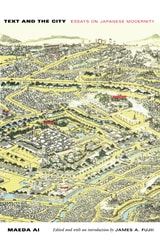
cover of Text and the City: Essays on Japanese Modernity

Text and the City

Essays on Japanese Modernity

Maeda Ai

Duke University Press, 2004

Maeda Ai was a prominent literary critic and an influential public intellectual in late-twentieth-century Japan. Text and the City is the first book of his work to appear in English. A literary and cultural critic deeply engaged with European critical thought, Maeda was a brilliant, insightful theorist of modernity for whom the city was the embodiment of modern life. He conducted a far-reaching inquiry into changing conceptions of space, temporality, and visual practices as they gave shape to the city and its inhabitants. James A. Fujii has assembled a selection of Maeda’s essays that question and explore the contours of Japanese modernity and resonate with the concerns of literary and cultural studies today.

Maeda remapped the study of modern Japanese literature and culture in the 1970s and 1980s, helping to generate widespread interest in studying mass culture on the one hand and marginalized sectors of modern Japanese society on the other. These essays reveal the broad range of Maeda’s cultural criticism. Among the topics considered are Tokyo; utopias; prisons; visual media technologies including panoramas and film; the popular culture of the Edo, Meiji, and contemporary periods; maps; women’s magazines; and women writers. Integrally related to these discussions are Maeda’s readings of works of Japanese literature including Matsubara Iwagoro’s In Darkest Tokyo, Nagai Kafu’s The Fox, Higuchi Ichiyo’s Growing Up, Kawabata Yasunari’s The Crimson Gang of Asakusa, and Narushima Ryuhoku’s short story “Useless Man.” Illuminating the infinitely rich phenomena of modernity, these essays are full of innovative, unexpected connections between cultural productions and urban life, between the text and the city.

[more]
cover of The New Star Chamber and Other Essays: Annotated Edition

The New Star Chamber and Other Essays

Annotated Edition

Edgar Lee Masters; edited by Jason Stacy

Southern Illinois University Press, 2023

Tracing the troubled roots of American capitalism and imperialism
 
Coedited by noted Masters scholar, Jason Stacy, and his class, “Editing History,” this annotated edition of Edgar Lee Masters’s The New Star Chamber and Other Essays reappears at a perilous time in US history, when large corporations and overseas conflicts once again threaten the integrity of American rights and liberties, and the United States still finds itself beholden to corporate power and the legacy of imperial hubris. In speaking to his times, Masters also speaks to ours.
 
These thirteen essays lay bare the political ideology that informed Spoon River Anthology. Masters argues that the dangerous imperialism championed by then-President Theodore Roosevelt was rooted in the Constitution itself. By debating the ethics of the Philippine-American War, criticizing Hamiltonian centralization of government, and extolling the virtues of Jeffersonian individualism, Masters elucidates the ways in which America had strayed from its constitutional morals and from democracy itself. The result is a compelling critique of corporate capitalism and burgeoning American imperialism, as well as an exemplary source for understanding its complicated author in the midst of his transformation from urban lawyer to poet of rural America.
 
In print again for the first time since 1904, this edition includes an introduction and historical annotations throughout. Edited and annotated by students at Southern Illinois University Edwardsville, and designed and illustrated by students at Southern Illinois University Carbondale, this volume traces economic and political pathologies to the origins of the American republic. The New Star Chamber and Other Essays is as vital now as it was over 100 years ago.
[more]
cover of Transformations of Sensibility: The Phenomenology of Meiji Literature

Transformations of Sensibility

The Phenomenology of Meiji Literature

Kamei Hideo; Translated, edited, and with an introduction by Michael Bourdaghs

University of Michigan Press, 2002
First published in Japan in 1983, this book is now a classic in modern Japanese literary studies. Covering an astonishing range of texts from the Meiji period (1868–1912), it presents sophisticated analyses of the ways that experiments in literary language produced multiple new—and sometimes revolutionary—forms of sensibility and subjectivity. Along the way, Kamei Hideo carries on an extended debate with Western theorists such as Saussure, Bakhtin, and Lotman, as well as with such contemporary Japanese critics as Karatani Kōjin and Noguchi Takehiko.
Transformations of Sensibility deliberately challenges conventional wisdom about the rise of modern literature in Japan and offers highly original close readings of works by such writers as Futabatei Shimei, Tsubouchi Shōyō, Higuchi Ichiyō, and Izumi Kyōka, as well as writers previously ignored by most scholars. It also provides a new critical theorization of the relationship between language and sensibility, one that links the specificity of Meiji literature to broader concerns that transcend the field of Japanese literary studies. Available in English translation for the first time, it includes a new preface by the author and an introduction by the translation editor that explain the theoretical and historical contexts in which the work first appeared.
[more]
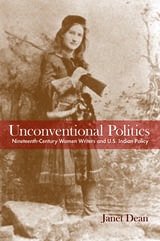
cover of Unconventional Politics: Nineteenth-Century Women Writers and U.S. Indian Policy

Unconventional Politics

Nineteenth-Century Women Writers and U.S. Indian Policy

Janet Dean

University of Massachusetts Press, 2016

Throughout the nineteenth century, Native and non-Native women writers protested U.S. government actions that threatened indigenous people's existence. The conventional genres they sometimes adopted—the sensationalistic captivity narrative, sentimental Indian lament poetry, didactic assimilation fiction, and the mass-circulated commercial magazine—typically had been used to reinforce the oppressive policies of removal, war, and allotment. But in Unconventional Politics Janet Dean explores how four authors, Sarah Wakefield, Lydia Huntley Sigourney, the Muscogee/Creek S. Alice Callahan, and the Cherokee Ora V. Eddleman, converted these frameworks to serve a politics of dissent. Intervening in current debates in feminist and Native American literary criticism, Dean shows how these women advocated for Native Americans by both politicizing conventional literature and employing literary skill to respond to national policy.

Dean argues that in protesting U.S. Indian policy through popular genres, Wakefield, Sigourney, Callahan, and Eddleman also critiqued cultural protocols and stretched the contours of accepted modes of feminine discourse. Their acts of improvisation and reinvention tell a new story about the development of American women's writing and political expression.
[more]
cover of Women and Public Life in Early Meiji Japan: The Development of the Feminist Movement

Women and Public Life in Early Meiji Japan

The Development of the Feminist Movement

Mara Patessio

University of Michigan Press, 2011

Women and Public Life in Early Meiji Japan focuses on women’s activities in the new public spaces of Meiji Japan. With chapters on public, private, and missionary schools for girls, their students, and teachers, on social and political groups women created, on female employment, and on women’s participation in print media, this book offers a new perspective on nineteenth- and early twentieth-century Japanese history. Women’s founding of and participation in conflicting discourses over the value of women in Meiji public life demonstrate that during this period active and vocal women were everywhere, that they did not meekly submit to the dictates of the government and intellectuals over what women could or should do, and that they were fully integrated in the production of Meiji culture.
Mara Patessio shows that the study of women is fundamental not only in order to understand fully the transformations of the Meiji period, but also to understand how later generations of women could successfully move the battle forward. Women and Public Life in Early Meiji Japan is essential reading for all students and teachers of 19th- and early 20th-century Japanese history and is of interest to scholars of women’s history more generally.
[more]