Results by title
2 books match the query '1869-1934'

A Great Big Girl Like Me
The Films of Marie DresslerVictoria Sturtevant
University of Illinois Press, 2008
In this study of Marie Dressler, MGM's most profitable movie star in the early 1930s, Victoria Sturtevant analyzes Dressler's use of her body to challenge Hollywood's standards for leading ladies. At five feet seven inches tall and two hundred pounds, Dressler was never considered the popular "delicate beauty," often playing ugly ducklings, old maids, doting mothers, and imperious dowagers. However, Dressler's body, her fearless physicality, and her athletic slapstick routines commanded the screen. Although an unlikely movie star, Dressler represented for Depression-era audiences a sign of abundance and generosity in a time of scarcity.
This premier analysis of her body of work explores how Dressler refocused the generic frame of her films beyond the shallow problems of the rich and beautiful, instead dignifying the marginalized, the elderly, women, and the poor. Sturtevant inteprets the meanings of Dressler's body through different genres, venues, and historical periods by looking at her vaudeville career, her transgressive representation of an "unruly" yet sexual body in Emma and Christopher Bean, ideas of the body politic in the films Politics and Prosperity, and Dressler as a mythic body in Min and Bill and Tugboat Annie.
[more]
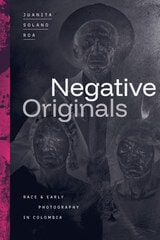
Negative Originals
Race and Early Photography in ColombiaJuanita Solano Roa
Duke University Press, 2025
In Negative Originals, Juanita Solano Roa explores race and identity through photographic practices in late nineteenth-century Medellín, Colombia. Focusing on the photographic studios of Fotografía Rodríguez and Benjamín de la Calle, Solano Roa examines the visual construction and dissemination of racial ideologies and the linkage of race to progress. She studies both positive and negative prints to highlight the juxtaposition of traditional portraiture, which reinforced prevailing racial ideologies, and subversive depictions of often excluded individuals such as cross-dressers, peasants, the poor, and Afro-Colombians. In redefining photography’s role, Solano Roa shifts the critic’s eye from traditional positive prints to negatives, exposing the form’s material, symbolic, and spatial significance. In doing so, she simultaneously uncovers new perspectives on the medium and challenges hegemonic histories. Engaging one of Latin America’s most important photographic archives, Solano Roa addresses urgent gaps in the history of Colombian and Latin American photography, particularly at the intersection of race, gender, and the construction of whiteness.
[more]