Results by title
8 books match the query '1870 - 1920'
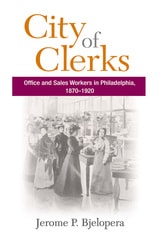
City of Clerks
Office and Sales Workers in Philadelphia, 1870-1920Jerome P. Bjelopera
University of Illinois Press, 2005
Below the middle class managers and professionals yet above the skilled blue-collar workers, sales and office workers occupied an intermediate position in urban America's social structure as the nation industrialized. Jerome P. Bjelopera traces the shifting occupational structures and work choices that facilitated the emergence of a white-collar workforce. His fascinating portrait reveals the lives led by Philadelphia's male and female clerks, both inside and outside the workplace, as they formed their own clubs, affirmed their "whiteness," and challenged sexual norms.
A vivid look at an overlooked but recognizable workforce, City of Clerks reveals how the notion of "white collar" shifted over half a century.
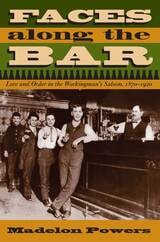
Faces along the Bar
Lore and Order in the Workingman's Saloon, 1870-1920Madelon Powers
University of Chicago Press, 1998
"A free-pouring blend of astonishing facts, folklore and firsthand period observations. . . . It's the rich details that'll inspire the casual reader to drink deep from this tap of knowledge."—Don Waller, USA Today recommended reading
"A surprise on every page."—Publishers Weekly
"Here we get social history that appreciates the bar talk even while dissecting its marvelous rituals."—Library Journal, starred review
"Careful scholarship with an anecdotal flair to please even the most sober of readers."—Nina C. Ayoub, Chronicle of Higher Education

From Man to Ape
Darwinism in Argentina, 1870-1920Adriana Novoa and Alex Levine
University of Chicago Press, 2010
Upon its publication, The Origin of Species was critically embraced in Europe and North America. But how did Darwin’s theories fare in other regions of the world? Adriana Novoa and Alex Levine offer here a history and interpretation of the reception of Darwinism in Argentina, illuminating the ways culture shapes scientific enterprise.
In order to explore how Argentina’s particular interests, ambitions, political anxieties, and prejudices shaped scientific research, From Man to Ape focuses on Darwin’s use of analogies. Both analogy and metaphor are culturally situated, and by studying scientific activity at Europe’s geographical and cultural periphery, Novoa and Levine show that familiar analogies assume unfamiliar and sometimes startling guises in Argentina. The transformation of these analogies in the Argentine context led science—as well as the interaction between science, popular culture, and public policy—in surprising directions. In diverging from European models, Argentine Darwinism reveals a great deal about both Darwinism and science in general.
Novel in its approach and its subject, From Man to Ape reveals a new way of understanding Latin American science and its impact on the scientific communities of Europe and North America.
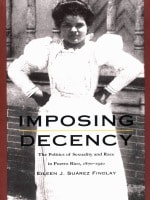
Imposing Decency
The Politics of Sexuality and Race in Puerto Rico, 1870–1920Eileen J. Suárez Findlay
Duke University Press, 2000
In showing how political projects and alliances in Puerto Rico were affected by racially contingent definitions of “decency” and “disreputability,” Findlay argues that attempts at moral reform and the state’s repression of “sexually dangerous” women were weapons used in batttles between elite and popular, American and Puerto Rican, and black and white. Based on a thorough analysis of popular and elite discourses found in both literature and official archives, Findlay contends that racialized sexual norms and practices were consistently a central component in the construction of social and political orders. The campaigns she analyzes include an attempt at moral reform by elite male liberals and a movement designed to enhance the family and cleanse urban space that ultimately translated into repression against symbollically darkened prostitutes. Findlay also explores how U.S. officials strove to construct a new colonial order by legalizing divorce and how feminist, labor, and Afro-Puerto Rican political demands escalated after World War I, often focusing on the rehabilitation and defense of prostitutes.
Imposing Decency forces us to rethink previous interpretations of political chronologies as well as reigning conceptualizations of both liberalism and the early working-class in Puerto Rico. Her work will appeal to scholars with an interest in Puerto Rican or Latin American studies, sexuality and national identity, women in Latin America, and general women’s studies.

Making America Corporate, 1870-1920
Olivier Zunz
University of Chicago Press, 1992
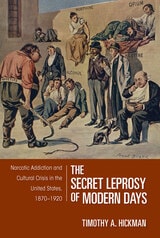
The Secret Leprosy of Modern Days
Narcotic Addiction and Cultural Crisis in the United States, 1870-1920Timothy A. Hickman
University of Massachusetts Press, 2007
Although the topic of habitual narcotic use first surfaced in the United States during the 1820s, it was not until after the Civil War that it became a subject of widespread public attention. Beginning in the 1870s, an increasingly urgent discussion of what some described as a national epidemic of “drug addiction” could be found in both medical journals and the popular press. Today, nearly a century and a half later, the term is so commonplace we speak of people being “addicted” to just about anything. Yet as Timothy A. Hickman argues in this revealing interdisciplinary study, the meaning of addiction has always been as much cultural as scientific and never fixed.
In The Secret Leprosy of Modern Days, Hickman resituates the idea of addiction within its original late nineteenth- and early twentieth-century context. Through close readings of a broad range of literary, medical, and legal texts, he shows how Americans of that era conceptualized the dangers of drug addiction in terms of other preoccupations and fears. Anxieties about the accelerating pace of technological change, the loss of personal autonomy, and the degeneration of society attributed to both foreign influences and a decline of manliness all fed into a widespread sense of cultural crisis—a crisis of which the spiraling “drug problem” was seen as both contributing cause and consequence. Not surprisingly, Hickman points out, deeply held assumptions of class, race, and gender also figured into the popular understanding of addiction. While white middle-class addicts were often depicted as helpless victims of the social and economic pressures of modern life, their less privileged and nonwhite counterparts were regarded as morally weak. Over time the distinction between “addict as patient” and “addict as criminal” came to be accepted by the emerging medical establishment and codified into law, eventually finding expression in the Harrison Narcotics Act of 1914, the first national anti-narcotic legislation in the history of the United States—and the basis for much thinking about addiction and drug policy ever since.
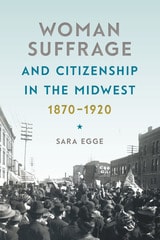
Woman Suffrage and Citizenship in the Midwest, 1870-1920
Sara Egge
University of Iowa Press, 2018
Winner of the 2019 Gita Chaudhuri Prize
Winner of the 2019 Benjamin F. Shambaugh Award
Historian Sara Egge offers critical insights into the woman suffrage movement by exploring how it emerged in small Midwestern communities—in Clay County, Iowa; Lyon County, Minnesota; and Yankton County, South Dakota. Examining this grassroots activism offers a new approach that uncovers the sophisticated ways Midwestern suffragists understood citizenship as obligation.
These suffragists, mostly Yankees who migrated from the Northeast after the Civil War, participated enthusiastically in settling the region and developing communal institutions such as libraries, schools, churches, and parks. Meanwhile, as Egge’s detailed local study also shows, the efforts of the National American Women’s Suffrage Association did not always succeed in promoting the movement’s goals. Instead, it gained support among Midwesterners only when local rural women claimed the right to vote on the basis of their well-established civic roles and public service.
By investigating civic responsibility, Egge reorients scholarship on woman suffrage and brings attention to the Midwest, a region overlooked by most historians of the movement. In doing so, she sheds new light onto the ways suffragists rejuvenated the cause in the twentieth century.
Women and American Socialism, 1870-1920
Mari Jo Buhle
University of Illinois Press, 1981