Results by title

4 books match the query '1871-1900'
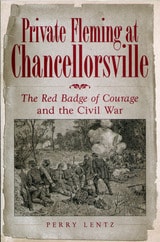
cover of Private Fleming at Chancellorsville: The Red Badge of Courage and the Civil War

Private Fleming at Chancellorsville

The Red Badge of Courage and the Civil War

Perry Lentz

University of Missouri Press, 2006
Famous for its insight into a young, inexperienced soldier’s psychology, Stephen Crane’s The Red Badge of Courage has long been assumed to have been based on little more than magazine articles and veterans’ reminiscences. It also has been subject to various misreadings, including ones unduly influenced by fictional responses to the wars of the twentieth century. Perry Lentz now draws on more than three decades of teaching the novel and his own experience as a historical novelist to plumb the historical realities that actually shaped Crane’s work and to confront these misreadings.
Taking a new look at a classic work that many may feel they already know, Lentz shows how this apparently impressionistic novel is actually a faithful reflection of Civil War combat based on thorough knowledge about combat in general and the battle of Chancellorsville in particular. Anchoring the novel’s action firmly in the Civil War, Lentz challenges the long-standing assumption that Crane did little research for the novel, arguing that he made extensive use of contemporary sources to fashion an accurate depiction of Chancellorsville.
Rich with information about infantry combat in the Civil War, from uniforms and weaponry to formations and battlefield tactics, Lentz’s study invites readers to follow the exploits of Private Henry Fleming of the 304th New York Volunteer Infantry Regiment as he and his fellow soldiers participate in this legendary battle. Lentz shows how Crane evokes a set of traditional responses from his reader and how close reading expands those responses. He examines Private Fleming’s adventures behind the lines of battle in terms of the historical situations in which they are set, then explains how Crane repeatedly entices readers into imposing their initial expectations and final evaluations upon the experiences of this particular soldier.
Lentz also investigates why the novel’s portrayal of its hero’s experiences on the second day of battle is sometimes ignored and always undervalued. By focusing on events both as they actually unfolded at Chancellorsville and as Crane depicted Fleming and his comrades experiencing them, he shows how these soldiers judge themselves, how others judge them, and how a reader can achieve a more sophisticated understanding of these judgments. Lentz’s work reclaims a place for this novel in the American canon and enhances our understanding of Crane, of a legendary battle, and of war literature in general.
[more]
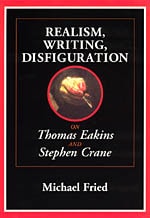
cover of Realism, Writing, Disfiguration: On Thomas Eakins and Stephen Crane

Realism, Writing, Disfiguration

On Thomas Eakins and Stephen Crane

Michael Fried

University of Chicago Press, 1987

"A highly original and gripping account of the works of Eakins and Crane. That remarkable combination of close reading and close viewing which Fried uniquely commands is brought to bear on the problematic nature of the making of images, of texts, and of the self in nineteenth-century America."—Svetlana Alpers, University of California, Berkeley

"An extraordinary achievement of scholarship and critical analysis. It is a book distinguished not only for its brilliance but for its courage, its grace and wit, its readiness to test its arguments in tough-minded ways, and its capacity to meet the challenge superbly. . . . This is a landmark in American cultural and intellectual studies."—Sacvan Bercovitch, Harvard University
[more]
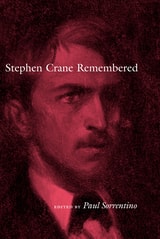
cover of Stephen Crane Remembered

Stephen Crane Remembered

Edited by Paul Sorrentino

University of Alabama Press, 2006

Revealing episodes in the life of the elusive writer, as told by acquaintances

This book collects reminiscences by contemporaries, friends, and associates of Stephen Crane that illuminate the life of this often misunderstood and misrepresented writer. Although Crane is widely regarded as a major American author, conclusions about his life, work, and thought remain obscure due to the difficulties in separating fact from fiction. His first biographer recorded mostly vague impressions and, to mythologize his subject, invented a multitude of the episodes and letters used in his account of Crane’s life. Subsequent biographies were either cursory summations or compendiums of verifiable facts. Crane himself was both reclusive and mercurial, protective of his inner life while projecting a variety of personae to suit others.

A flamboyant personality and close friend of writers such as William Dean Howells, Henry James, and Joseph Conrad, Crane made telling impressions on his contemporaries. They often constitute the best assessments of Crane’s own personality and work. The 90 reminiscences gathered here offer a much-needed account of Crane’s life from a variety of viewpoints, as well as important information about the contributors themselves.

[more]
cover of The Pluralistic Philosophy of Stephen Crane

The Pluralistic Philosophy of Stephen Crane

Patrick K. Dooley

University of Illinois Press, 1993

The first extended analysis by a scholar
formally trained in the discipline of philosophical inquiry. Dooley shows how
Crane's philosophical pluralism, which represents his response to the acute moral
uncertainties resulting from the decline of late nineteenth-century religious
authority, allies him with the contextualism of such contemporary philosophers
as William James, C. S. Peirce, and Josiah Royce."
-- James B. Colvert, author of Stephen Crane
 
[more]