Results by title
5 books match the query '1874-1940'
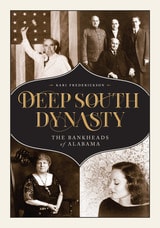
Deep South Dynasty
The Bankheads of AlabamaKari Frederickson
University of Alabama Press, 2022
WINNER OF THE GULF SOUTH HISTORICAL ASSOCIATION'S MICHAEL V. R. THOMASON BOOK AWARD
Family, influence, and the making of Southern power.
From Reconstruction through the end of World War II, the Bankheads served as the principal architects of the political, economic, and cultural framework of Alabama and the greater South. As a family, they were instrumental in fashioning the New South and the twentieth century American political economy, but now the Bankhead name is largely associated only with place names.
Deep South Dynasty: The Bankheads of Alabama is a deeply researched epic family biography that reflects the complicated and evolving world inhabited by three generations of the extremely accomplished—if problematic—Bankhead family of northwest Alabama. Kari Frederickson’s expertly crafted account traces the careers of five members of the family—John Hollis Bankhead; his sons, John Hollis Bankhead Jr. and William Brockman Bankhead; his daughter, Marie Bankhead Owen; and his granddaughter, Tallulah Brockman Bankhead.
A Confederate veteran and son of a slaveholder, John Hollis Bankhead held political office almost continuously from 1865 until his death in 1920, first in state-level positions and ultimately in Congress–in the House then in the Senate–for thirty-three years. Two of his three sons, John Jr. and William, followed in their father’s political footsteps. John Jr., a successful corporate attorney, was elected to the state legislature and then to the US Senate in 1930; William was elected to the House of Representatives in 1916 and chosen Speaker of the House in 1936. Together, father and sons played key roles in crafting and maintaining a conservative political culture, legal code, and economic system that facilitated economic opportunities for cotton farmers, coal barons, and emerging industries in Alabama and across the South while perpetuating White supremacy.
Daughter Marie Bankhead Owen extended the family’s cultural power during her thirty-five-year tenure as director of the Alabama Department of Archives and History. From this position and through her work with groups like the United Daughters of the Confederacy, she embraced and disseminated a historical narrative steeped in Lost Cause mythology that validated the power and privilege of White elites and naturalized the second-class status of African Americans. William’s daughter, actress Tallulah Bankhead, benefited from her family’s rich political bloodlines and in turn lent them a touch of glamour and made the Bankheads modern. Frederickson’s meticulously researched examination of this once-powerful but now largely forgotten southern family is a sweeping and complex story of the region and its relationship with the wider world over the course of eight decades, from the wreckage of the Civil War to the dawn of the nuclear age.
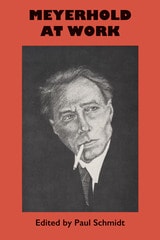
Meyerhold at Work
Edited by Paul Schmidt; translations by Paul Schmidt, Ilya Levin, and Vern McGee
University of Texas Press, 1980
“Not a mirror but a magnifying glass”—such, in the poet Mayakovsky’s words, was the theater of Vsevolod Meyerhold. The first to insist on the primacy of the director’s role, indeed the first to conceive of it as a role, this passionately dedicated Russian director tore down the fourth wall and forced the actors and audience together into one inescapable community of experience.
Yet Meyerhold recorded few of his theories in writing, and the intensity and brilliance of his work must be recaptured through the actors and artists who helped create the performances. Focusing on Meyerhold’s postrevolutionary career, Paul Schmidt has assembled in this book journals, letters, reminiscences, and, of special interest, actual rehearsal notes that build a fascinating, intimate picture of Meyerhold as a theorist and as a man.
Included are Meyerhold’s frantic notes to his teacher, friend, and bête noire Stanislavsky; detailed descriptions of how he trained his actors in “biomechanics”; and memories by such students as Eisenstein and such friends as Pasternak and Ehrenburg. One chapter deals with Meyerhold’s never-realized conception of Boris Godunov, while another describes his direction of Camille, which starred Zinaida Raikh, his wife, and which played its 725th and last performance on the day Stalin’s government liquidated Meyerhold’s theater. Paul Schmidt’s introduction and headnotes enhance our understanding of Meyerhold as a pioneer of modern theater.
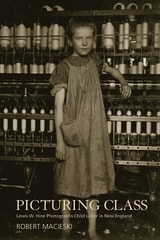
Picturing Class
Lewis W. Hine Photographs Child Labor in New EnglandRobert Macieski
University of Massachusetts Press, 2015
In this richly illustrated book, Robert Macieski examines Lewis W. Hine's art and advocacy on behalf of child laborers as part of the National Child Labor Committee (NCLC) between 1909 and 1917. A “social photographer”—as he called himself—Hine created images that documented children at work throughout New England, revealing their exploitation in the North as he had for rural working children in the South. Hine staged his images, highlighting particular types of labor in specific places: the “newsies” in Connecticut cities; sardine canners in Eastport, Maine; cranberry pickers in Cape Cod bogs; industrial homeworkers in Boston and Providence; and cotton textile workers throughout the region. His association with the NCLC connected him to a network of local and national reformers, social workers, and child welfare professionals, a broad coalition he supported in their fight to end this unethical labor practice. Macieski also chronicles Hine's efforts to mount major exhibitions that would help move public opinion against child labor.
In Picturing Class, Macieski explores the historical context of Hine's photographs and the social worlds of his subjects. He offers a detailed analysis of many of the images, unearthing the stories behind the creation of these photographs and the lives of their subjects. In telling the story of these photographs, their creation, and their reception, Macieski demonstrates how Hine worked to advance an unvarnished picture of a rapidly changing region and the young workers at the center of this important shift.
The Director's Prism
E. T. A. Hoffmann and the Russian Theatrical Avant-GardeDassia N. Posner
Northwestern University Press, 2016
Shortlist, 2019 Prague Quadrennial Best Scenography and Design Publication Award
The Director's Prism investigates how and why three of Russia's most innovative directors— Vsevolod Meyerhold, Alexander Tairov, and Sergei Eisenstein—used the fantastical tales of German Romantic writer E. T. A. Hoffmann to reinvent the rules of theatrical practice. Because the rise of the director and the Russian cult of Hoffmann closely coincided, Posner argues, many characteristics we associate with avant-garde theater—subjective perspective, breaking through the fourth wall, activating the spectator as a co-creator—become uniquely legible in the context of this engagement. Posner examines the artistic poetics of Meyerhold's grotesque, Tairov's mime-drama, and Eisenstein's theatrical attraction through production analyses, based on extensive archival research, that challenge the notion of theater as a mirror to life, instead viewing the director as a prism through whom life is refracted. A resource for scholars and practitioners alike, this groundbreaking study provides a fresh, provocative perspective on experimental theater, intercultural borrowings, and the nature of the creative process.
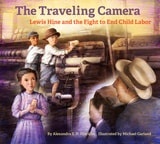
The The Traveling Camera
Lewis Hine and the Fight to End Child LaborAlexandra S. D. Hinrichs
J. Paul Getty Trust, The, 2021
Stunning visuals and poetic text combine to tell the inspiring story of Lewis Hine (1874–1940), a teacher and photographer who employed his art as a tool for social reform. Working for the National Child Labor Committee, Hine traveled the United States, taking pictures of children as young as five toiling under dangerous conditions in cotton mills, seafood canneries, farms, and coal mines. He often wore disguises to sneak into factories, impersonating a machinery inspector or traveling salesman. He said, “If I could tell this story in words, I wouldn’t need to lug a camera.” His poignant pictures attracted national attention and were instrumental in the passage of child labor laws. The Traveling Camera contains extensive back matter, including a time line, original photos, and a bibliography.
Ages six to nine.