Results by title
3 books match the query '1874-1952'
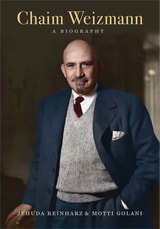
Chaim Weizmann
A BiographyJehuda Reinharz and Motti Golani
Brandeis University Press, 2024
A magisterial biography of Israel’s first president.
In Chaim Weizmann: A Biography, Jehuda Reinharz and Motti Golani show how Weizmann, a leader of the World Zionist Organization who became the first president of Israel, advocated for a Jewish state by gaining the support of influential politicians and statesmen as well as Jews around the world. Beginning with his childhood in Belorussia and concluding with his tenure as president, Reinharz and Golani describe how a Russian Jew, who immigrated to the United Kingdom in the early twentieth century, was able to advance the goals of Theodor Herzl, the founder of the Zionist Organization. Weizmann is also shown as a man of human foibles—his infatuations, political machinations, and elitism—as well as a man of admirable qualities—intelligence, wit, charisma, and dedication.
Weizmann, who came to the UK to work as a biochemist, was in regular communication with British political figures, including prime ministers Arthur James Balfour, David Lloyd George, Winston Churchill, and Ramsay MacDonald. He also met presidents of the United States from Woodrow Wilson to Harry Truman. His success in earning the support of British political figures helped lead to the Balfour Declaration, which advocated for a “national home” for the Jewish people in Palestine.
As the authors show in this authoritative account of Weizmann’s life, Weizmann was guided by the belief that “Zion shall be redeemed in justice,” a phrase that recurs often in his writings.
[more]
Chaim Weizmann
The Zionist DreamTom Fraser
Haus Publishing, 2009
The Arab-Israeli conflict has been one of the most defining features of recent world history, flaring up into open war fare yet again in Gaza at the end of 2008 and provoking large-scale demonstrations in the streets of cities across the world. The decision in 1919 by the Paris Peace Conference to award the Mandate for Palestine to Great Britain—which had announced its commitment to the creation of a national home for the Jewish people in the Balfour Declaration two years previously—sowed the seeds of this seemingly intractable problem, yet when the Zionist leader Chaim Weizmann (1874-1952) spoke before the Conference on 27 February 1919, he would have appeared as only one of the many representatives of minor nationalities putting their case to the peacemakers, and, what is more, one whose people had no territory of their own. How a Jewish chemistry professor from an obscure part of Eastern Europe could find himself at the heart of international diplomacy, and later become the first president of the State of Israel, is one of the most fascinating stories of the Paris Peace Conference and its aftermath. Ninety years after the Conference, what Weizmann said and did there is an essential part of our understanding of how this small, but critical, part of the world evolved out of the deliberations.
[more]
Making the Modern Middle East
Second EditionT.G. Fraser, Andrew Mango, and Robert McNamara
Gingko, 2015
A century ago, as World War I got underway, the Middle East was dominated, as it had been for centuries, by the Ottoman Empire. But by 1923, its political shape had changed beyond recognition, as the collapse of the Ottoman Empire and the insistent claims of Arab and Turkish nationalism and Zionism led to a redrawing of borders and shuffling of alliances—a transformation whose consequences are still felt today.
This fully revised and updated second edition of The Makers of the Modern Middle East traces those changes and the ensuing history of the region through the rest of the twentieth century and on to the present. Focusing in particular on three leaders—Emir Feisal, Mustafa Kemal, and Chaim Weizmann—the book offers a clear, authoritative account of the region seen from a transnational perspective, one that enables readers to understand its complex history and the way it affects present-day events.
This fully revised and updated second edition of The Makers of the Modern Middle East traces those changes and the ensuing history of the region through the rest of the twentieth century and on to the present. Focusing in particular on three leaders—Emir Feisal, Mustafa Kemal, and Chaim Weizmann—the book offers a clear, authoritative account of the region seen from a transnational perspective, one that enables readers to understand its complex history and the way it affects present-day events.
[more]