Results by title
14 books match the query '1875-'
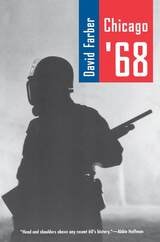
Chicago '68
David Farber
University of Chicago Press, 1988
"Chicago '68 was a watershed summer. Chicago '68 is a watershed book. Farber succeeds in presenting a sensitive, fairminded composite portrait that is at once a model of fine narrative history and an example of how one can walk the intellectual tightrope between 'reporting one's findings' and offering judgements about them."—Peter I. Rose, Contemporary Sociology
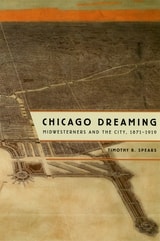
Chicago Dreaming
Midwesterners and the City, 1871-1919Timothy B. Spears
University of Chicago Press, 2005
Through innovative readings of Theodore Dreiser, Willa Cather, and Richard Wright, Spears argues that the migratory perspective was crucial to the rise of Chicago's emerging literary culture. In following the paths of several well-known migrants, including Jane Addams, cartoonist John T. McCutcheon, and businessman John Glessner, Spears also shows how the view from the hinterland permeated urban culture and informed the development of key Chicago institutions. Further exploring the notion of dreaming, he brings to light the internal desires that lured Midwestern migrants to the city as well as the nostalgia that led them to dream of the homes they left behind.
With this fascinating new take on the rise of Chicago, Chicago Dreaming blurs the line between country and city to reveal the provincial character of modern urban culture.
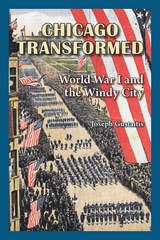
Chicago Transformed
World War I and the Windy CityJoseph Gustaitis
Southern Illinois University Press, 2016
It’s been called the “war that changed everything,” and it is difficult to think of a historical event that had a greater impact on the world than the First World War. Events during the war profoundly changed our nation, and Chicago, especially, was transformed during this period. Between 1913 and 1919, Chicago transitioned from a nineteenth-century city to the metropolis it is today. Despite the importance of the war years, this period has not been documented adequately in histories of the city. In Chicago in World War I: How the Great War Transformed a Great City, Joseph Gustaitis fills this gap in the historical record, covering the important wartime events, developments, movements, and people that helped shape Chicago.
Gustaitis attributes many of Chicago’s changes to the labor shortage caused by the war. African Americans from the South flocked to Chicago during the Great Migration, and Mexican immigration increased as well. This influx of new populations along with a wave of anti-German hysteria—which nearly extinguished German culture in Chicago—changed the city’s ethnic composition. As the ethnic landscape changed, so too did the culture. Jazz and blues accompanied African Americans to the city, and Chicago soon became America’s jazz and blues capital. Gustaitis also demonstrates how the nation’s first sexual revolution occurred not during the 1960s but during the World War I years, when the labor shortage opened up unprecedented employment opportunities for women. These opportunities gave women assertiveness and freedom that endured beyond the war years. In addition, the shortage of workers invigorated organized labor, and determined attempts were made to organize in Chicago’s two leading industrial workplaces—the stockyards and the steel mills—which helped launch the union movement of the twentieth century. Gustaitis explores other topics as well: Prohibition, which practically defined the city in the 1920s; the exploits of Chicago’s soldiers, both white and black; life on the home front; the War Exposition in Grant Park; and some of the city’s contributions to the war effort. The book also contains sketches of the wartime activities of prominent Chicagoans, including Jane Addams, Ernest Hemingway, Clarence Darrow, Rabbi Emil Hirsch, John T. McCutcheon, “Big Bill” Thompson, and Eunice Tietjens.
Although its focus is Chicago, this book provides insight into change nationwide, as many of the effects that the First World War had on the city also affected the United States as a whole. Drawing on a variety of sources and written in an accessible style that combines economic, cultural, and political history, Chicago in World War I: How the Great War Transformed a Great City portrays Chicago before the war, traces the changes initiated during the war years, and shows how these changes still endure in the cultural, ethnic, and political landscape of this great city and the nation.
Chicago's Greatest Year, 1893
The White City and the Birth of a Modern MetropolisJoseph Gustaitis
Southern Illinois University Press, 2013
In 1893, the 27.5 million visitors to the Chicago World’s Fair feasted their eyes on the impressive architecture of the White City, lit at night by thousands of electric lights. In addition to marveling at the revolutionary exhibits, most visitors discovered something else: beyond the fair’s 633 acres lay a modern metropolis that rivaled the world’s greatest cities. The Columbian Exposition marked Chicago’s arrival on the world stage, but even without the splendor of the fair, 1893 would still have been Chicago’s greatest year.
An almost endless list of achievements took place in Chicago in 1893. Chicago’s most important skyscraper was completed in 1893, and Frank Lloyd Wright opened his office in the same year. African American physician and Chicagoan Daniel Hale Williams performed one of the first known open-heart surgeries in 1893. Sears and Roebuck was incorporated, and William Wrigley invented Juicy Fruit gum that year. The Field Museum, the Art Institute of Chicago, and the Museum of Science and Industry all started in 1893. The Cubs’ new ballpark opened in this year, and an Austro-Hungarian immigrant began selling hot dogs outside the World’s Fair grounds. His wares became the famous “Chicago hot dog.”
“Cities are not buildings; cities are people,” writes author Joseph Gustaitis. Throughout the book, he brings forgotten pioneers back to the forefront of Chicago’s history, connecting these important people of 1893 with their effects on the city and its institutions today. The facts in this history of a year range from funny to astounding, showcasing innovators, civic leaders, VIPs, and power brokers who made 1893 Chicago about so much more than the fair.
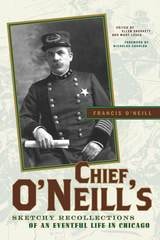
Chief O'Neill's Sketchy Recollections of an Eventful Life in Chicago
Francis O'Neill, Edited by Ellen Skerrett and Mary Lesch with a foreword by Nicholas Carolan
Northwestern University Press, 2008
This remarkable memoir of immigration and assimilation provides a rare view of urban life in Chicago in the late 1800s by a newcomer to the city and the Midwest, and the nation as well. Francis O’Neill left Ireland in 1865. After five years traveling the world as a sailor, he and his family settled in Chicago just shortly before the Great Fire of 1871.
As O’Neill looked back on his life, writing in Chicago at the age of 83, he could give first-hand accounts of the Pullman strike of 1894, the railway strike of 1903, and the packing-house strike of 1904. He could also reflect on the corruption that kept him, in spite of his innovations, extremely high exam scores, and performance, subject to powerful aldermen who prevented his advance as a member of the Chicago Police Department. Despite these obstacles, O’Neill eventually rose to be chief of police—a position from which he could enact much-needed civil service reform. In addition to his professional success, O’Neill is also remembered and beloved for his hobby, preserving traditional Irish music.
O’Neill’s story offers perspective on the inner workings of the police department at the turn of the twentieth century. His memoir also brings to life the challenges involved in succeeding in a new land, providing for his family, and integrating into a new culture. Francis O’Neill serves as a fine documentarian of the Irish immigrant experience in Chicago.
Ephemeral City
A People's History of Chicago's Century of Progress World's FairLindsay Fullerton
University of Illinois Press, 2025
Less celebrated than the 1893 Chicago World’s Fair, the 1933–1934 Century of Progress Exposition brought visitors face-to-face with gleaming American consumerism in the midst of the Great Depression. Lindsay Fullerton draws on a wealth of personal photographs, scrapbooks, oral histories, and writings to illuminate the wildly different experiences of fairgoers against the backdrop of a city steeped in poverty and segregation.
The Exposition took place amidst massive changes sparked by expansion of mass media, Franklin Roosevelt’s election, the repeal of Prohibition, and the Great Migration. A diverse cross-section of Chicagoans informs Fullerton’s history of the event in the context of the fast-changing America of the interwar era. These personal accounts tell stories of how attendees interpreted their own experiences while being surrounded by whiz-bang products and full-throated evangelism on the benefits of progress.
A colorful people’s history, Ephemeral City takes readers inside the other Chicago World’s Fair and how visitors interacted with a pivotal moment in American history.
Land of Hope
Chicago, Black Southerners, and the Great MigrationJames R. Grossman
University of Chicago Press, 1989
Polish Immigrants and Industrial Chicago
Workers on the South Side, 1880-1922Dominic A. Pacyga
University of Chicago Press, 2003

Race Riot
CHICAGO IN THE RED SUMMER OF 1919William M. Tuttle, Jr.
University of Illinois Press, 1996
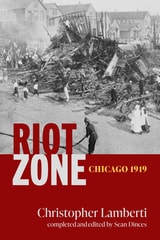
Riot Zone
Chicago 1919Christopher Lamberti, completed and edited by Sean Dinces
Temple University Press, 2027
Riot Zone presents a compelling forensic microhistory of the racial violence that exploded in Chicago starting on July 27, 1919, when a Black teenager named Eugene Williams drowned in Lake Michigan after white beachgoers attacked him as he swam with friends. In the days that followed, white gang members terrorized African Americans on the city’s South Side and Black Chicagoans armed and defended themselves in response. By the end of the first week of August, when the rioting finally ended, thirty-eight Chicagoans lay dead and hundreds nursed injuries as a result of what became known as America’s “Red Summer.”
The late Christopher Lamberti, with the help of editor Sean Dinces, recounts this sobering history using GIS software to map what occurred. The authors revisit and debunk ideas about the role race and ethnicity played in the riot and its aftermath, showing how the politics of housing and racial conflicts over residential space set the stage for the riots that ensued.
With insights that echo in today’s conflicts, Riot Zone proves that there is still plenty to learn about the history of America’s ongoing struggle with urban and racial violence.
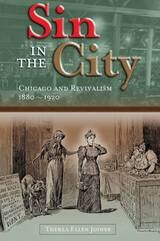
Sin in the City
Chicago and Revivalism, 1880-1920Thekla Ellen Joiner
University of Missouri Press, 2013
Long before today’s culture wars, the “Third Great Awakening” rocked America. During the late nineteenth and early twentieth centuries, evangelists such as Dwight L. Moody and Billy Sunday roused citizens to renounce sin as it manifested in popular culture, moral ambiguity, and the changing role of women.
Sin in the City examines three urban revivals in turn-of-the-century Chicago to show how revivalists negotiated that era’s perceived racial, sexual, and class threats. While most studies of this movement have focused on its male leaders and their interactions with society, Thekla Ellen Joiner raises new questions about gender and race by exploring Third Awakening revivalism as the ritualized performance of an evangelical social system defined by middle-class Protestant moral aspirations for urban America. Rather than approaching these events merely as the achievements of persuasive men, she views them as choreographed collective rituals reinforcing a moral order defined by ideals of femininity, masculinity, and racial purity.
Joiner reveals how revivalist rhetoric and ritual shifted from sentimentalist identification of sin with males to a more hard-nosed focus on females, castigating “loose women” whose economic and sexual independence defied revivalist ideals and its civic culture. She focuses on Dwight L. Moody’s 1893 World’s Fair revival, the 1910 Chapman-Alexander campaign, and the 1918 Billy Sunday revival, comparing the locations, organization, messages, and leaders of these three events to depict the shift from masculinized to feminized sin. She identifies the central role women played in the Third Awakening as the revivalists promoted feminine virtue as the corrective to America’s urban decline. She also shows that even as its definition of sin became more feminized, Billy Sunday’s revivalism began to conform to Chicago’s emerging color line.
Enraged by rapid social change in cities like Chicago, these preachers spurred Protestant evangelicals to formulate a gendered and racialized moral regime for urban America. Yet, as Joiner shows, even as revivalists demonized new forms of entertainment, they used many of the modern cultural practices popularized in theaters and nickelodeons to boost the success of their mass conversions.
Sin in the City shows that the legacy of the Third Awakening lives on today in the religious right’s sociopolitical activism; crusade for family values; disparagement of feminism; and promotion of spirituality in middle-class, racial, and cultural terms. Providing cultural and gender analysis too often lacking in the study of American religious history, it offers a new model for understanding the development of a gendered theology and set of religious practices that influenced Protestantism in a period of enormous social change.
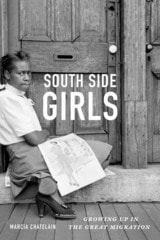
South Side Girls
Growing Up in the Great MigrationMarcia Chatelain
Duke University Press, 2015
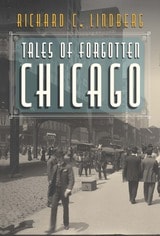
Tales of Forgotten Chicago
Richard C. Lindberg
Southern Illinois University Press, 2020
Tales of Forgotten Chicago contains twenty-one fascinating, little-known stories about a great city and its people. Richard C. Lindberg has dug deeply to reveal lost historical events and hidden gems from Chicago’s past.
Spanning the Civil War through the 1960s, the volume showcases forgotten crimes, punishments, and consequences: poisoned soup that nearly killed three hundred leading citizens, politicians, and business and religious leaders; a woman in showbiz and her street-thug husband whose checkered lives inspired a 1955 James Cagney movie; and the first police woman in Chicago, hired as a result of the senseless killing of a young factory girl in a racially tinged case of the 1880s.
Also included are tales of industry and invention, such as America’s first automobile race, the haunting of a wealthy Gilded Age manufacturer’s mansion, and the identity of the telephone’s rightful inventor. Chapters on the history of early city landmarks spotlight the fight to save Lakefront Park and how “Lucky” Charlie Weeghman’s north side baseball park became Wrigley Field. Other chapters explore civic, cultural, and political happenings: the great Railroad Fairs of 1948 and 1949; Richard J. Daley’s revival of the St. Patrick’s Day parade; political disrupter Lar “America First” Daly; and the founding of the Special Olympics in Chicago by Anne Burke and others. Finally, some are just wonderful tales, such asa touching story about the sinking of Chicago's beloved Christmas tree ship.
Engrossing and imaginative, this collection opens new windows into the past of the Windy City.
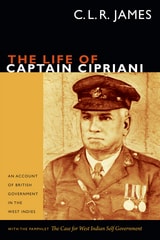
The Life of Captain Cipriani
An Account of British Government in the West Indies, with the pamphlet The Case for West-Indian Self GovernmentC. L. R. James
Duke University Press, 2014