Results by title
13 books match the query '1877-1964'
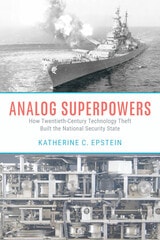
Analog Superpowers
How Twentieth-Century Technology Theft Built the National Security StateKatherine C. Epstein
University of Chicago Press, 2024
At the beginning of the twentieth century, two British inventors, Arthur Pollen and Harold Isherwood, became fascinated by a major military question: how to aim the big guns of battleships. These warships—of enormous geopolitical import before the advent of intercontinental missiles or drones—had to shoot in poor light and choppy seas at distant moving targets, conditions that impeded accurate gunfire. Seeing the need to account for a plethora of variables, Pollen and Isherwood built an integrated system for gathering data, calculating predictions, and transmitting the results to the gunners. At the heart of their invention was the most advanced analog computer of the day, a technological breakthrough that anticipated the famous Norden bombsight of World War II, the inertial guidance systems of nuclear missiles, and the networked “smart” systems that dominate combat today. Recognizing the value of Pollen and Isherwood’s invention, the British Royal Navy and the United States Navy pirated it, one after the other. When the inventors sued, both the British and US governments invoked secrecy, citing national security concerns.
Drawing on a wealth of archival evidence, Analog Superpowers analyzes these and related legal battles over naval technology, exploring how national defense tested the two countries’ commitment to individual rights and the free market. Katherine C. Epstein deftly sets out Pollen’s and Isherwood’s pioneering achievements, the patent questions raised, the geopolitical rivalry between Britain and the United States, and the legal precedents each country developed to control military tools built by private contractors.
Epstein’s account reveals that long before the US national security state sought to restrict information about atomic energy, it was already embroiled in another contest between innovation and secrecy. The America portrayed in this sweeping and accessible history isn’t yet a global hegemon but a rising superpower ready to acquire foreign technology by fair means or foul—much as it accuses China of doing today.

Anyplace But Here
Arna Bontemps & Jack Conroy
University of Missouri Press, 1997
Originally published in 1945 as They Seek a City, this classic was revised and expanded in 1966 to include chapters on Marcus Garvey, the Black Muslims, Malcolm X, and the racial disturbances in Detroit, Chicago, and Watts. Filled with stories about real men and women who sought a new life in the North, Anyplace But Here depicts the theme of hope, undercut by disappointment, and hope renewed as it details the African American's search for a home.
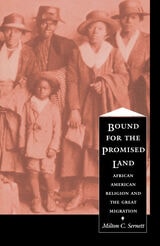
Bound For the Promised Land
African American Religion and the Great MigrationMilton C. Sernett
Duke University Press, 1997
Drawing on a range of sources—interviews, government documents, church periodicals, books, pamphlets, and articles—Sernett shows how the mass migration created an institutional crisis for black religious leaders. He describes the creative tensions that resulted when the southern migrants who saw their exodus as the Second Emancipation brought their religious beliefs and practices into northern cities such as Chicago, and traces the resulting emergence of the belief that black churches ought to be more than places for "praying and preaching." Explaining how this social gospel perspective came to dominate many of the classic studies of African American religion, Bound for the Promised Land sheds new light on various components of the development of black religion, including philanthropic endeavors to "modernize" the southern black rural church. In providing a balanced and holistic understanding of black religion in post–World War I America, Bound for the Promised Land serves to reveal the challenges presently confronting this vital component of America’s religious mosaic.
Broken Brotherhood
The Rise and Fall of the National Afro-American CouncilBenjamin R. Justesen
Southern Illinois University Press, 2008
Broken Brotherhood: The Rise and Fall of the National Afro-American Council gives a comprehensive account of the National Afro-American Council, the first truly nationwide U.S. civil rights organization, which existed from 1898 to 1908. Based on exhaustive research, the volume chronicles the Council’s achievements and its annual meetings and provides portraits of its key leaders.
Led by four of the most notable African American leaders of the time—journalist T. Thomas Fortune, Bishop Alexander Walters, educator Booker T. Washington, and Congressman George Henry White—the Council persevered for a decade despite structural flaws and external pressures that eventually led to its demise in 1908.
Author Benjamin R. Justesen provides historical context for the Council’s development during an era of unprecedented growth in African American organizations. Justesen establishes the National Afro-American Council as the earliest national arena for discussions of critical social and political issues affecting African Americans and the single most important united voice lobbying for protection of the nation’s largest minority. In a period marked by racial segregation, widespread disfranchisement, and lynching violence, the nonpartisan council helped establish two more enduring successor organizations, providing core leadership for both the National Association for the Advancement of Colored People and the National Urban League.
Broken Brotherhood traces the history of the Council and the complicated relationships among key leaders from its creation in Rochester in 1898 to its last gathering in Baltimore in 1907, drawing on both private correspondence and contemporary journalism to create a balanced historical portrait. Enhanced by thirteen illustrations, the volume also provides intriguing details about the ten national gatherings, describes the Council’s unsuccessful attempt to challenge disfranchisement before the U.S. Supreme Court, and sheds light on the gradual breakdown of Republican solidarity among African American leaders in the first decade of the twentieth century.
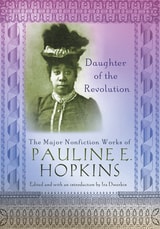
Daughter of the Revolution
The Major Nonfiction Works of Pauline HopkinsDworkin, Ira
Rutgers University Press, 2007
Pauline E. Hopkins (1859–1930) came to prominence in the early years of the twentieth century as an outspoken writer, editor, and critic. Frequently recognized for her first novel, Contending Forces, she is currently one of the most widely read and studied African American novelists from that period.
While nearly all of Hopkins’s fiction remains in print, there is very little of her nonfiction available. This reader brings together dozens of her hard-to-find essays, including longer nonfiction works such as Famous Men of the Negro Race and The Dark Races of the Twentieth Century, some of which are published here for the first time in their entirety.
Through these works, along with two juvenile essays from the 1870s, a personal letter, and two speeches, readers encounter a voice that is committed to constructing an international discourse on race, recovering the militant abolitionist tradition to combat Jim Crow, celebrating black political participation during and after the Reconstruction era, articulating the connections between race and labor, and insisting on equal rights for women. Hopkins’s writing will challenge contemporary scholars to rethink their understanding of black activism and modernity in the early twentieth century.
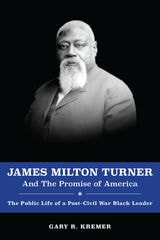
James Milton Turner and the Promise of America
The Public Life of a Post-Civil War Black LeaderGary R. Kremer
University of Missouri Press, 2020
Born a slave, Turner gained freedom when he was a child and received his education in clandestine St. Louis schools, later briefly attending Oberlin College. A self-taught lawyer, Turner earned a statewide reputation and wielded power far out of proportion to Missouri's relatively small black population.
After working nearly a decade in Liberia, Turner never regained the prominence he had enjoyed during Reconstruction.

Jump for Joy
Jazz, Basketball, and Black Culture in 1930s AmericaGena Caponi-Tabery
University of Massachusetts Press, 2008
If the 1930s was the Swing Era, then the years from 1937 on might well be called the Jump Era. That summer Count Basie recorded “Jumping at the Woodside,” and suddenly jump tunes seemed to be everywhere. Along with the bouncy beat came a new dance step—the high-flying aerials of the jitterbuggers—and the basketball games that took place in the dance halls of African America became faster, higher, and flashier. Duke Ellington and a cast of hundreds put the buoyant spirit of the era on stage with their 1941 musical revue, Jump for Joy, a title that captured the momentum and direction of the new culture of exuberance.
Several high-profile public victories accompanied this increasing optimism: the spectacular successes of African American athletes at the 1936 Olympics, the 1937 union victory of the Brotherhood of Sleeping Car Porters, and Joe Louis's 1937 and 1938 heavyweight championship fights. For the first time in history, Black Americans emerged as cultural heroes and ambassadors, and many felt a new pride in citizenship.
In this book, Gena Caponi-Tabery chronicles these triumphs and shows how they shaped American music, sports, and dance of the 1930s and beyond. But she also shows how they emboldened ordinary African Americans to push for greater recognition and civil liberties—how cultural change preceded and catalyzed political action.
Tracing the path of one symbolic gesture—the jump—across cultural and disciplinary boundaries, Caponi-Tabery provides a unique political, intellectual, and artistic analysis of the years immediately preceding World War II.
Negro Thought in America, 1880-1915
Racial Ideologies in the Age of Booker T. WashingtonAugust Meier
University of Michigan Press, 1963

Neither Nature nor Grace
Aquinas, Barth, and Garrigou-Lagrance on the Epistemic Use of God's EffectsT. Adam Van Wart
Catholic University of America Press, 2021
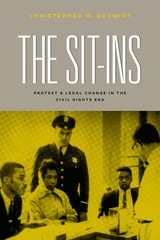
The Sit-Ins
Protest and Legal Change in the Civil Rights EraChristopher W. Schmidt
University of Chicago Press, 2018
The Sit-Ins tells the story of the student lunch counter protests and the national debate they sparked over the meaning of the constitutional right of all Americans to equal protection of the law. Christopher W. Schmidt describes how behind the now-iconic scenes of African American college students sitting in quiet defiance at “whites only” lunch counters lies a series of underappreciated legal dilemmas—about the meaning of the Constitution, the capacity of legal institutions to remedy different forms of injustice, and the relationship between legal reform and social change. The students’ actions initiated a national conversation over whether the Constitution’s equal protection clause extended to the activities of private businesses that served the general public. The courts, the traditional focal point for accounts of constitutional disputes, played an important but ultimately secondary role in this story. The great victory of the sit-in movement came not in the Supreme Court, but in Congress, with the passage of the Civil Rights Act of 1964, landmark legislation that recognized the right African American students had claimed for themselves four years earlier. The Sit-Ins invites a broader understanding of how Americans contest and construct the meaning of their Constitution.
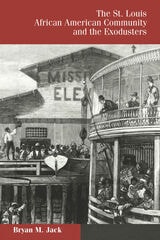
The St. Louis African American Community and the Exodusters
Bryan M. Jack
University of Missouri Press, 2021
In the aftermath of the Civil War, thousands of former slaves made their way from the South to the Kansas plains. Called “Exodusters,” they were searching for their own promised land. Bryan Jack now tells the story of this American exodus as it played out in St. Louis, a key stop in the journey west.
Many of the Exodusters landed on the St. Louis levee destitute, appearing more as refugees than as homesteaders, and city officials refused aid for fear of encouraging more migrants. To the stranded Exodusters, St. Louis became a barrier as formidable as the Red Sea, and Jack tells how the city’s African American community organized relief in response to this crisis and provided the migrants with funds to continue their journey.
The St. Louis African American Community and the Exodusters tells of former slaves such as George Rogers and Jacob Stevens, who fled violence and intimidation in Louisiana and Mississippi. It documents the efforts of individuals in St. Louis, such as Charlton Tandy, Moses Dickson, and Rev. John Turner, who reached out to help them. But it also shows that black aid to the Exodusters was more than charity. Jack argues that community support was a form of collective resistance to white supremacy and segregation as well as a statement for freedom and self-direction—reflecting an understanding that if the Exodusters’ right to freedom of movement was limited, so would be the rights of all African Americans. He also discusses divisions within the African American community and among its leaders regarding the nature of aid and even whether it should be provided.
In telling of the community’s efforts—a commitment to civil rights that had started well before the Civil War—Jack provides a more complete picture of St. Louis as a city, of Missouri as a state, and of African American life in an era of dramatic change. Blending African American, southern, western, and labor history, The St. Louis African American Community and the Exodusters offers an important new lens for exploring the complex racial relationships that existed within post-Reconstruction America.
The Two Reconstructions
The Struggle for Black EnfranchisementRichard M. Valelly
University of Chicago Press, 2004
The Reconstruction era marked a huge political leap for African Americans, who rapidly went from the status of slaves to voters and officeholders. Yet this hard-won progress lasted only a few decades. Ultimately a "second reconstruction"—associated with the civil rights movement and the Voting Rights Act—became necessary.
How did the first reconstruction fail so utterly, setting the stage for the complete disenfranchisement of Southern black voters, and why did the second succeed? These are among the questions Richard M. Valelly answers in this fascinating history. The fate of black enfranchisement, he argues, has been closely intertwined with the strengths and constraints of our political institutions. Valelly shows how effective biracial coalitions have been the key to success and incisively traces how and why political parties and the national courts either rewarded or discouraged the formation of coalitions.
Revamping our understanding of American race relations, The Two Reconstructions brilliantly explains a puzzle that lies at the heart of America’s development as a political democracy.
White Violence and Black Response
From Reconstruction to MontgomeryHerbert Shapiro
University of Massachusetts Press, 1988
We are taught that America is a society based on respect for the law and orderly procedures. That the Constitution stands as a safeguard of individual freedom, and the courts and the police are supposedly established to enforce the law. When a controversial issue arises in the American fabric, it is to be resolved not in the streets but through the democratic processes of elections. Yet, for blacks these liberal values have been turned into their opposites. The courts have most often stood silent in the face of racist violence or have turned their wrath against the victims, not the perpetrators; the police have protected the mob rather than the mobbed and have often either aided the lynchers or displayed amazing inability to identify them. Where race is concerned, legislative or judicial action to deal with controversial issues has often come late and been partial in nature, while white violence has continued to terrorize black Americans without hindrance.
In White Violence and Black Response: From Reconstruction to Montgomery, Herbert Shapiro explores the depths of violence generated by white racism and the irony of the American association with violence as a behavior of black people. Citing the nation's political leadership, educational institutions, and news media as institutions that fail to educate Americans about the oppressive social conditions that have root in these criminal acts, Shapiro is able to expose the ways in which white supremacy operates within American institutions and the responses by black people in this powerful read.