Results by title
3 books match the query '1878-1944'
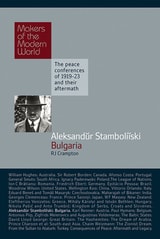
Aleksandur Stamboliiski
BulgariaRichard Crampton
Haus Publishing, 2009
Aleksandur Stamboliiski was one of the most original politicians of the 20th century. His tragedy was that he came to power at the end of the First World War in which Bulgaria had been defeated. It fell to him, therefore, to accept and apply the peace settlement. This created tensions between him and traditional Bulgarian nationalism, tensions which ended with his murder in 1923. The book will examine the origins of this traditional nationalism from the foundation of the Bulgarian state in 1878, and of the agrarian movement which came to represent the social aspirations of the majority of the peasant population. It will also illustrate Stamboliiski's rise to power and examine his ideology. Emphasis will be placed on how this ideology clashed with the monarchy, the military, and the nationalists. Stamboliiski's policies in the Balkan wars and the First World War will be described before the details of the 1919 peace settlement are examined. The implementation of those terms will then be discussed as will the coup of 1923. The legacy of the peace treaty in the inter-war period and of Stamboliiski's image in the years after his downfall will form the final section of the book.
[more]
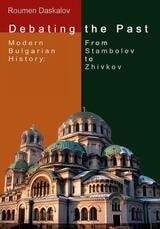
Debating the Past
Modern Bulgarian Historiography—From Stambolov to ZhivkovRoumen Daskalov
Central European University Press, 2011
The book is comprised of the four major debates on modern Bulgarian history from Independence in 1878 to the fall of communism in 1989. The debates are on the Bulgarian–Russian/Soviet relations, on the relations between Agrarians and Communists, on Bulgarian Fascism, and on Communism. They are associated with the rule of key political personalities in Bulgarian history: Stambolov (1887–1894), Stamboliiski (1919–1923), Tsar Boris III (1918–1943), and the communist leaders Georgi Dimitrov and Todor Zhivkov (1956–1989). The debates are traced through their various articulations and dramatic turns from their beginnings to the present day.
[more]
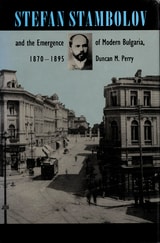
Stefan Stambolov and the Emergence of Modern Bulgaria, 1870-1895
Duncan M. Perry
Duke University Press, 1993
Little known in the United States but increasingly important in the affairs of southeastern Europe, Bulgaria is a land with a stormy history. No less stormy is the story of Stefan Stambolov, who ruled the country during some of its most turbulent years. Duncan M. Perry's biography of Stambolov, the first in English in the twentieth century, illuminates the life, motives, and personality of this major figure.
Perry begins with Bulgaria in the tumultuous years immediately following its founding in 1878. After the ousting of the country's first prince, Stambolov enters the stage as the fiery young lawyer who restored him to the throne. Although the prince promptly abdicated, Stambolov stepped into the breach and led the nation during the interregnum. Perry traces this patriotic politician's transformation into an authoritarian prime minister. He shows how Stambolov stabilized the Bulgarian economy and brought relative security to the land—but not without cost to himself and his regime. Perry depicts a man whose promotion of Bulgaria's independence exacted its price in individual rights, a ruler whose assassination in 1895 was the cause of both rejoicing and sorrow.
Stambolov thus emerges from these pages as a complex historical figure, an authoritarian ruler who protected his country's liberty at the cost of the people's freedom and whose dictatorial policies set Bulgaria upon a course of stability and modernization. An afterword compares the Bulgarian liberation era of Stambolov with the communist-era dictator, Todor Zhikov, analyzing similarities and differences.
[more]