Results by title
4 books match the query '1880-1968'
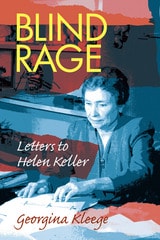
Blind Rage
Letters to Helen KellerGeorgina Kleege
Gallaudet University Press, 2006
As a young blind girl, Georgina Kleege repeatedly heard the refrain, “Why can’t you be more like Helen Keller?” Kleege’s resentment culminates in her book Blind Rage: Letters to Helen Keller, an ingenious examination of the life of this renowned international figure using 21st-century sensibilities. Kleege’s absorption with Keller originated as an angry response to the ideal of a secular saint, which no real blind or deaf person could ever emulate. However, her investigation into the genuine person revealed that a much more complex set of characters and circumstances shaped Keller’s life.
Blind Rage employs an adroit form of creative nonfiction to review the critical junctures in Keller’s life. The simple facts about Helen Keller are well-known: how Anne Sullivan taught her deaf-blind pupil to communicate and learn; her impressive career as a Radcliffe graduate and author; her countless public appearances in various venues, from cinema to vaudeville, to campaigns for the American Foundation for the Blind. But Kleege delves below the surface to question the perfection of this image. Through the device of her letters, she challenges Keller to reveal her actual emotions, the real nature of her long relationship with Sullivan, with Sullivan’s husband, and her brief engagement to Peter Fagan. Kleege’s imaginative dramatization, distinguished by her depiction of Keller’s command of abstract sensations, gradually shifts in perspective from anger to admiration. Blind Rage criticizes the Helen Keller myth for prolonging an unrealistic model for blind people, yet it appreciates the individual who found a practical way to live despite the restrictions of her myth.
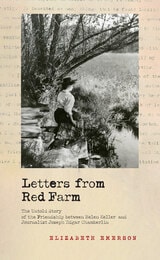
Letters from Red Farm
The Untold Story of the Friendship between Helen Keller and Journalist Joseph Edgar ChamberlinElizabeth Emerson
University of Massachusetts Press, 2021
Informed by previously unpublished letters and extensive research, Letters from Red Farm explores for the first time Keller's deep and enduring friendship with the man who became her literary mentor and friend for over forty years. Written by Chamberlin's great-great granddaughter, this engaging story imparts new insights into Keller's life and personality, introduces the irresistible Chamberlin to a modern public, and follows Keller's burgeoning interest in social activism, as she took up the causes of disability rights, women's issues, and pacifism.
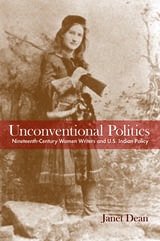
Unconventional Politics
Nineteenth-Century Women Writers and U.S. Indian PolicyJanet Dean
University of Massachusetts Press, 2016
Dean argues that in protesting U.S. Indian policy through popular genres, Wakefield, Sigourney, Callahan, and Eddleman also critiqued cultural protocols and stretched the contours of accepted modes of feminine discourse. Their acts of improvisation and reinvention tell a new story about the development of American women's writing and political expression.
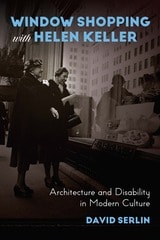
Window Shopping with Helen Keller
Architecture and Disability in Modern CultureDavid Serlin
University of Chicago Press, 2025
Window Shopping with Helen Keller recovers a series of influential moments when architects and designers engaged the embodied experiences of people with disabilities. David Serlin reveals how people with sensory and physical impairments navigated urban spaces and helped to shape modern culture. Through four case studies—the lives of Joseph Merrick (aka “The Elephant Man”) and Helen Keller, the projects of the Works Progress Administration, and the design of the Illinois Regional Library for the Blind and Physically Handicapped—Serlin offers a new history of modernity’s entanglements with disability.