Results by title

4 books match the query '1881-1938'
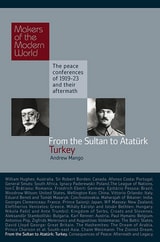
cover of From the Sultan to Atatürk: Turkey

From the Sultan to Atatürk

Turkey

Andrew Mango

Haus Publishing, 2009

World War I sounded the death knell of empires. The forces of disintegration affected several empires simultaneously. To that extent they were impersonal. But prudent statesmen could delay the death of empires, rulers such as Emperor Franz Josef II of Austria-Hungary and the Ottoman Sultan Abdülhamid II. Adventurous rulers - Kaiser Wilhelm of Germany and Enver Pasha in the Ottoman Empire - hastened it. Enver's decision to enter the war on the side of Germany destroyed the Ottoman state. It may have been doomed in any case, but he was the agent of its doom. The last Sultan Mehmet VI Vahdettin thought he could salvage the Ottoman state in something like its old form. But Vahdettin and his ministers could not succeed because the victorious Allies had decided on the final partition of the Ottoman state. The chief proponent of partition was Lloyd George, heir to the Turcophobe tradition of British liberals, who fell under the spell of the Greek irredentist politician Venizelos. With these two in the lead, the Allies sought to impose partition on the Sultan's state. When the Sultan sent his emissaries to the Paris peace conference they could not win a reprieve. The Treaty of Sèvres which the Sultan's government signed put an end to Ottoman independence. The Treaty of Sèvres was not ratified. Turkish nationalists, with military officers in the lead, defied the Allies, who promptly broke ranks, each one trying to win concessions for himself at the expense of the others. Mustafa Kemal emerged as the leader of the military resistance. Diplomacy allowed Mustafa Kemal to isolate his people's enemies: Greek and Armenian irredentists. Having done so, he defeated them by force of arms. In effect, the defeat of the Ottoman empire in the First World War was followed by the Turks' victory in two separate wars: a brief military campaign against the Armenians and a long one against the Greeks. Lausanne - where General Ismet succeeded in securing peace on Turkey's terms - was the founding charter of the modern Turkish nation state. But more than that it showed that empires could no longer rule peoples against their wishes. This need not be disastrous: Mustafa Kemal demonstrated that the interests of developed countries were compatible with those of developing ones. He fought the West in order to become like it. Where his domestic critics wanted to go on defying the West, Mustafa Kemal saw that his country could fare best in cooperation with the West.
[more]
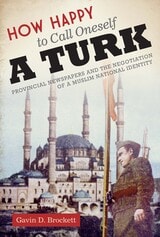
cover of How Happy to Call Oneself a Turk: Provincial Newspapers and the Negotiation of a Muslim National Identity

How Happy to Call Oneself a Turk

Provincial Newspapers and the Negotiation of a Muslim National Identity

By Gavin D. Brockett

University of Texas Press, 2011

The modern nation-state of Turkey was established in 1923, but when and how did its citizens begin to identify themselves as Turks? Mustafa Kemal Atatürk, Turkey's founding president, is almost universally credited with creating a Turkish national identity through his revolutionary program to "secularize" the former heartland of the Ottoman Empire. Yet, despite Turkey's status as the lone secular state in the Muslim Middle East, religion remains a powerful force in Turkish society, and the country today is governed by a democratically elected political party with a distinctly religious (Islamist) orientation.

In this history, Gavin D. Brockett takes a fresh look at the formation of Turkish national identity, focusing on the relationship between Islam and nationalism and the process through which a "religious national identity" emerged. Challenging the orthodoxy that Atatürk and the political elite imposed a sense of national identity from the top down, Brockett examines the social and political debates in provincial newspapers from around the country. He shows that the unprecedented expansion of print media in Turkey between 1945 and 1954, which followed the end of strict, single-party authoritarian government, created a forum in which ordinary people could inject popular religious identities into the new Turkish nationalism. Brockett makes a convincing case that it was this fruitful negotiation between secular nationalism and Islam—rather than the imposition of secularism alone—that created the modern Turkish national identity.
[more]
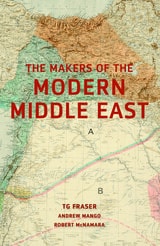
cover of Making the Modern Middle East: Second Edition

Making the Modern Middle East

Second Edition

T.G. Fraser, Andrew Mango, and Robert McNamara

Gingko, 2015

A century ago, as World War I got underway, the Middle East was dominated, as it had been for centuries, by the Ottoman Empire. But by 1923, its political shape had changed beyond recognition, as the collapse of the Ottoman Empire and the insistent claims of Arab and Turkish nationalism and Zionism led to a redrawing of borders and shuffling of alliances—a transformation whose consequences are still felt today.
           
This fully revised and updated second edition of The Makers of the Modern Middle East traces those changes and the ensuing history of the region through the rest of the twentieth century and on to the present. Focusing in particular on three leaders—Emir Feisal, Mustafa Kemal, and Chaim Weizmann—the book offers a clear, authoritative account of the region seen from a transnational perspective, one that enables readers to understand its complex history and the way it affects present-day events.
[more]
cover of Transformative Political Leadership: Making a Difference in the Developing World

Transformative Political Leadership

Making a Difference in the Developing World

Robert I. Rotberg

University of Chicago Press, 2012

Accomplished political leaders have a clear strategy for turning political visions into reality. Through well-honed analytical, political, and emotional intelligence, leaders chart paths to promising futures that include economic growth, material prosperity, and human well-being. Alas, such leaders are rare in the developing world, where often institutions are weak and greed and corruption strong—and where responsible leadership therefore has the potential to effect the greatest change.
          
In Transformative Political Leadership, Robert I. Rotberg focuses on the role of leadership in politics and argues that accomplished leaders demonstrate a particular set of skills. Through illustrative case studies of leaders who have performed ably in the developing world—among them Nelson Mandela in South Africa, Seretse Khama in Botswana, Lee Kuan Yew in Singapore, and Kemal Ataturk in Turkey—Rotberg examines how these leaders transformed their respective countries. The importance of capable leadership is woefully understudied in political science, and this book will be an important tool in exploring how leaders lead and how nations and institutions are built.
[more]