Results by title
2 books match the query '1882 - 1930'

A Festival of Violence
An Analysis of Southern Lynchings, 1882-1930Stewart Tolnay and E.M. Beck
University of Illinois Press, 1995
practice. Stewart Tolnay and E. M. Beck empirically test competing explanations of the causes of lynching, using U.S. Census and historical voting data and a newly constructed inventory of southern lynch victims. Among their surprising findings: lynching responded to fluctuations in the price of cotton, decreasing in frequency when prices rose and increasing when they fell.
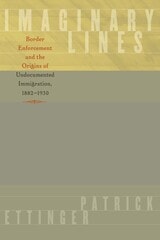
Imaginary Lines
Border Enforcement and the Origins of Undocumented Immigration, 1882-1930By Patrick Ettinger
University of Texas Press, 2009
Southwest Book Award, Border Regional Library Association, 2011
Although popularly conceived as a relatively recent phenomenon, patterns of immigrant smuggling and undocumented entry across American land borders first emerged in the late nineteenth century. Ingenious smugglers and immigrants, long and remote boundary lines, and strong push-and-pull factors created porous borders then, much as they do now.
Historian Patrick Ettinger offers the first comprehensive historical study of evolving border enforcement efforts on American land borders at the turn of the twentieth century. He traces the origins of widespread immigrant smuggling and illicit entry on the northern and southern United States borders at a time when English, Irish, Chinese, Italian, Russian, Lebanese, Japanese, Greek, and, later, Mexican migrants created various "backdoors" into the United States. No other work looks so closely at the sweeping, if often ineffectual, innovations in federal border enforcement practices designed to stem these flows.
From upstate Maine to Puget Sound, from San Diego to the Lower Rio Grande Valley in Texas, federal officials struggled to adapt national immigration policies to challenging local conditions, all the while battling wits with resourceful smugglers and determined immigrants. In effect, the period saw the simultaneous "drawing" and "erasing" of the official border, and its gradual articulation and elaboration in the midst of consistently successful efforts to undermine it.