Results by title
5 books match the query '1883-1946'

Anticipations of the General Theory?
And Other Essays on KeynesDon Patinkin
University of Chicago Press, 1982
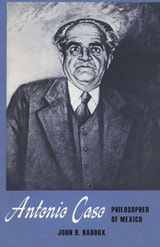
Antonio Caso
Philosopher of MexicoBy John H. Haddox
University of Texas Press, 1971
Few men have had as much cultural and educational influence on their own countries as the philosopher and educator Antonio Caso (1883-1946). He was above all a patriot of his beloved Mexico, and he sought to deliver his humanitarian message to his countrymen.
In his youth, after the revolt against Díaz, he was a member of the Ateneo de la Juventud, a group that sought to bring Mexico, spiritually and economically, back to the Mexicans. Caso realized that this effort involved the forming of a national consciousness among his people, whom he saw divided by their private and public interests.
As an educator of Mexican youth for more than thirty years, Caso sought to imbue in his students the desire to search and to question. He saw education as a perpetual search for truth, and his own life and philosophy reflect this search. He rejected any system that proposed to describe all of reality, and he despised all dogmas—official or unofficial. He particularly fought against positivism and Marxism, systems current in his youth.
The first part of this book is an introduction to the philosophical and educational ideas of Caso, as well as to the intellectual and political ideas in his life. Mr. Haddox skillfully shows the development of Caso's ideas and how they took shape from his own reading as well as from the experiences of his age and of his country. The second part contains Mr. Haddox's translations of selections from Caso's writings. They give a moving picture of Caso's hopes for Mexico and for humanitiy.
Contra Keynes and Cambridge
Essays, CorrespondenceF. A. Hayek
University of Chicago Press, 1995
When the journal Economica published a review of Keynes's Treatise on Money by Hayek in 1931, Keynes's response consisted principlally of an attack on Hayek's own work on monetary theory, Prices and Production. Conducted almost entirely in economics journals, the battle that followed revealed two very different responses to a world in economic crisis. Keynes sought a revision of the liberal political order—arguing for greater government intervention in the hope of protecting against the painful fluctuations of the business cycle. Hayek instead warned that state involvement would cause irreparable damage to the economy.
This volume begins with Hayek's 1963 reminiscence "The Economics of the 1930s as Seen from London," which has never been published before. The articles, letters, and reviews from journals published in the 1930s are followed by Hayek's later reflections on Keynes's work and influence. The Introduction by Bruce Caldwell puts the debate in context, providing detailed information about the economists in Keynes's circle at Cambridge, their role in the acceptance of his ideas, and the ways in which theory affected policy during the interwar period.
Caldwell calls the debate between Hayek and Keynes "a battle for the minds of the rising generation of British-trained economists." There is no doubt that Keynes won the battle during his lifetime. Now, when many of Hayek's ideas have been vindicated by the collapse of collectivist economies and the revival of the free market around the world, this book clarifies Hayek's work on monetary theory—formed in heated opposition to Keynes—and illuminates his efforts to fight protectionism in an age of economic crisis.
F. A. Hayek (1899-1992), recipient of the Medal of Freedom in 1991 and co-winner of the Nobel Memorial Prize in Economics in 1974, was a pioneer in monetary theory and the principal proponent of classical liberal thought in the twentieth century. He taught at the University of London, the University of Chicago, and the University of Freiburg.

Stilwell and Mountbatten in Burma
Allies at War, 1943-1944Jonathan Templin Ritter
University of North Texas Press, 2017
The Fatal Conceit
The Errors of SocialismF. A. Hayek
University of Chicago Press, 1988
"The achievement of The Fatal Conceit is that it freshly shows why socialism must be refuted rather than merely dismissed—then refutes it again."—David R. Henderson, Fortune.
"Fascinating. . . . The energy and precision with which Mr. Hayek sweeps away his opposition is impressive."—Edward H. Crane, Wall Street Journal
F. A. Hayek is considered a pioneer in monetary theory, the preeminent proponent of the libertarian philosophy, and the ideological mentor of the Reagan and Thatcher "revolutions."