Results by title
2 books match the query '1888-1966'
A Religion, Not a State
Ali 'Abd al-Raziq's Islamic justification of Political SecularismSouad T Ali
University of Utah Press, 2009
Utah Series in Middle East Studies
In this notable work, Souad T. Ali examines the seminal writings of Egyptian reformist scholar Ali'Abd al-Raziq, often regarded as the intellectual father of Islamic secularism, and his controversial argument that the caliphate should be considered a human innovation, rather than a religious imperative. 'Abd al Raziq contended that Islam is "a religion, not a state; a message, not a government," a major departure from the traditional view that religious and political spheres are intertwined and inseparable in Islam.
Opponents denounced 'Abd al-Raziq's ideas as a foreign corruption imported from the West. Ali's careful, objective, and scholarly examination of 'Abd al-Raziq's work, however, reveals that his arguments are not based in Western thought. Rather, they sit firmly within the dictates of Islam's sacred texts, particularly the Quran and Hadith, and also enjoy considerable support from the historical record.
This analysis critically challenges prevalent misinterpretations of Islam that have endured for centuries. Ali recognizes the varied models and discourses that have arisen throughout different epochs, especially so the role that Western intervention has played in placing the question of Islam's modernity at the forefront of intellectual debate. Throughout, the study emphasizes the atmosphere of openness and tolerance that is a requisite for free, intelligent debate.
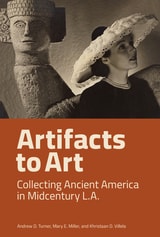
Artifacts to Art
Collecting Ancient America in Midcentury L.A.Andrew D. Turner
J. Paul Getty Trust, The, 2026
By the mid-twentieth century, ancient Mexican artifacts had undergone a striking transformation. Once dismissed as anthropological curiosities, sought after more for their ethnographic value than aesthetic merit, they had become prized artworks that were prominently displayed in major US museums, featured in advertisements and Hollywood films, and shown adorning the homes of celebrities.
At the center of this shift was Earl Stendahl, a savvy Los Angeles art dealer who played a pivotal role in shaping public and institutional perceptions of these objects. Through strategic marketing and a keen eye for opportunity, he repositioned these artifacts, selling them to an elite clientele that included movie stars, wealthy collectors, and museum curators. In doing so, he helped define a new canon of “ancient American art.”
Beneath this glamorous facade, however, lies a darker narrative of the looting, smuggling, and forgery that fueled this midcentury craze, exposing how the desire for authenticity and prestige often came at the expense of ethical collecting practices and cultural heritage. This book brings together art history, museum studies, and the politics of the antiquities trade, offering both a social history and a critical examination of how ancient Mexico’s past was sold in twentieth-century America.
This volume is published to accompany an exhibition on view at the Getty Research Institute at the Getty Center from June 23 to October 18, 2026.