Results by title
3 books match the query '1888-1969'
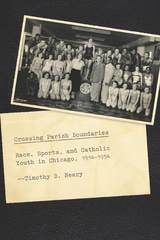
Crossing Parish Boundaries
Race, Sports, and Catholic Youth in Chicago, 1914-1954Timothy B. Neary
University of Chicago Press, 2016
Controversy erupted in spring 2001 when Chicago’s mostly white Southside Catholic Conference youth sports league rejected the application of the predominantly black St. Sabina grade school. Fifty years after Brown v. Board of Education, interracialism seemed stubbornly unattainable, and the national spotlight once again turned to the history of racial conflict in Catholic parishes. It’s widely understood that midcentury, working class, white ethnic Catholics were among the most virulent racists, but, as Crossing Parish Boundaries shows, that’s not the whole story.
In this book, Timothy B. Neary reveals the history of Bishop Bernard Sheil’s Catholic Youth Organization (CYO), which brought together thousands of young people of all races and religions from Chicago’s racially segregated neighborhoods to take part in sports and educational programming. Tens of thousands of boys and girls participated in basketball, track and field, and the most popular sport of all, boxing, which regularly filled Chicago Stadium with roaring crowds. The history of Bishop Sheil and the CYO shows a cosmopolitan version of American Catholicism, one that is usually overshadowed by accounts of white ethnic Catholics aggressively resisting the racial integration of their working-class neighborhoods. By telling the story of Catholic-sponsored interracial cooperation within Chicago, Crossing Parish Boundaries complicates our understanding of northern urban race relations in the mid-twentieth century.
In this book, Timothy B. Neary reveals the history of Bishop Bernard Sheil’s Catholic Youth Organization (CYO), which brought together thousands of young people of all races and religions from Chicago’s racially segregated neighborhoods to take part in sports and educational programming. Tens of thousands of boys and girls participated in basketball, track and field, and the most popular sport of all, boxing, which regularly filled Chicago Stadium with roaring crowds. The history of Bishop Sheil and the CYO shows a cosmopolitan version of American Catholicism, one that is usually overshadowed by accounts of white ethnic Catholics aggressively resisting the racial integration of their working-class neighborhoods. By telling the story of Catholic-sponsored interracial cooperation within Chicago, Crossing Parish Boundaries complicates our understanding of northern urban race relations in the mid-twentieth century.
[more]
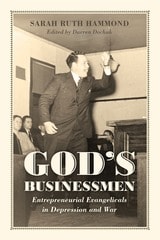
God's Businessmen
Entrepreneurial Evangelicals in Depression and WarSarah Ruth Hammond
University of Chicago Press, 2017
How evangelical businessmen in the 1930s and 1940s joined their religious and business lives.
The evangelical embrace of conservatism is a familiar feature of the contemporary political landscape. What’s less well-known, however, is that the connection predates the Reagan revolution, going all the way back to the Depression and World War II. Evangelical businessmen at the time were quite active in opposing the New Deal—on both theological and economic grounds—and in doing so claimed a place alongside other conservatives in the public sphere. Like previous generations of devout laymen, they self-consciously merged their religious and business lives, financing and organizing evangelical causes with the kind of visionary pragmatism that they practiced in the boardroom.
In God’s Businessmen, Sarah Ruth Hammond explores not only these men’s personal trajectories but also those of the service clubs and other institutions that, like them, believed that businessmen were God’s instrument for the Christianization of the world. Hammond presents a capacious portrait of the relationship between the evangelical business community and the New Deal—and in doing so makes important contributions to American religious history, business history, and the history of the American state.
[more]
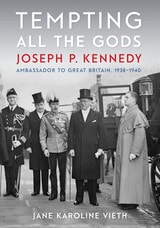
Tempting All the Gods
Joseph P. Kennedy, Ambassador to Great Britain, 1938–1940Jane Karoline Vieth
Michigan State University Press, 2021
Tempting All the Gods is a detailed study of Joseph P. Kennedy’s diplomatic career in London. It examines Kennedy’s role as ambassador to the Court of St. James’s from 1938–1940, a crucial time in world history. It describes his attitudes toward American foreign policy before the outbreak of war and after the war began, explains why he held those views, and assesses their impact on Anglo-American relations. It also looks at the diplomatic background against which he worked, at the political philosophies and personalities of the statesmen with whom he dealt, and at his relations with them, particularly President Franklin Roosevelt and British Prime Ministers Neville Chamberlain and Winston Churchill. Here the reader will find a meticulously researched account of Kennedy’s career based on the latest evidence available, providing a current and balanced historical reassessment. Scholars will be able to study Kennedy’s diplomatic career within the broader context of international relations and also to gain a fuller understanding of his view of his own motives and policies, including an understanding of why the ambassadorship was the greatest achievement—with the poorest outcome—in the varied life of an intensely ambitious man who was dedicated foremost to family, friends, and fortune. This book will prove significant to students of Anglo-American relations and of World War II, and to the general public, with its enduring fascination with the Kennedy family.
[more]