Results by title
6 books match the query '1889-1974'
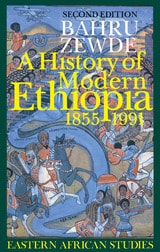
A History of Modern Ethiopia, 1855–1991
Second EditionBahru Zewde
Ohio University Press, 2002
Bounded by Sudan to the west and north, Kenya to the south, Somalia to the southeast, and Eritrea and Djibouti to the northeast, Ethiopia is a pivotal country in the geopolitics of the region. Yet it is important to understand this ancient and often splintered country in its own right.
In A History of Modern Ethiopia, Bahru Zewde, one of Ethiopia’s leading historians, provides a compact and comprehensive history of his country, particularly the last two centuries. Of importance to historians, political scientists, journalists, and Africanists alike, Bahru’s A History of Modern Ethiopia, now with additional material taking it up to the last decade, will be the preeminent overview of present-day Ethiopia.
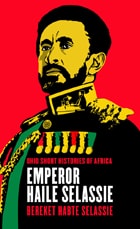
Emperor Haile Selassie
Bereket Habte Selassie
Ohio University Press, 2014
Emperor Haile Selassie was an iconic figure of the twentieth century, a progressive monarch who ruled Ethiopia from 1916 to 1974. This book, written by a former state official who served in a number of important positions in Selassie’s government, tells both the story of the emperor’s life and the story of modern Ethiopia.
After a struggle for the throne in 1916, the young Selassie emerged first as regent and then as supreme leader of Ethiopia. Over the course of his nearly six-decade rule, the emperor abolished slavery, introduced constitutional reform, and expanded educational opportunity. The Italian invasion of Ethiopia in the 1930s led to a five-year exile in England, from which he returned in time to lead his country through World War II. Selassie was also instrumental in the founding of the Organization of African Unity in 1963, but he fell short of the ultimate goal of a promised democracy in Ethiopia. The corruption that grew under his absolute rule, as well as his seeming indifference to the famine that gripped Ethiopia in the 1970s, led finally to his overthrow by the armed forces that he had created.
Haile Selassie was an enlightened monarch in many ways, but also a man with flaws like any other. This short biography is a sensitive portrayal of Selassie as both emperor and man, by one who knew him well.
Five Public Philosophies of Walter Lippmann
By Benjamin F. Wright
University of Texas Press, 1973
Essayist, editor, columnist, author of many books, and winner of a special Pulitzer Prize citation in 1958 for his powers of news analysis, Walter Lippmann both appraised and influenced twentieth-century American politics. No other author of the century dealt with the persistent problems of politics from so many approaches, was so widely read, or varied so widely in his conclusions.
Benjamin F. Wright’s study is the first book devoted to an exposition and analysis of Lippmann’s nine “books of political philosophy,” as James Reston called them. These books provide a fascinating study of changes in the political and economic ideas of the most important journalist of his time.
Lippmann’s books published in 1913 and 1914 reflect the optimism of the Progressive Era, of faith in science and in the ability of people to choose their goals and attain them. In 1922 and 1925, while editor of the New York World, Lippmann wrote searching, often pessimistic analyses of what he believed to be the prevailing assumptions regarding the nature and role of public opinion. Although in the Coolidge era he relegated government to a minor role as mediator, he became an enthusiastic defender of the achievements of the early New Deal. Two years later in a longer look, he found the same New Deal following the path toward totalitarianism. Keynes was discarded and his place taken by the economics of Adam Smith, bolstered by the common law of Coke and the Constitution of the founders. Finally, in 1955, in the extremely popular and very engaging Public Philosophy, there is a lament for the “decline of the West” and a plea to return to the age of civility and natural law.
In a final analytical chapter, Wright presents a critique of Lippmann’s historical understanding and the modern applications of the tradition of natural law. He also assesses Lippmann’s inability to translate the “public philosophy” into programs or institutional changes and the failure to account for the expansion of governmental functions together with the continued strength of constitutional democracy in the West.

Imagining Ethiopia
Struggles for History and Identity in the Horn of AfricaJohn Sorenson
Rutgers University Press, 1993
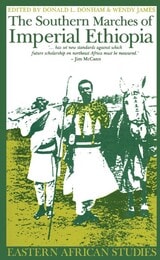
Southern Marches of Imperial Ethiopia
Essays in History and Social AnthropologyDonald L. Donham
Ohio University Press, 2002
This pioneering book, first published to wide acclaim in 1986, traces the way the Ethiopian center and the peripheral regions of the country affected each other. It looks specifically at the expansion of the highland Ethiopian state into the western and southern lowlands from the 1890s up to 1974.

The Emperor's Clothes
A Personal Viewpoint of Politics and Administration in the Imperial Ethiopian Government, 1941-1974Gaitachew Bekele
Michigan State University Press, 1993
. . . An engaging personal account of a public service career n the period leading to the 1974 revolution. It ...persuades and provides real insight into the genuine noblesse oblige of the first generation of technocrats drawn from the social elite of the post- war period.
-James McCann, Boston University