Results by title
3 books match the query '1891-'
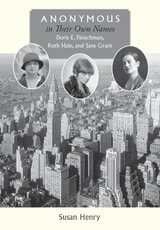
Anonymous in Their Own Names
Doris E. Fleischman, Ruth Hale, and Jane GrantSusan Henry
Vanderbilt University Press, 2012
Anonymous in Their Own Names recounts the lives of three women who, while working as their husbands' uncredited professional partners, had a profound and enduring impact on the media in the first half of the twentieth century. With her husband, Edward L. Bernays, Doris E. Fleischman helped found and form the field of public relations. Ruth Hale helped her husband, Heywood Broun, become one of the most popular and influential newspaper columnists of the 1920s and 1930s. In 1925 Jane Grant and her husband, Harold Ross, started the New Yorker magazine.
Yet these women's achievements have been invisible to countless authors who have written about their husbands. This invisibility is especially ironic given that all three were feminists who kept their birth names when they married as a sign of their equality with their husbands, then battled the government and societal norms to retain their names. Hale and Grant so believed in this cause that in 1921 they founded the Lucy Stone League to help other women keep their names, and Grant and Fleischman revived the league in 1950. This was the same year Grant and her second husband, William Harris, founded White Flower Farm, pioneering at that time and today one of the country's most celebrated commercial nurseries.
Despite strikingly different personalities, the three women were friends and lived in overlapping, immensely stimulating New York City circles. Susan Henry explores their pivotal roles in their husbands' extraordinary success and much more, including their problematic marriages and their strategies for overcoming barriers that thwarted many of their contemporaries.
[more]
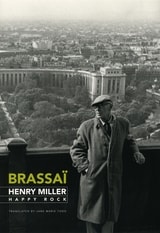
Henry Miller, Happy Rock
Brassaï
University of Chicago Press, 2002
"In a world like this one, it's difficult to devote oneself to art body and soul. To get published, to get exhibited, to get produced often requires ten or twenty years of patient, intense labor. I spent half my life at it! And how do you survive during all that time? Beg? Live off other people until you're successful? What a dog's life! I know something about that! You're always recognized too late. And today, it's no longer enough to have talent, originality, to write a good or beautiful book. One must be inspired! Not only touch the public but create one's own public. Otherwise, you're headed straight for suicide."
That's Henry Miller's advice for young aspiring artists, as remembered by his very good friend Brassaï in this lively book. One of two that Brassaï wrote about the man who called himself a "happy rock," this volume covers their lives and friendship from the 1950s to 1973. Over the course of a number of warm, intimate conversations, Brassaï and Miller revisit their careers; discuss art, literature, Paris, Greece, Japan, World War II, and more; and consider the lives and works of many others in their circle, including Lawrence Durrell, Henri Matisse, Salvador Dalí, Georges Simenon, André Malraux, Hans Reichel, Paul Klee, and Amedeo Modigliani. Throughout Miller's zest for life shines through, as do his love of art and his passionate intensity for just about everything he does, from discussing a movie or play he'd just seen to reminiscing about a decades-long love.
Brassaï's Henry Miller, Happy Rock presents a vivid portrait of two close friends who thoroughly enjoy each other's company—and just happen to be world—famous artists too.
[more]
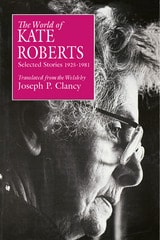
The World of Kate Roberts
Selected Stories, 1925-1981Joseph Clancy
Temple University Press, 1991
Publishers Weekly Best Book of 1991, 1991
Kate Roberts (1891-1985) was the foremost twentieth-century prose writer in the Welsh language. She produced a considerable body of fiction, seven novels and novellas and nine collections of short stories, and was active in the Welsh Nationalist Party as a publisher and a literary and political journalist. A contemporary of D. H. Lawrence, Katherine Mansfield, and Sherwood Anderson, she created the modern form of the short story in Welsh, and through six decades of writing earned a place with this century's masters of the genre.
The World of Kate Roberts offers in English a large selection of stories, many previously, untranslated, that span her long writing career. Joseph P. Clancy's translations convey the intensity, the insight, and the distinctive prose style with which this Welsh-language writer illuminates her characters' often heroic ordinary lives. This book contains twenty-seven short stories, two short novels, and "Tea in the Heather," eight linked stories of childhood in North Wales at the turn of the century. Excerpts from her autobiography provide background for the non-Welsh reader and an Introduction presents Kate Roberts' life and work largely through her own words.
The experience of poverty is the vital center of Kate Roberts' fiction: material poverty in the slate-quarrying villages of North Wales and the coal-mining communities in the south at the turn of the century and during the Depression; and the cultural, moral, and spiritual poverty of contemporary life in a small town. This poverty defines the experiences and tests the resources of her characters. Her concern was to record, to examine, and to celebrate without sentimentality the life of the close-knit society in which she had grown up. What is most characteristically Welsh in Roberts' vision is that fellowship, membership in a community, is essential to the realization of the human self. "We never saw riches," observed Kate Roberts, "but we had riches that no one can take away from us, the riches of a language and a culture."
[more]