Results by title

3 books match the query '1891-1971'
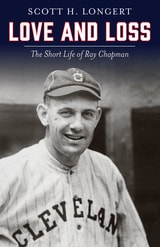
cover of Love and Loss: The Short Life of Ray Chapman

Love and Loss

The Short Life of Ray Chapman

Scott H. Longert

Ohio University Press, 2024

The son of a coal miner from a small Illinois town, Cleveland Indians shortstop Ray Chapman lived the American dream until his untimely death at age twenty-nine. In his brief life, he reached the pinnacle of baseball success as the best shortstop in the American League. While many professional ballplayers struggled with meager salaries, the handsome Chapman had married heiress Kathleen Daly, one of Cleveland’s wealthiest women. With a child on the way and an executive job in the offseason, Chapman was moving toward a privileged place in society until an errant fastball fractured his skull and ended his life the next day. Late in the 1920 pennant race, the Indians were in New York for a key series against the Yankees. New York pitcher Carl Mays threw a high hard one that Chapman could not evade. He was taken to a nearby hospital, where doctors tried in vain to save his life. The tragedy did not end there. His widow took her own life eight years later, and their daughter, Rae, subsequently died from meningitis. Today, people visit Chapman’s impressive grave in Cleveland’s Lake View Cemetery, leaving baseballs and gloves in his memory. Though gone over a hundred years, he is well remembered as a Cleveland icon. This book goes far beyond the well-worn accounts of Chapman’s untimely death to illustrate the fullness of his short life.
[more]
cover of Samuel Bronfman: The Life and Times of Seagram’s Mr. Sam

Samuel Bronfman

The Life and Times of Seagram’s Mr. Sam

Michael R. Marrus

Brandeis University Press, 1991

As the creator of the Seagram whiskey empire Sam Bronfman became a mythic figure in the business world, and in the years after his death the legend has developed further and further away from the life. Now for the first time the complete story of the man and the business he built is available. Sam Bronfman was according to Business Week "a volatile, shrewd, and highly individualistic leader [whose] technical knowledge and financial acumen remain unchallenged." For over twenty years, Forbes noted, Sam judged the U.S. market correctly -- as virtually no one else did. The story includes the passing on of the vast Seagram enterprise to the leadership of his sons, Edgar and Charles. Samuel Bronfman's father failed as a wheat farmer and then found success selling frozen fish, firewood and horses. At this point young Sam observed to his father, "The bar makes more profits than we do. Instead of selling horses, we should be selling the drinks." And thus began what was to become the Seagram whiskey empire. Sam's insight and timing were right as Canada, and especially the United States, were coming under the influence of the temperance movement. While legend often places Sam in the thick of Prohibition era bootlegging and rum running, in fact he built for the long term and kept his operations within both the law and its loopholes as he supplied American bootleggers. Sam demonstrated his marketing genius by insisting on quality in a business notorious for cutting corners and thereby set the standard for the industry in the decades to follow. Sam's success in penetrating the American market was such that after Prohibition his competitors lobbied the federal government for his protection. While Samuel Bronfman is a classic rags to riches tale, it is also the story of a Jew who remained in many ways outside business and social establishments even after becoming internationally famous. Commuting every week between his Montreal and New York office, his was a private life centered on his family and their home in Montreal and summer places such as Tarrytown, New York. In the 1950s Sam, under instructions from his daughter Phyllis Lambert, commissioned Mies van der Rohe to design a new corporate headquarters, the Seagram building at 375 Park Avenue, a landmark on the New York City skyline. As a leader of the Jewish community Sam was elected president of the Canadian Jewish Congress in 1939, and went on to organize financial aid to the fledgling state of Israel, beginning decades long involvement in Jewish affairs and support for the Jewish state. Sam was an intuitive leader and manager who knew his industry inside out and set the highest standards for his products and himself. His life makes a fascinating tale of business, power, wealth, and ethnic politics.
[more]
cover of Toward Nationalism's End: An Intellectual Biography of Hans Kohn

Toward Nationalism's End

An Intellectual Biography of Hans Kohn

Adi Gordon

Brandeis University Press, 2017

This intellectual biography of Hans Kohn (1891–1971) looks at theories of nationalism in the twentieth century as articulated through the life and work of its leading scholar and activist. Hans Kohn was born in late nineteenth-century Prague, but his peripatetic life took him from the Revolutionary-era Russia to interwar-era Palestine under the British Empire to the United States during the Cold War. Bearing witness to dramatic reconfigurations of national and political identities, he spearheaded an intellectual revolution that fundamentally challenged assumptions about the “naturalness” and the immutability of nationalism. Reconstructing Kohn’s long and fascinating career, Gordon uncovers the multiple political and intellectual trends that intersected with and shaped his theories of nationalism. Throughout his life, Kohn was not simply a theorist but also a participant in multiple and often conflicting movements: Zionism and anti-Zionism, pacifism, liberalism, and military interventionism. His evolving theories thus drew from and reflected fierce debates about the nature of internationalism, imperialism, liberalism, collective security, and especially the Jewish Question. Kohn’s scholarship was not an abstraction but a product of his lived experience as a Habsburg Jew, an erstwhile cultural Zionist, and an American Cold Warrior. As a product of the times, his concepts of nationalism reflected the changing world around him and evolved radically over his lifetime. His intellectual biography thus offers a panorama of the dynamic intellectual cornerstones of the twentieth century.
[more]