Results by title
3 books match the query '1892-1972'

Anonymous in Their Own Names
Doris E. Fleischman, Ruth Hale, and Jane GrantSusan Henry
Vanderbilt University Press, 2012
Anonymous in Their Own Names recounts the lives of three women who, while working as their husbands' uncredited professional partners, had a profound and enduring impact on the media in the first half of the twentieth century. With her husband, Edward L. Bernays, Doris E. Fleischman helped found and form the field of public relations. Ruth Hale helped her husband, Heywood Broun, become one of the most popular and influential newspaper columnists of the 1920s and 1930s. In 1925 Jane Grant and her husband, Harold Ross, started the New Yorker magazine.
Yet these women's achievements have been invisible to countless authors who have written about their husbands. This invisibility is especially ironic given that all three were feminists who kept their birth names when they married as a sign of their equality with their husbands, then battled the government and societal norms to retain their names. Hale and Grant so believed in this cause that in 1921 they founded the Lucy Stone League to help other women keep their names, and Grant and Fleischman revived the league in 1950. This was the same year Grant and her second husband, William Harris, founded White Flower Farm, pioneering at that time and today one of the country's most celebrated commercial nurseries.
Despite strikingly different personalities, the three women were friends and lived in overlapping, immensely stimulating New York City circles. Susan Henry explores their pivotal roles in their husbands' extraordinary success and much more, including their problematic marriages and their strategies for overcoming barriers that thwarted many of their contemporaries.
[more]
Darger's Resources
Michael Moon
Duke University Press, 2012
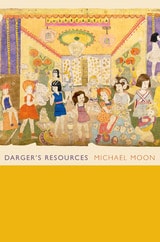
Henry Darger (1892–1973) was a hospital janitor and an immensely productive artist and writer. In the first decades of adulthood, he wrote a 15,145-page fictional epic, In the Realms of the Unreal. He spent much of the rest of his long life illustrating it in astonishing drawings and watercolors. In Darger's unfolding saga, pastoral utopias are repeatedly savaged by extreme violence directed at children, particularly girls. Given his disturbing subject matter and the extreme solitude he maintained throughout his life, critics have characterized Darger as eccentric, deranged, and even dangerous, as an outsider artist compelled to create a fantasy universe. Contesting such pathologizing interpretations, Michael Moon looks to Darger's resources, to the narratives and materials that inspired him and often found their way into his writing, drawings, and paintings. Moon finds an artist who reveled in the burgeoning popular culture of the early twentieth century, in its newspaper comic strips, pulp fiction, illustrated children's books, and mass-produced religious art. Moon contends that Darger's work deserves and rewards comparison with that of contemporaries of his, such as the "pulp historians" H. P. Lovecraft and Robert Howard, the Oz chronicler L. Frank Baum, and the newspaper cartoonist Bud Fisher.
[more]
Liberated
The Radical Art and Life of Claude CahunKaz Rowe
J. Paul Getty Trust, The, 2023
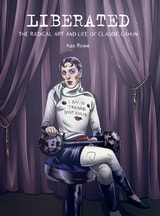
Courageous Surrealist artist Claude Cahun championed freedom at every turn, from rejecting gender norms and finding queer love to risking death to sabotage the Nazis.
At the turn of the twentieth century in Nantes, France, Lucy Schwob met Suzanne Malherbe, and lightning struck. The two became partners both artistically and romantically and transformed themselves into the creative personas Claude Cahun and Marcel Moore. Together, the couple embarked on a radical journey of Surrealist collaboration that would take them from conservative provincial France to the vibrancy of 1920s Paris to the oppression of Nazi-occupied Jersey during World War II, where they used art to undermine the Nazi regime.
Cahun and Moore challenged gender roles and championed freedom at a time when strict societal norms meant that the truth of their relationship had to remain secret. Featuring ten photographs by Cahun and Moore, this graphic biography by cartoonist Kaz Rowe brings Cahun’s inspiring story to life.
Ages thirteen to eighteen
[more]