Results by title
3 books match the query '1893-'
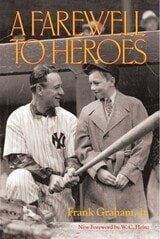
A Farewell to Heroes
Frank Graham Jr. Foreword by W.C. Heinz
Southern Illinois University Press, 2003
Originally published in 1981 and long out of print, this dual autobiography covers five unforgettable decades of the New York sporting life from 1915 to 1965. Told initially from the point of view of Frank Graham, premier sportswriter for TheNew York Sun, A Farewell to Heroes also includes the chronicles of Frank, Jr., who picks up the narrative as he becomes a sports journalist in his own right.
Frank Graham, Sr., was a self-taught writer known for his uncanny ability to capture the high drama of a game-winning play or the color of a fight mob’s conversation in spare, straightforward prose. As a reporter, he covered the rough-and-tumble Giants of John McGraw’s day and continued through boxing’s greatest era, spanning the reigns of Jack Dempsey and Joe Louis.
As the younger Frank tells more of the story, we watch Lou Gehrig take Babe Ruth’s place as the Yankees’ star and then trace his glorious career to its tragic conclusion. We see firsthand the legendary Branch Rickey and Jackie Robinson and boxing’s brief but golden age on television in the 1950s.
Aided by sixteen photographs and preserving the most masterful of his father’s writing while adding to it the best of his own, Frank Graham, Jr., has given the sports fan A Farewell to Heroes, perhaps the ultimate sports reminiscence of a time when the romance of sport gave life a golden hue, when heroes still roamed the earth.
“In what he calls this ‘kind of dual autobiography,’ he is his father’s son, having learned to look and listen as his father did and still go his own way,” says W. C. Heinz, longtime sportswriter for The New York Sun, in his new foreword to this paperback edition.
Ohio Farm
Wheeler McMillen
The Ohio State University Press, 1997
Uncomplicated when compared with the task of managing today's highly mechanized agricultural complexes, life on the early twentieth-century small farm entailed hard work and afforded simple pleasures that brought satisfaction and enjoyment to the farm and family. Farming on that scale and in the same manner has now become almost completely infeasible, yet in those times a good farmer could prosper and become independent. Wheeler McMillen’s father, Lewis, did both.
Relying frequently on his father’s account books and concise diaries, for this is primarily his father’s story, McMillen recounts the immense labor that farming demanded before the advent of the tractor and the combine harvester. He evokes the special excitements of having company for Sunday dinner, attending the annual oyster supper at the Grange Hall, and gathering on the Fourth of July with the interminable wait for darkness to fall. McMillen also portrays the quiet peace and ineffable joy of private moments, such as resting the horses during spring plowing to watch bronzed grackles search for food in the freshly turned furrows.
Wheeler McMillen’s slice of history will speak to those interested in what rural life was once like in the Midwest and to Ohioans who would like to learn more about their state’s recent past.
Realism, Utopia, and the Mushroom Cloud
Four Activist Intellectuals and their Strategies for Peace, 1945-1989--Louise Weiss (France), Leo Szilard (USA), E. P. Thompson (England), Danilo Dolci (Italy)Michael Bess
University of Chicago Press, 1993
Nagasaki, and continued preparations for nuclear war illustrate the modern
world's propensity for mass destruction. . . . Yet there have been
important signs of resistance to this trend. These have included not only
the emergence of mass-based peace and disarmament movements but activist
intellectuals grappling with the growing problem posed by mass violence
among nation-states. . . . Bess examines the lives and ideas of four of
these intellectuals: Leo Szilard of Hungary and (later) the United States,
E. P. Thompson of England, Danilo Dolci of Italy, and Louise Weiss of
France. . . . Realism, Utopia, and the Mushroom Cloud is a powerful,
important scholarly work, casting new light upon some of the great issues
of modern times. Readers will learn much from it."—Lawrence S.
Wittner, Peace and Change
"Bess seeks to understand the way in which the creation of the atomic bomb
has changed the social and political situation of humankind. Are we to be
held hostage by military forces or can we transform our situation? He
describes the lives of four very different activists, each with different
views on what causes conflict and how best to address conflict. . . .
Overall, this book offers an interesting perspective on life after the
atomic bomb. . . . In asking ourselves what the possibilities of our future
are, we can turn to these lives for some guidance. . . . This book is
informative, provocative, and encourages one to consider carefully how s/he
chooses to live."—Erin McKenna, Utopian Studies
"These four lives, researched and skillfully presented by historian Michael
Bess, make fascinating stories in themselves. They also serve as useful
vehicles for examining major cross-currents of Cold War resistance. . . .
From Weiss the cynical pragmatist to Szilard the high-level fixer to
hompson the social reformer to Dolce the spiritual street organizer,
Michael Bess has woven an illuminating tapestry of human efforts to cope
with life under the mushroom cloud."—Samuel H. Day Jr., The
Progressive