Results by title
3 books match the query '1893-1962'
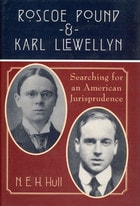
Roscoe Pound and Karl Llewellyn
Searching for an American JurisprudenceN. E. H. Hull
University of Chicago Press, 1997
American legal history is traditionally viewed as a series of schools of thought or landmark court decisions, not as the work of individuals. Here, N. E. H. Hull tells the pivotal story of American jurisprudence through two of its most influential shapers: Karl Llewellyn, father of legal realism, poet, and mercurial romantic, and Roscoe Pound, iron-willed leader of sociological jurisprudence. These theorists adapted the legal profession to the changing needs of twentieth-century America.
Through meticulous archival research, Hull shows how the intellectual battles of the day took place against a network of private and public relationships and demonstrates how Pound's and Llewellyn's ideas of jurisprudence sprang from a kind of intellectual bricolage, the pragmatic assemblage of parts rather than the development of a unified whole, that is peculiarly American. Humorous, engaging, and provocative, Roscoe Pound and Karl Llewellyn uncovers the roots of American jurisprudence in the lives of two of its most compelling figures.
Through meticulous archival research, Hull shows how the intellectual battles of the day took place against a network of private and public relationships and demonstrates how Pound's and Llewellyn's ideas of jurisprudence sprang from a kind of intellectual bricolage, the pragmatic assemblage of parts rather than the development of a unified whole, that is peculiarly American. Humorous, engaging, and provocative, Roscoe Pound and Karl Llewellyn uncovers the roots of American jurisprudence in the lives of two of its most compelling figures.
[more]
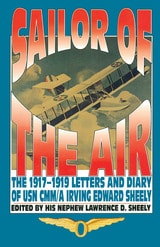
Sailor Of The Air
The 1917-1919 Letters and Diary of USN CMM/A Irving Edward SheelyLawrence D. Sheely
University of Alabama Press, 1993
In the winter of 1917, with most of the world at war, twenty-three-year-old Irving Edward Sheely of Albany, New York, enlisted in Naval Aviation and began his training at Pensacola Naval Air Station. When Congress declared ware on Germany on April 6, 1917, the combined strength of aviation within the Navy and Marine Corps was 48 officers, 239 enlisted men, 54 airplanes, one airship, and one air station.
Lieutenant Kenneth Whiting immediately recruited seven volunteer officers and 122 volunteer enlisted men with orders to go directly to France as the First Aeronautical Detachment. By June, the first organized contingent of American forces arrived in the combat zone at St. Nazaire, France—woefully unprepared to take on the mighty submarine force of Imperial Germany. Among this small detachment was Landsman Machinist Mate Second Class Irving E. Sheely.
Trained by American and foreign officers, using both American and foreign aircraft, Sheely learned aviation and aviation combat at the heart of the action. He served as Observer/Gunlayer with Navy Lieutenant Kenneth MacLeish as pilot, and the two participated in some of the first antisubmarine air patrols in history, including a sea landing to rescue a downed crew. While at Clermont-Ferrand, Sheely developed an improved bombsight, for which he was praised by MacLeish. Following the Armistice, Sheely participated in the closing of the Navy base at Eastleigh, England, and returned to the United States in November 1918.
Utilizing Sheely’s correspondence and meticulous diary spanning 19 months of training and service—mostly on foreign soil and in foreign aircraft—this book presents an unusual first person account of the wartime experience of naval aviation in World War I. Sheely’s letters and diary describe the many deprivations and inadequacies of the aviation program and show clearly the sacrifices made by the officers and enlisted men. He supplied for himself items, such as helmet and goggles, that later servicemen would expect the military to issue. In addition to wartime description, the letters reveal the young man’s concern for his family and his interest in home, so a very human story emerges.
[more]
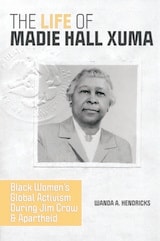
The Life of Madie Hall Xuma
Black Women's Global Activism during Jim Crow and ApartheidWanda A. Hendricks
University of Illinois Press, 2022
Revered in South Africa as "An African American Mother of the Nation," Madie Beatrice Hall Xuma spent her extraordinary life immersed in global women's activism. Wanda A. Hendricks's biography follows Hall Xuma from her upbringing in the Jim Crow South to her leadership role in the African National Congress (ANC) and beyond. Hall Xuma was already known for her social welfare work when she married South African physician and ANC activist Alfred Bitini Xuma. Becoming president of the ANC Women’s League put Hall Xuma at the forefront of fighting racial discrimination as South Africa moved toward apartheid. Hendricks provides the long-overlooked context for the events that undergirded Hall Xuma’s life and work. As she shows, a confluence of history, ideas, and organizations both shaped Hall Xuma and centered her in the histories of Black women and women’s activism, and of South Africa and the United States.
[more]