Results by title

2 books match the query '1894-1955'
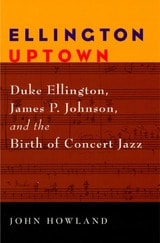
cover of Ellington Uptown: Duke Ellington, James P. Johnson, and the Birth of Concert Jazz

Ellington Uptown

Duke Ellington, James P. Johnson, and the Birth of Concert Jazz

John Howland

University of Michigan Press, 2009
During the early decades of the twentieth century symphonic jazz involved an expansive family of music that emulated, paralleled, and intersected the jazz tradition. Though now largely forgotten, symphonic jazz was both a popular music -- arranging tradition and a repertory of hybrid concert works, both of which reveled in the mildly irreverent interbreeding of white and black and high and low music. While the roots of symphonic jazz can be traced to certain black ragtime orchestras of the teens, the idiom came to maturation in the music of 1920s white dance bands. Through a close examination of the music of Duke Ellington and James P. Johnson, Ellington Uptown uncovers compositions that have usually fallen in the cracks between concert music, jazz, and popular music. It also places the concert works of these two iconic figures in context through an investigation both of related compositions by black and white peers and of symphonic jazz---style arrangements from a diverse number of early sound films, Broadway musicals, Harlem nightclub floor shows, and select interwar radio programs. Both Ellington and Johnson were part of a close-knit community of several generations of Harlem musicians. Older figures like Will Marion Cook, Will Vodery, W. C. Handy, and James Reese Europe were the generation of black musicians that initially broke New York entertainment's racial barriers in the first two decades of the century. By the 1920s, Cook, Vodery, and Handy had become mentors to Harlem's younger musicians. This generational connection is a key for understanding Johnson’s and Ellington's ambitions to use the success of Harlem's white-oriented entertainment trade as a springboard for establishing a black concert music tradition based on Harlem jazz and popular music.
[more]
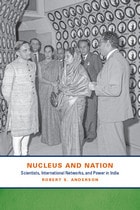
cover of Nucleus and Nation: Scientists, International Networks, and Power in India

Nucleus and Nation

Scientists, International Networks, and Power in India

Robert S. Anderson

University of Chicago Press, 2010

In 1974 India joined the elite roster of nuclear world powers when it exploded its first nuclear bomb. But the technological progress that facilitated that feat was set in motion many decades before, as India sought both independence from the British and respect from the larger world. Over the course of the twentieth century, India metamorphosed from a marginal place to a serious hub of technological and scientific innovation. It is this tale of transformation that Robert S. Anderson recounts in Nucleus and Nation.

Tracing the long institutional and individual preparations for India’s first nuclear test and its consequences, Anderson begins with the careers of India’s renowned scientists—Meghnad Saha, Shanti Bhatnagar, Homi Bhabha, and their patron Jawaharlal Nehru—in the first half of the twentieth century before focusing on the evolution of the large and complex scientific community—especially Vikram Sarabhi—in the later part of the era. By contextualizing Indian debates over nuclear power within the larger conversation about modernization and industrialization, Anderson hones in on the thorny issue of the integration of science into the framework and self-reliant ideals of Indian nationalism. In this way, Nucleus and Nation is more than a history of nuclear science and engineering and the Indian Atomic Energy Commission; it is a unique perspective on the history of Indian nationhood and the politics of its scientific community.

[more]