Results by title
2 books match the query '1894-1956'

Fred Allen's Radio Comedy
Alan Havig
Temple University Press, 1991
"A notable example of radio at its best."
--Back Stage/SHOOT
In 1954, James Thurber wrote: "You can count on the thumb of one hand the American who is at once a comedian, a humorist, a wit, and a satirist, and his name is Fred Allen." Several decades after his death and more than forty years since his radio program left the air, Fred Allen's reputation as a respected humorist remains intact. In this book, Alan Havig explores the roots of his comedy, the themes it exploited, the problems and challenges that faced the radio comedy writer, and Allen's unique success with the one-dimensional medium of radio. Tracing a career that lasted from 1912 into the 1950s and encompassed vaudeville, Broadway revues, movies, radio, and television, Havig describes the "verbal slapstick" style that was Fred Allen's hallmark and legacy to American comedy.
More than a biography of Fred Allen, this is a study of the development of the radio industry, a discussion of American humor, and the story of how one relates to the other. Using a wide variety of published and unpublished sources, including the Allen Papers, Havig analyzes Allen's radio comedy of the 1930s and 40s within the context of the peculiar advantages and limitations of radio as a medium for comedy. He argues that Allen did not merely transfer vaudeville routines to a non-visual medium as did Eddie Cantor, Ed Wynn, and others. Allen developed a comedic style that depended on word play, sound effects, and on his audience's ability and readiness to imagine a visual world in which his eccentric characters operated.
Havig illustrates his story with numerous examples of Allen's humor, with fascinating anecdotes, and excerpts from radio broadcasts. In accounting for the comedian's success, he deals with vaudeville, comedy writing, sponsor's demands and censorship of material, and the organizational world of radio broadcasting companies.
Describing radio as "an instrument of wit," Fred Allen wrote: "on radio you could do subtle writing because you had access to the imagination...that was why I liked radio. we had some fun." Readers will also have some fun remembering or discovering for the first time Allen's Alley and the magic of radio comedy in its prime.
"Fred was one of the greatest of vaudeville and radio comedians. Anyone even casually concerned with the state of American humor will be well advised to give his work, as Mr. Havig presents it, careful study."
--Steve Allen
"Alan Havig has done an intelligent, careful and exhaustive research job. This is a well-written, solid performance-biography."
--J. Fred MacDonald, Curator of the Museum of Broadcast Communication, Chicago
[more]
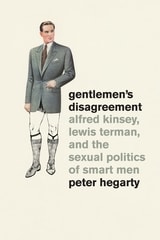
Gentlemen's Disagreement
Alfred Kinsey, Lewis Terman, and the Sexual Politics of Smart MenPeter Hegarty
University of Chicago Press, 2013
What is the relationship between intelligence and sex? In recent decades, studies of the controversial histories of both intelligence testing and of human sexuality in the United States have been increasingly common—and hotly debated. But rarely have the intersections of these histories been examined. In Gentlemen’s Disagreement, Peter Hegarty enters this historical debate by recalling the debate between Lewis Terman—the intellect who championed the testing of intelligence— and pioneering sex researcher Alfred Kinsey, and shows how intelligence and sexuality have interacted in American psychology.
Through a fluent discussion of intellectually gifted onanists, unhappily married men, queer geniuses, lonely frontiersmen, religious ascetics, and the two scholars themselves, Hegarty traces the origins of Terman’s complaints about Kinsey’s work to show how the intelligence testing movement was much more concerned with sexuality than we might remember. And, drawing on Foucault, Hegarty reconciles these legendary figures by showing how intelligence and sexuality in early American psychology and sexology were intertwined then and remain so to this day.
[more]