Results by title
5 books match the query '1894-1962'
Beleaguered Poets and Leftist Critics
Stevens, Cummings, Frost, and Williams in the 1930sMilton A. Cohen
University of Alabama Press, 2011
A critical examination of modernist poetry and the demands of leftist literary theory.
Different as they were as poets, Wallace Stevens, E. E. Cummings, Robert Frost, and William Carlos Williams grappled with the highly charged literary politics of the 1930s in comparable ways. As other writers moved sharply to the Left, and as leftist critics promulgated a proletarian aesthetics, these modernist poets keenly felt the pressure of the times and politicized literary scene. All four poets saw their reputations critically challenged in these years and felt compelled to respond to the new politics, literary and national, in distinct ways, ranging from rejection to involvement.
Beleaguered Poets and Leftist Critics closely examines the dynamics of these responses: what these four poets wrote—in letters, essays, lectures, fiction (for Williams), and most importantly, in their poems; what they believed politically and aesthetically; how critics, particularly leftist critics, reviewed their work; how these poets reacted to that criticism and to the broader milieu of leftism. Each poet’s response and its subsequent impact on his poetic output is a unique case study of the conflicting demands of art and politics in a time of great social change.

E. Franklin Frazier Reconsidered
Platt, Anthony M
Rutgers University Press, 1991
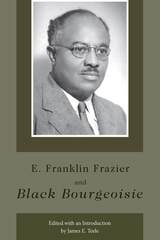
E. Franklin Frazier and Black Bourgeoisie
E. Franklin Frazier
University of Missouri Press, 2002
When E. Franklin Frazier was elected the first black president of the American Sociological Association in 1948, he was established as the leading American scholar on the black family and was also recognized as a leading theorist on the dynamics of social change and race relations. By 1948 his lengthy list of publications included over fifty articles and four major books, including the acclaimed Negro Family in the United States. Frazier was known for his thorough scholarship and his mastery of skills in both history and sociology.
With the publication of Bourgeoisie Noire in 1955 (translated in 1957 as Black Bourgeoisie), Frazier apparently set out on a different track, one in which he employed his skills in a critical analysis of the black middle class. The book met with mixed reviews and harsh criticism from the black middle and professional class. Yet Frazier stood solidly by his argument that the black middle class was marked by conspicuous consumption, wish fulfillment, and a world of make-believe. While Frazier published four additional books after 1948, Black Bourgeoisie remained by far his most controversial.
Given his status in American sociology, there has been surprisingly little study of Frazier's work. In E. Franklin Frazier and Black Bourgeoisie, a group of distinguished scholars remedies that lack, focusing on his often-scorned Black Bourgeoisie.
This in-depth look at Frazier's controversial publication is relevant to the growing concerns about racism, problems in our cities, the limitations of affirmative action, and the promise of self-help.
Modernist Travel Writing
Intellectuals AbroadDavid G. Farley
University of Missouri Press, 2010
Modernist Travel Writing argues that the travel book is a crucial genre for understanding the development of modernism in the years between the wars, despite the established view that travel writing during the interwar period was largely an escapist genre—one in which writers hearkened back to the realism of nineteenth-century literature in order to avoid interwar anxiety. Farley analyzes works that exist on the margins of modernism, generically and geographically, works that have yet to receive the critical attention they deserve, partly due to their classification as travel narratives and partly because of their complex modernist styles.
The book begins by examining the ways that travel and the emergent travel regulations in the wake of the First World War helped shape Ezra Pound’s Cantos. From there, it goes on to examine E. E. Cummings’s frustrated attempts to navigate the “unworld” of Soviet Russia in his book Eimi,Wyndham Lewis’s satiric journey through colonial Morocco in Filibusters in Barbary,and Rebecca West’s urgent efforts to make sense of the fractious Balkan states in Black Lamb and Grey Falcon. These modernist writers traveled to countries that experienced most directly the tumult of revolution, the effects of empire, and the upheaval of war during the years between World War I and World War II. Farley’s study focuses on the question of what constitutes “evidence” for Pound, Lewis, Cummings, and West as they establish their authority as eyewitnesses, translate what they see for an audience back home, and attempt to make sense of a transformed and transforming modern world.
Modernist Travel Writing makes an original contribution to the study of literary modernism while taking a distinctive look at a unique subset within the growing field of travel writing studies. David Farley’s work will be of interest to students and teachers in both of these fields as well as to early-twentieth-century literary historians and general enthusiasts of modernist studies.
Pound/Cummings
The Correspondence of Ezra Pound and E.E. CummingsBarry Ahearn, Editor
University of Michigan Press, 1996
Throughout the correspondence both poets reveal themselves and their beliefs to a remarkable degree. Pound entrusted to Cummings details of his political outlook in the 1930s and 1940s, including his opinions about Mussolini's Italy. The letters to Cummings also shed new light on the question of Pound's sanity after World War II. Although he was diagnosed as mentally unfit, the letters generally show no evidence of paranoia, only of his characteristic eccentricity.
Similarly, these letters should provoke a reevaluation of Cummings. Critics have treated Cummings's political views as either strictly private matters or merely incidental to his art. The letters, however, show that Cummings's radically conservative political opinions are wholly consistent with his poetics, and raise the question of the relation between Cummings's political principles and his enthusiasm for particular forms (and particular stars) of mass entertainment.
In addition to their political revelations, the letters are steeped in the literary climate--and literary gossip--of the times. Pound comments often and candidly on Cummings's poetry and prose; both Pound and Cummings send light verse to each other. And the poets exchange anecdotes about such figures as Henry James, Wyndham Lewis, T. S. Eliot, Edmund Grosse, Max Eastman, and Aldous Huxley, among other writers.
There is much here to interest and delight both fans and foes of Pound and Cummings. The book will be of primary importance to students and scholars of modern poetry, especially those who emphasize the intersection of literary works and political history.
Barry Ahearn is Associate Professor of English, Tulane University.