Results by title
7 books match the query '1895-'
Birkenau, The Camp Of Death
Marco Nahon
University of Alabama Press, 1989
Blazing Cane
Sugar Communities, Class, and State Formation in Cuba, 1868–1959Gillian McGillivray
Duke University Press, 2009
Focusing on sugar communities in eastern and central Cuba, McGillivray recounts how farmers and workers pushed the Cuban government to move from exclusive to inclusive politics and back again. The revolutionary caudillo networks that formed between 1895 and 1898, the farmer alliances that coalesced in the 1920s, and the working-class groups of the 1930s affected both day-to-day local politics and larger state-building efforts. Not limiting her analysis to the island, McGillivray shows that twentieth-century Cuban history reflected broader trends in the Western Hemisphere, from modernity to popular nationalism to Cold War repression.
Persian Diary, 1939-1941
Walter N. Koelz
University of Michigan Press, 1983
Reyita
The Life of a Black Cuban Woman in the Twentieth CenturyMaría de los Reyes Castillo Bueno
Duke University Press, 2000
Sensitive to and deeply knowledgeable of the systemic causes and consequences of poverty, Reyita’s testimony considers the impact of slavery on succeeding generations, her mother’s internalized racism, and Cuba’s residual discrimination. The humiliation and poverty inflicted on the black Cuban community as well as her decision to marry a white man to ensure a higher standard of living form the basis of other chapters. Reyita actively participated in the life of the community—often caring for the children of prostitutes along with her own eight children and giving herbal medicine and “spiritualist” guidance to ill or troubled neighbors. She describes her growing resistance, over five decades of marriage, to her husband’s sexism and negativity. Strong-willed and frank about her sexuality as well as her religious and political convictions, Reyita recounts joining the revolutionary movement in the face of her husband’s stern objections, a decision that added significant political purpose to her life. At book’s end, Reyita radiates gratification that her 118 descendants have many different hues of skin, enjoy a variety of professions, and—“most importantly”—are free of racial prejudice.
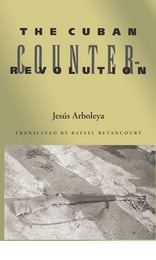
The Cuban Counterrevolution
Jesús Arboleya
Ohio University Press, 2000
For forty years the Cuban Revolution has been at the forefront of American public opinion, yet few are knowledgeable about the history of its enemies and the responsibility of the U.S. government in organizing and sustaining the Cuban counterrevolution. Available in English for the first time, this outstanding study by Cuban historian and former diplomat Jesús Arboleya traces the evolution of the counterrevolutionary movement from its beginnings before 1959, to its transformation into the Cuban-American groups that today dominate U.S. policy toward Cuba. Arboleya also analyzes the role played by Cuban immigrants to the U.S. and the perspectives for improvement in relations between the two nations as a result of the generational and social changes that have been occurring in the Cuban-American community.
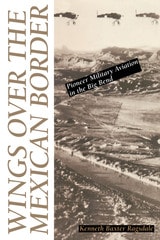
Wings over the Mexican Border
Pioneer Military Aviation in the Big BendBy Kenneth Baxter Ragsdale
University of Texas Press, 1997
Against a backdrop of revolution, border banditry, freewheeling aerial dramatics, and World War II comes this compelling look at the rise of U.S. combat aviation at an unlikely proving ground—a remote airfield in the rugged reaches of the southwestern Texas borderlands. Here, at Elmo Johnson's Big Bend ranch, hundreds of young Army Air Corps pilots demonstrated the U.S. military's reconnaissance and emergency response capabilities and, in so doing, dramatized the changing role of the airplane as an instrument of war and peace.
Kenneth Ragsdale's gripping account not only sets the United States squarely in the forefront of aerial development but also provides a reflective look at U.S.-Mexican relations of the 1920s, 1930s, and 1940s, particularly the tense days and aftermath of the Escobar Rebellion of 1929. He paints a vivid picture of the development of the U.S. aerial strike force; the character, ideals, and expectations of the men who would one day become combat leaders; and the high esteem in which U.S. citizens held the courageous pilots.
Particularly noteworthy is Ragsdale's portrait of Elmo Johnson, the Big Bend rancher, trader, and rural sage who emerges as the dominant figure at one of the most unusual facilities in the annals of the Air Corps. Wings over the Mexican Border tells a stirring story of the American frontier juxtaposed with the new age of aerial technology.

Wrapped in Beauty
The Koelz Collection of Kashmiri ShawlsGrace Beardsley in collaboration with Carla M. Sinopoli
University of Michigan Press, 2005