Results by title
7 books match the query '1898-1948'
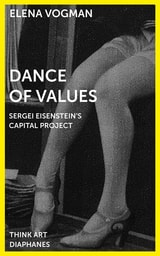
Dance of Values
Sergei Eisenstein’s Capital ProjectElena Vogman
Diaphanes, 2018
Eisenstein at 100
Edited by Al LaValley and P. Scherr
Rutgers University Press, 2001
Like many other figures once closely associated with the Soviet state, the great Russian filmmaker Sergei Eisenstein has become the subject of renewed interest. A decade after the fall of the Soviet Union, and with fresh material on his life and art now available, a more complex picture of Eisenstein is emerging. This collection-featuring the work of major film theorists and Russian scholars-offers the first post-Soviet reconsideration of Eisenstein's contribution to world cinema.
The contributors address themes previously avoided by Soviet critics, such as sexuality, religion, gender, and politics, in The Battleship Potemkin, October, Alexander Nevsky, and Ivan the Terrible. These films and others are also reassessed in light of a more thorough knowledge of Eisenstein’s life and of the complicated historical, cultural, and political contexts in which he worked. Of particular concern here is Eisenstein’s struggle with Soviet censorship, which resulted in a tenuous balance between the pressures of the state and his goals as an artist. Essays explore the manner in which Eisenstein’s later theoretical writings reveal continuity with the more well known earlier work, issues of historical revisionism, and the relationship between autobiography and the films. Eisenstein’s undeniable influence on his contemporaries and subsequent generations, as well as his reception by the film community and the public, are illuminated.
Rather than fostering the popular image of Eisenstein as the “inventor” of film montage, the director of Potemkin, and the enthusiastic early supporter of the Bolsheviks, Eisenstein at 100 presents a much richer and more profound picture of Eisenstein the man, the director, and the film theorist.
Eisenstein, Cinema, and History
James Goodwin
University of Illinois Press, 1993
stands alone as the maker of a fully historical cinema. James Goodwin treats
issues of revolutionary history and historical representation as central to
an understanding of Eisentein's work, which explores two movements within Soviet
history and consciousness: the Bolshevik Revolution and the Stalinist state.
Goodwin articulates intersections
between Eisentein's ideas and aspects of the thought of Walter Benjamin, Georg
Lukács, Ernst Bloch, and Bertolt Brecht. He also shows how the formal
properties and filmic techniques of each work reveal perspectives on history
. Individual chapters focus on Strike, Battleship Potemkin, October, Old
and New, projects of the 1930s, Alexander Nevsky, and Ivan the
Terrible.
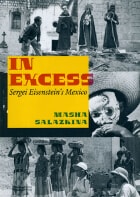
In Excess
Sergei Eisenstein's MexicoMasha Salazkina
University of Chicago Press, 2009
During the 1920s and ’30s, Mexico attracted an international roster of artists and intellectuals—including Orson Welles, Katherine Anne Porter, and Leon Trotsky—who were drawn to the heady tumult engendered by battling cultural ideologies in an emerging center for the avant-garde. Against the backdrop of this cosmopolitan milieu, In Excess reconstructs the years that the renowned Soviet director Sergei Eisenstein spent in the country to work on his controversial film ¡Que Viva Mexico!
Illuminating the inextricability of Eisenstein’s oeuvre from the global cultures of modernity and film, Masha Salazkina situates this unfinished project within the twin contexts of postrevolutionary Mexico and the ideas of such contemporaneous thinkers as Walter Benjamin. In doing so, Salazkina explains how Eisenstein’s engagement with Mexican mythology, politics, and art deeply influenced his ideas, particularly about sexuality. She also uncovers the role Eisenstein’s bisexuality played in his creative thinking and identifies his use of the baroque as an important turn toward excess and hybrid forms. Beautifully illustrated with rare photographs, In Excess provides the most complete genealogy available of major shifts in this modern master’s theories and aesthetics.
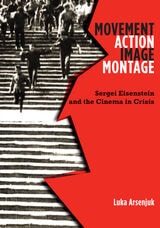
Movement, Action, Image, Montage
Sergei Eisenstein and the Cinema in CrisisLuka Arsenjuk
University of Minnesota Press, 2018
A major new study of Sergei Eisenstein delivers fresh, in-depth analyses of the iconic filmmaker’s body of work
What can we still learn from Sergei Eisenstein? Long valorized as the essential filmmaker of the Russian Revolution and celebrated for his indispensable contributions to cinematic technique, Eisenstein’s relevance to contemporary culture is far from exhausted. In Movement, Action, Image, Montage, Luka Arsenjuk considers the auteur as a filmmaker and a theorist, drawing on philosophers such as Georg Wilhelm Friedrich Hegel and Gilles Deleuze—as well as Eisenstein’s own untranslated texts—to reframe the way we think about the great director and his legacy.
Focusing on Eisenstein’s unique treatment of the foundational concepts of cinema—movement, action, image, and montage—Arsenjuk invests each aspect of the auteur’s art with new significance for the twenty-first century. Eisenstein’s work and thought, he argues, belong as much to the future as the past, and both can offer novel contributions to long-standing cinematic questions and debates.
Movement, Action, Image, Montage brings new elements of Eisenstein’s output into academic consideration, by means ranging from sustained and comprehensive theorization of Eisenstein’s practice as a graphic artist to purposeful engagement with his recently published, unfinished book Method, still unavailable in English translation. This tour de force offers new and significant insights on Eisenstein’s oeuvre—the films, the art, and the theory—and is a landmark work on an essential filmmaker.
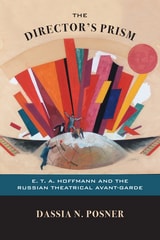
The Director's Prism
E. T. A. Hoffmann and the Russian Theatrical Avant-GardeDassia N. Posner
Northwestern University Press, 2016
Shortlist, 2019 Prague Quadrennial Best Scenography and Design Publication Award
The Director's Prism investigates how and why three of Russia's most innovative directors— Vsevolod Meyerhold, Alexander Tairov, and Sergei Eisenstein—used the fantastical tales of German Romantic writer E. T. A. Hoffmann to reinvent the rules of theatrical practice. Because the rise of the director and the Russian cult of Hoffmann closely coincided, Posner argues, many characteristics we associate with avant-garde theater—subjective perspective, breaking through the fourth wall, activating the spectator as a co-creator—become uniquely legible in the context of this engagement. Posner examines the artistic poetics of Meyerhold's grotesque, Tairov's mime-drama, and Eisenstein's theatrical attraction through production analyses, based on extensive archival research, that challenge the notion of theater as a mirror to life, instead viewing the director as a prism through whom life is refracted. A resource for scholars and practitioners alike, this groundbreaking study provides a fresh, provocative perspective on experimental theater, intercultural borrowings, and the nature of the creative process.
United States–Latin American Relations, 1850–1903
Establishing a RelationshipEdited by Thomas M. Leonard
University of Alabama Press, 1999
United States–Latin American Relations, 1850–1903 is a collection of essays that provide an in-depth analysis of the developing relationship between the Americas during the critical period from the Mexican War to the Panama Canal treaty of 1903.
During the second half of the 19th century several forces in the United States, Latin America, and Europe converged to set the stage for the establishment of a more permanent relationship between the United States and Latin America. The key factors--security, economics, and modernization--created both commonalities and conflicts between and among regions. In this volume, scholars examine not only the domestic but also the geopolitical forces that encouraged and guided development of diplomatic relations in this rapidly changing period.
As the contributors note, by the end of the century, economic interests dominated the relationship that eventually developed. This period saw the building of a string of U.S. naval bases in Latin America and the Caribbean, the rapid industrialization of the United States and the development of a substantial export market, the entrance of many U.S. entrepreneurs into Latin American countries, and the first two inter-American conferences. By the century's end, the United States appeared as the dominant partner in the relationship, a perception that earned it the "imperialist" label.
This volume untangles this complex relationship by examining U.S. relations with Mexico, Cuba, Colombia, Central America, Peru, Argentina, Chile, Brazil, Uruguay, and Paraguay from the perspective of both the United States and the individual Latin American countries.
A companion volume to United States-Latin American Relations, 1800-1850: The Formative Generations, edited by T. Ray Shurbutt, this book establishes a historical perspective crucial to understanding contemporary diplomatic relations.