Results by title
7 books match the query '1898-1976'
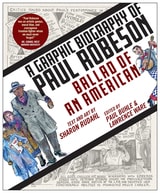
Ballad of an American
A Graphic Biography of Paul RobesonSharon Rudahl
Rutgers University Press, 2021
The first-ever graphic biography of Paul Robeson, Ballad of an American, charts Robeson’s career as a singer, actor, scholar, athlete, and activist who achieved global fame. Through his films, concerts, and records, he became a potent symbol representing the promise of a multicultural, multiracial American democracy at a time when, despite his stardom, he was denied personal access to his many audiences.
Robeson was a major figure in the rise of anti-colonialism in Africa and elsewhere, and a tireless campaigner for internationalism, peace, and human rights. Later in life, he embraced the civil rights and antiwar movements with the hope that new generations would attain his ideals of a peaceful and abundant world. Ballad of an American features beautifully drawn chapters by artist Sharon Rudahl, a compelling narrative about his life, and an afterword on the lasting impact of Robeson’s work in both the arts and politics. This graphic biography will enable all kinds of readers—especially newer generations who may be unfamiliar with him—to understand his life’s story and everlasting global significance.
Ballad of an American: A Graphic Biography of Paul Robeson is published in conjunction with Rutgers University’s centennial commemoration of Robeson’s 1919 graduation from the university.
Study guide for Ballad of an American: A Graphic Biography of Paul Robeson (https://d3tto5i5w9ogdd.cloudfront.net/wp-content/uploads/2021/05/10201015/YA_Adult-Study-Guide-for-A-Graphic-Biography-of-Paul-Robeson.pdf).
View the blad for Ballad of an American.
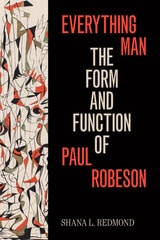
Everything Man
The Form and Function of Paul RobesonShana L. Redmond
Duke University Press, 2020
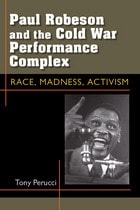
Paul Robeson and the Cold War Performance Complex
Race, Madness, ActivismTony Perucci
University of Michigan Press, 2012
Actor and singer Paul Robeson's performances in Othello, Show Boat, and The Emperor Jones made him famous, but his midcentury appearances in support of causes ranging from labor and civil rights to antilynching and American warmongering made him notorious. When Robeson announced at the 1949 Paris Peace Conference that it was "unthinkable" for blacks to go to war against the Soviet Union, the mainstream American press declared him insane.
Notions of Communism, blackness, and insanity were interchangeably deployed during the Cold War to discount activism such as Robeson's, just a part of an array of social and cultural practices that author Tony Perucci calls the Cold War performance complex. Focusing on two key Robeson performances---the concerts in Peekskill, New York, in 1949 and his appearance before the House Committee on Un-American Activities in 1956---Perucci demonstrates how these performances and the government's response to them are central to understanding the history of Cold War culture in the United States. His book provides a transformative new perspective on how the struggle over the politics of performance in the 1950s was also a domestic struggle over freedom and equality. The book closely examines both of these performance events as well as artifacts from Cold War culture---including congressional documents, FBI files, foreign policy papers, the popular literature on mental illness, and government propaganda films---to study the operation of power and activism in American Cold War culture.
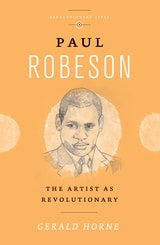
Paul Robeson
The Artist as RevolutionaryGerald Horne
Pluto Press, 2015
“A fine, taut analysis of the great African American athlete, singer, actor, and political activist.”
—Choice, Highly Recommended
Paul Robeson should be remembered today as the forerunner of Malcolm X, Dr. Martin Luther King, Jr. and Muhammad Ali. He sacrificed his fame and fortune a performer and athlete in order to fight for the rights of African Americans during the time of Jim Crow and U.S. Apartheid.
A world-famous singer and actor, a trained lawyer, an early star of American professional football and a polyglot who spoke over a dozen languages: these could be the crowning achievements of a life well-lived. Yet for Paul Robeson the higher calling of social justice led him to abandon both the NFL and Hollywood and become one of the most important political activists of his generation, a crusader for freedom and equality who battled both Jim Crow and US Senator Joseph McCarthy during the communist witch hunt of the 1950s.
In Paul Robeson: The Artist as Revolutionary, Gerald Horne discovers within Robeson's remarkable and revolutionary life the story of the twentieth century's great political struggles: against racism, against colonialism, against poverty—and for international socialism. Chapters include:
*”The Best Known American in the World"
*Rising Revolutionary
*From Moscow to Madrid
*"Black Stalin"?
*Robeson: Primary Victim of the "Blacklist"
*Triumph—and Tragedy
*Death of a Revolutionary
In the Introduction, Horne writes: “Paul Robeson—activist, artist, athlete—experienced a dramatic rise and fall, perhaps unparalleled in U.S. history. From mingling with the elite of London society and Hollywood in the 1930s, by the time he died in 1976, he was a virtual recluse in a plain abode in a working-class neighborhood of Philadelphia. What helps to explicate this tragic art of his life is a fateful decision he made when fascism was rising: he threw in his lot with those battling for socialism and decide to sacrifice his thriving artistic career on behalf of the struggle against Jim Crow—or U.S. apartheid.”
This critical and searching biography provides an opportunity for readers to comprehend the triumphs and tragedies of the revolutionary progressive movement of which Paul Robeson was not just a part, but perhaps its most resonant symbol.
The Aftermath of War
Jean-Paul Sartre
Seagull Books, 2008
The Lysenko Affair
David Joravsky
University of Chicago Press, 1970
"A standard source both for Soviet specialists and for sociologists of science."—American Journal of Sociology
"Joravsky has produced . . . the most detailed and authoritative treatment of Lysenko and his view on genetics."—New York Times Book Review
The Pseudoscience Wars
Immanuel Velikovsky and the Birth of the Modern FringeMichael D. Gordin
University of Chicago Press, 2012