Results by title
2 books match the query '1900 - 1945'
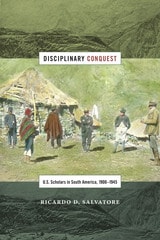
Disciplinary Conquest
U.S. Scholars in South America, 1900–1945Ricardo D. Salvatore
Duke University Press, 2016
In Disciplinary Conquest Ricardo D. Salvatore rewrites the origin story of Latin American studies by tracing the discipline's roots back to the first half of the twentieth century. Salvatore focuses on the work of five representative U.S. scholars of South America—historian Clarence Haring, geographer Isaiah Bowman, political scientist Leo Rowe, sociologist Edward Ross, and archaeologist Hiram Bingham—to show how Latin American studies was allied with U.S. business and foreign policy interests. Diplomats, policy makers, business investors, and the American public used the knowledge these and other scholars gathered to build an informal empire that fostered the growth of U.S. economic, technological, and cultural hegemony throughout the hemisphere. Tying the drive to know South America to the specialization and rise of Latin American studies, Salvatore shows how the disciplinary conquest of South America affirmed a new mode of American imperial engagement.
[more]
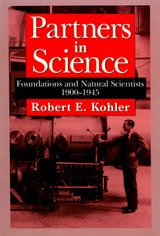
Partners in Science
Foundations and Natural Scientists, 1900-1945Robert E. Kohler
University of Chicago Press, 1991
Robert Kohler shows exactly how entrepreneurial academic scientists became intimate "partners in science" with the officers of the large foundations created by John D. Rockefeller and Andrew Carnegie, and in so doing tells a fascinating story of how the modern system of grant-getting and grant-giving evolved, and how this funding process has changed the way laboratory scientists make their careers and do their work.
"This book is a rich historical tapestry of people, institutions and scientific ideas. It will stand for a long time as a source of precise and detailed information about an important aspect of the scientific enterprise. . .It also contains many valuable lessons for the coming years."—John Ziman, Times Higher Education Supplement
"This book is a rich historical tapestry of people, institutions and scientific ideas. It will stand for a long time as a source of precise and detailed information about an important aspect of the scientific enterprise. . .It also contains many valuable lessons for the coming years."—John Ziman, Times Higher Education Supplement
[more]