Results by title
2 books match the query '1900 - 1955'

English Pastoral Music
From Arcadia to Utopia, 1900-1955Eric Saylor
University of Illinois Press, 2017
Covering works by popular figures like Ralph Vaughan Williams and Gustav Holst as well as less familiar English composers, Eric Saylor's pioneering book examines pastoral music's critical, theoretical, and stylistic foundations alongside its creative manifestations in the contexts of Arcadia, war, landscape, and the Utopian imagination. As Saylor shows, pastoral music adapted and transformed established musical and aesthetic conventions that reflected the experiences of British composers and audiences during the early twentieth century. By approaching pastoral music as a cultural phenomenon dependent on time and place, Saylor forcefully challenges the body of critical opinion that has long dismissed it as antiquated, insular, and reactionary.
[more]
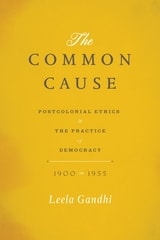
The Common Cause
Postcolonial Ethics and the Practice of Democracy, 1900-1955Leela Gandhi
University of Chicago Press, 2014
Europeans and Americans tend to hold the opinion that democracy is a uniquely Western inheritance, but in The Common Cause, Leela Gandhi recovers stories of an alternate version, describing a transnational history of democracy in the first half of the twentieth century through the lens of ethics in the broad sense of disciplined self-fashioning. Gandhi identifies a shared culture of perfectionism across imperialism, fascism, and liberalism—an ethic that excluded the ordinary and unexceptional. But, she also illuminates an ethic of moral imperfectionism, a set of anticolonial, antifascist practices devoted to ordinariness and abnegation that ranged from doomed mutinies in the Indian military to Mahatma Gandhi’s spiritual discipline.
Reframing the way we think about some of the most consequential political events of the era, Gandhi presents moral imperfectionism as the lost tradition of global democratic thought and offers it to us as a key to democracy’s future. In doing so, she defends democracy as a shared art of living on the other side of perfection and mounts a postcolonial appeal for an ethics of becoming common.
Reframing the way we think about some of the most consequential political events of the era, Gandhi presents moral imperfectionism as the lost tradition of global democratic thought and offers it to us as a key to democracy’s future. In doing so, she defends democracy as a shared art of living on the other side of perfection and mounts a postcolonial appeal for an ethics of becoming common.
[more]