Results by title

5 books match the query '1900-1990'
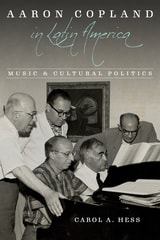
cover of Aaron Copland in Latin America: Music and Cultural Politics

Aaron Copland in Latin America

Music and Cultural Politics

Carol A. Hess

University of Illinois Press, 2023

Between 1941 and 1963, Aaron Copland made four government-sponsored tours of Latin America that drew extensive attention at home and abroad. Interviews with eyewitnesses, previously untapped Latin American press accounts, and Copland’s diaries inform Carol A. Hess’s in-depth examination of the composer’s approach to cultural diplomacy. As Hess shows, Copland’s tours facilitated an exchange of music and ideas with Latin American composers while capturing the tenor of United States diplomatic efforts at various points in history. In Latin America, Copland’s introduced works by U.S. composers (including himself) through lectures, radio broadcasts, live performance, and conversations. Back at home, he used his celebrity to draw attention to regional composers he admired. Hess’s focus on Latin America’s reception of Copland provides a variety of outside perspectives on the composer and his mission. She also teases out the broader meanings behind reviews of Copland and examines his critics in the context of their backgrounds, training, aesthetics, and politics.
[more]
cover of Aaron Copland: The Life and Work of an Uncommon Man

Aaron Copland

The Life and Work of an Uncommon Man

Howard Pollack

University of Illinois Press, 1999

One of America's most beloved and accomplished composers, Aaron Copland played a crucial role in American music's coming of age. Indeed, Copland masterworks like Appalachian Spring and A Lincoln Portrait only begin to tell the epic story of a career spent composing a wealth of music for opera, ballet, chorus, orchestra, chamber ensemble, band, radio, and film.

Howard Pollack's expansive biography examines Copland's long list of accomplishments while also telling the story of the composer's musical development, political sympathies, personal life, relationships as an openly gay man, and tireless encouragement of younger composers. A winner of the Pulitzer Prize and an Academy Award, Copland played a vital role in the Yaddo Festival and as a beloved teacher at Tanglewood, Harvard, and the New School for Social Research. He turned to conducting later in life and via tours promoted American classical music overseas while taking it to appreciative audiences across the United States.
[more]
cover of The American Stravinsky: The Style and Aesthetics of Copland's New American Music, the Early Works, 1921-1938

The American Stravinsky

The Style and Aesthetics of Copland's New American Music, the Early Works, 1921-1938

Gayle Murchison

University of Michigan Press, 2013

One of the country's most enduringly successful composers, Aaron Copland created a distinctively American style and aesthetic in works for a diversity of genres and mediums, including ballet, opera, and film. Also active as a critic, mentor, advocate, and concert organizer, he played a decisive role in the growth of serious music in the Americas in the twentieth century.

In The American Stravinsky, Gayle Murchison closely analyzes selected works to discern the specific compositional techniques Copland used, and to understand the degree to which they derived from European models, particularly the influence of Igor Stravinsky. Murchison examines how Copland both Americanized these models and made them his own, thereby finding his own compositional voice. Murchison also discusses Copland's aesthetics of music and his ideas about its purpose and social function.
[more]
cover of Tonality as Drama: Closure and Interruption in Four Twentieth-Century American Operas

Tonality as Drama

Closure and Interruption in Four Twentieth-Century American Operas

Edward D. Latham

University of North Texas Press, 2008
[more]
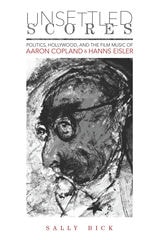
cover of Unsettled Scores: Politics, Hollywood, and the Film Music of Aaron Copland and Hanns Eisler

Unsettled Scores

Politics, Hollywood, and the Film Music of Aaron Copland and Hanns Eisler

Sally Bick

University of Illinois Press, 2019

The Hollywood careers of Aaron Copland and Hanns Eisler brought the composers and their high art sensibility into direct conflict with the premier producer of America's potent mass culture. Drawn by Hollywood's potential to reach—and edify—the public, Copland and Eisler expertly wove sophisticated musical ideas into Hollywood and, each in their own distinctive way, left an indelible mark on movie history. Sally Bick's dual study of Copland and Eisler pairs interpretations of their writings on film composing with a close examination of their first Hollywood projects: Copland's music for Of Mice and Men and Eisler's score for Hangmen Also Die! Bick illuminates the different ways the composers treated a film score as means of expressing their political ideas on society, capitalism, and the human condition. She also delves into Copland's and Eisler's often conflicted attempts to adapt their music to fit Hollywood's commercial demands, an enterprise that took place even as they wrote hostile critiques of the film industry.
[more]