Results by title
3 books match the query '1901-1973'
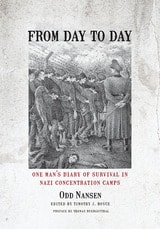
From Day to Day
One Man's Diary of Survival in Nazi Concentration CampsOdd Nansen
Vanderbilt University Press, 2016
Nansen, a Norwegian, was arrested in 1942 by the Nazis, and spent the remainder of World War II in concentration camps--Grini in Oslo, Veidal above the Arctic Circle, and Sachsenhausen in Germany. For three and a half years, Nansen kept a secret diary on tissue-paper-thin pages later smuggled out by various means, including inside the prisoners' hollowed-out breadboards.
Unlike writers of retrospective Holocaust memoirs, Nansen recorded the mundane and horrific details of camp life as they happened, "from day to day." With an unsparing eye, Nansen described the casual brutality and random terror that was the fate of a camp prisoner. His entries reveal his constantly frustrated hopes for an early end to the war, his longing for his wife and children, his horror at the especially barbaric treatment reserved for Jews, and his disgust at the anti-Semitism of some of his fellow Norwegians. Nansen often confronted his German jailors with unusual outspokenness and sometimes with a sense of humor and absurdity that was not appreciated by his captors.
After the Putnam's edition received rave reviews in 1949, the book fell into obscurity. In 1956, in response to a poll about the "most undeservedly neglected" book of the preceding quarter-century, Carl Sandburg singled out From Day to Day, calling it "an epic narrative," which took "its place among the great affirmations of the power of the human spirit to rise above terror, torture, and death." Indeed, Nansen witnessed all the horrors of the camps, yet still saw hope for the future. He sought reconciliation with the German people, even donating the proceeds of the German edition of his book to German refugee relief work. Nansen was following in the footsteps of his father, Fridtjof, an Arctic explorer and humanitarian who was awarded the Nobel Peace Prize in 1922 for his work on behalf of World War I refugees. (Fridtjof also created the "Nansen passport" for stateless persons.)
Forty sketches of camp life and death by Nansen, an architect and talented draftsman, provide a sense of immediacy and acute observation matched by the diary entries. The preface is written by Thomas Buergenthal, who was "Tommy," the ten-year-old survivor of the Auschwitz Death March, whom Nansen met at Sachsenhausen and saved using his extra food rations. Buergenthal, author of A Lucky Child, formerly served as a judge on the International Court of Justice at The Hague and is a recipient of the 2015 Elie Wiesel Award from the US Holocaust Memorial Museum.
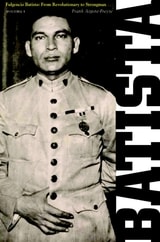
Fulgencio Batista
The Making of a DictatorArgote-Freyre, Frank
Rutgers University Press, 2000
Pawn of the U.S. government. Right-hand man to the mob. Iron-fisted dictator. For decades, public understanding of the pre-Revolutionary Cuban dictator Fulgencio Batista has been limited to these stereotypes. While on some level they all contain an element of truth, these superficial characterizations barely scratch the surface of the complex and compelling career of this important political figure.
Second only to Fidel Castro, Batista is the most controversial leader in modern Cuban history. And yet, until now, there has been no objective biography written about him. Existing biographical literature is predominantly polemical and either borders on hero worship or launches a series of attacks aimed at denigrating his entire legacy.
In this book, the first of two volumes, Frank Argote-Freyre provides a full and balanced portrait of this historically shadowed figure. He describes Batista's rise to power as part of a revolutionary movement and the intrigues and dangers that surrounded him. Drawing on an extensive review of Cuban newspapers, government records, memos, oral history interviews, and a selection of Batista's personal documents, Argote-Freyre moves beyond simplistic caricatures to uncover the real man-one with strengths and weaknesses and with a career marked by accomplishments as well as failures.
This volume focuses on Batista's role as a revolutionary leader from 1933 to 1934 and his image as a "strongman" in the years between 1934 and 1939. Argote-Freyre also uses Batista as an interpretive prism to review an entire era that is usually ignored by scholars-the Republican period of Cuban history. Bringing together global and local events, he considers the significance and relationship of the worldwide economic depression, the beginnings of World War II, and in Cuba, the Revolution of 1933, the expansion of the middle class, and the gradual development of democratic institutions.
Fulgencio Batista and most of Cuba's past prior to the Revolution of 1959 has been lost in the historical mists. Cuba had a rich and fascinating history before the Marxist Revolution and the reign of Fidel Castro. This captivating and long-overdue book uncovers it.

The Convict and the Colonel
A Story of Colonialism and Resistance in the CaribbeanRichard Price
Duke University Press, 2006
In a stunning combination of scholarship and storytelling, the award-winning anthropologist Richard Price draws on long-term ethnography, archival documents, cinema and street theater, and Caribbean fiction and poetry to explore how one generation’s powerful historical metaphors could so quickly become the next generation’s trivial pursuit, how memories of oppression, inequality, and struggle could so easily become replaced by nostalgia, complicity, and celebration.
“A superb callaloo of a book. . . . Richard Price has a remarkable grasp of the literatures of the Caribbean, and draws on this resource to explore the underlying insanity of the colonial experience, as well as the bewildering complexities of the postcolonial world where memory is erased or invented according to the demands of a market modernity.”—George Lamming, author of The Pleasures of Exile
“By beautifully crafting elements as disparate as biographical data, sociological studies, literary sources, and archival documents, Richard Price’s research is more fascinating than a piece of fiction.”—Maryse Condé, author of I, Tituba, Black Witch of Salem
“Price does it again. Mixing eras, genres, and voices, he carries the reader through the contradictory streams of historical consciousness in the Caribbean island of Martinique. The result is as complex and as enticing as the sea it evokes.”—Michel-Rolph Trouillot, author of Silencing the Past
“Filled with insights that are at once theoretical, methodological, and ethnographic, The Convict and the Colonel is required reading for anyone interested in colonialism, memory, and contemporary Caribbean societies.”—Jennifer Cole, American Ethnologist