Results by title
10 books match the query '1902-'
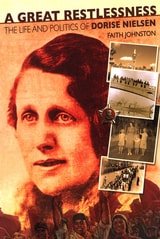
A Great Restlessness
The Life and Politics of Dorise NielsenFaith Johnston
University of Manitoba Press, 2006

A Memoir
John A. Hannah
Michigan State University Press, 1980
This is a very personal look at the growth and evolution of Michigan State University, as seen from the eyes of its dynamic president. As twelfth president of Michigan State University, John Alfred Hannah served from July 1, 1941, to April 1, 1969. His tenure was characterized by extensive growth of the University, in both size and enrollments. President Hannah's activities were not limited to the University, as he filled a variety of positions in both the federal government and private industry.
Disturbing Indians
The Archaeology of Southern FictionAnnette Trefzer
University of Alabama Press, 2007
How Faulkner, Welty, Lytle, and Gordon reimagined and reconstructed the Native American past in their work.
In this book, Annette Trefzer argues that not only have Native Americans played an active role in the construction of the South’s cultural landscape—despite a history of colonization, dispossession, and removal aimed at rendering them invisible—but that their under-examined presence in southern literature also provides a crucial avenue for a post-regional understanding of the American South. William Faulkner, Eudora Welty, Andrew Lytle, and Caroline Gordon created works about the Spanish conquest of the New World, the Cherokee frontier during the Revolution, the expansion into the Mississippi Territory, and the slaveholding societies of the American southeast. They wrote 100 years after the forceful removal of Native Americans from the southeast but consistently returned to the idea of an "Indian frontier," each articulating a different vision and discourse about Native Americans—wholesome and pure in the vision of some, symptomatic of hybridity and universality for others.
Trefzer contends that these writers engage in a double discourse about the region and nation: fabricating regional identity by invoking the South’s "native" heritage and pointing to issues of national guilt, colonization, westward expansion, and imperialism in a period that saw the US sphere of influence widen dramatically. In both cases, the "Indian" signifies regional and national self-definitions and contributes to the shaping of cultural, racial, and national "others." Trefzer employs the idea of archeology in two senses: quite literally the excavation of artifacts in the South during the New Deal administration of the 1930s (a surfacing of material culture to which each writer responded) and archeology as a method for exploring texts she addresses (literary digs into the textual strata of America’s literature and its cultural history).

Frank Waters
Man and MysticVine Deloria Jr.
Ohio University Press, 1993
“In addition to his accomplishments as a talented novelist, a thorough historian, and an excellent essayist, Frank Waters is that rare breed of man who has merged heart and mind early in his life and moved forward to confront ultimate questions. This dilemma of faith and heritage, religion and identity, and commitment and comfort has never been resolved intellectually. Even with profound faith and rigorous discipline of self, mystics have found it difficult to resolve through action and prayer…I look at the life and writing of Frank Waters…and find…a remarkable journey of inquiry spanning nearly a century and illuminating questions which I did not think possible to formulate.”
—Vine Deloria, Jr., editor
Contributors to this volume are Alvin M. Josephy, Jr., Bobby Bridger, Steven Wall, Will Wright, William Eastlake, Larry Evers, David Jongeward, Max Evans, Win Blevins, Barbara Waters, Rudolfo Anaya, Thomas J. Lyon, Joe Gordon, Robert Kostka, Charles Adams, Father Peter J. Powell, Quay Grigg, Alexander Blackburn, and T. N. Luther.

Gudrun’s Kitchen
Recipes from a Norwegian FamilyIrene O. Sandvold
Wisconsin Historical Society Press, 2011
The youngest of a large Norwegian immigrant family, Gudrun Thue Sandvold was known for her beaming blue eyes and a reserve that gave way to laughter whenever she got together with her sisters. She took immeasurable pride in her children and grandchildren, kept an exquisite home, and turned the most mundane occasion into a party. And to all who knew her, Gudrun’s cooking was the stuff of legend.
Part cookbook, part immigrant story, and part family memoir, Gudrun's Kitchen features hundreds of Gudrun Sandvold’s recipes for comfort food from a time when families and friends gathered at the table and connected with one another every single day. But this book is much more than a guide to Norwegian culinary traditions; it is an important contribution to immigrant history and a vital documentation of our nation’s multicultural heritage.

Kusiq
An Eskimo Life History from the Arctic Coast of Alaska.Waldo Bodfish Sr.
University of Alaska Press, 1991
(Journal of the West)
A vivid 'inside' account of an observant Eskimo male who mastered much of the traditional subsistence technology and lore and who lived through the end of commercial whaling, the development and decline of introduced reindeer herding and the fur market, and through World War II and its aftermath. In its scope as well as in the presentation of historical, cultural, and linguistic context,Kusiq is far more extensive than [other] autobiographies.
(American Indian Culture and Research Journal)
Kusiq represents a new wave in literature, the expressions of cultural awakenings among native American cultures, the attempt to redefine the native world in written form, to recast history, a history for too long the domain of the white system.
(ARCTIC)
It would be difficult to find a better, more interesting first-person account of Eskimo life during the first half of this century. [It is] second in an ambitious series of oral histories developed by the University of Alaska Press.
(Scan-A-Book)
The collaborators for this book include William Schneider, curator of oral history at the Elmer E. Rasmuson Library, University of Alaska Fairbanks; Leona Kisautaq Okakok, manager of the Arctic Education Foundation at the Arctic Slope Regional Corporation; and James Mumigana Nageak, coordinator of bilingual and multicultural instruction at the North Slope Borough School District. Schneider recorded and compiled Bodfish's stories, while Okakok and Nageak, both Inupiaq Eskimo language specialists, contributed their skills in interviewing, translating, and clarifying Inupiaq concepts. The book contains twelve chapters of Bodfish's narrative, background and commentary by the collaborators, and information on pronunciation, personal names, genealogical relations, and place names.

Max Lerner
Pilgrim in the Promised LandSanford Lakoff
University of Chicago Press, 1998
Politically, Lerner went through a series of metamorphoses. During the 1930s, he was an anti-fascist "popular front progressive" writing for the Nation and the New Republic. From the 1940s through the 1970s, he became the country's leading liberal columnist—first with the lively but short-lived PM, then for the New York Post. In the 1980s, however, he was repelled by the New Left and the counterculture and joined the ranks of the neoconservatives, scandalizing some readers but insisting he owed it to them to tell the truth as he saw it.
This riveting biography begins with Lerner's own gripping account of the hardships his family endured in emigrating from Russia and his own boyhood triumphs and frustrations. Sanford Lakoff traces Lerner's American pilgrimage from his education at Yale, where he felt the bitter sting of anti-Semitism, through his years as a radical inspired by Thorstein Veblen, into mellower maturity as a widely read columnist, an inspiring teacher, the author of America as a Civilization, a much-loved father, and—to the end—an unapologetic romantic, who liked to say that he never learned anything worth knowing except from women.

My Father Said Yes
A White Pastor in Little Rock School IntegrationDunbar H. Ogden
Vanderbilt University Press, 2008
My Father Said Yes is the untold story of the Reverend Dunbar Ogden, who became the pro-integration leader in Little Rock's white community. He responded to a call for support from Daisy Bates, co-owner of the town's black newspaper. Both faced fierce opposition from within as well as from outside. Reverend Ogden lost his church and Daisy Bates lost her newspaper.
This memoir is also a moving father-son story. In this frank account, the author discusses the depression his father battled for most of his life, as well as the family tragedy of his brother's suicide.
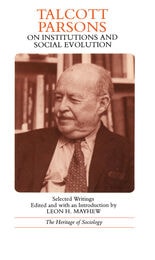
Talcott Parsons on Institutions and Social Evolution
Selected WritingsTalcott Parsons
University of Chicago Press, 1983
In his extensive introduction to this volume, Leon H. Mayhew brings a new focus and clarity to Talcott Parsons's work. Explicating Parsons on his own terms, Mayhew discusses the basic tools of Parsonian analysis and interprets the larger themes of his work. He provides a chronological account of the development of Parsons's thought, his presuppositions, and his position on the ideological spectrum of social thought.
Mayhew then presents twenty of Parsons's essays, touching on each of the major aspects of his work, including "action" theory and the celebrated four-function scheme. Other topics covered include the role of theory in social research, evolutionary universals in society, influence, control, and the mass media.
"Talcott Parsons on Institutions and Social Evolution will become a standard reference for those studying that development of his sociological ideas."—Martin Bulmer, The Times Higher Education Supplement

The Secret of the Hardy Boys
Leslie McFarlane and the Stratemeyer SyndicateMarilyn S. Greenwald
Ohio University Press, 2004
For generations of readers, the Hardy Boys were the creations of the legendary Franklin W. Dixon—except Dixon never existed. Behind the iconic series stood the Stratemeyer Syndicate, a powerhouse of children’s publishing, and one gifted but largely unrecognized writer: Leslie McFarlane.
In The Secret of the Hardy Boys, acclaimed biographer Marilyn S. Greenwald uncovers the remarkable story of the man who first brought Frank and Joe Hardy to life. A young Canadian journalist with ambitions beyond formula fiction, McFarlane infused the Syndicate’s rigid plots with wit, atmosphere, and narrative vitality—helping to shape one of the most enduring franchises in children’s literature.
Bound by contract and reluctant to claim authorship, McFarlane kept his role a secret for decades, receiving little financial reward for books that sold in the millions. Yet his story is far from one of regret. Drawing on extensive research, Greenwald paints a vivid portrait of a versatile writer who navigated the shifting landscape of twentieth-century media, from pulp magazines to radio and film.
Rich in literary history and human insight, The Secret of the Hardy Boys is both a revealing behind-the-scenes account of a cultural phenomenon and an inspiring testament to creativity, resilience, and the quiet architects of beloved stories.