Results by title

13 books match the query '1905-'
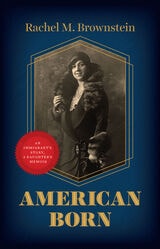
cover of American Born: An Immigrant's Story, a Daughter's Memoir

American Born

An Immigrant's Story, a Daughter's Memoir

Rachel M. Brownstein

University of Chicago Press, 2023

An incisive memoir of Rachel M. Brownstein’s seemingly quintessential Jewish mother, a resilient and courageous immigrant in New York.

When she arrived alone in New York in 1924, eighteen-year-old Reisel Thaler resembled the other Yiddish-speaking immigrants from Eastern Europe who accompanied her. Yet she already had an American passport tucked in her scant luggage. Reisel had drawn her first breath on the Lower East Side of Manhattan in 1905, then was taken back to Galicia (in what is now Poland) by her father before she turned two. She was, as she would boast to the end of her days, “American born.” 

The distinguished biographer and critic Rachel M. Brownstein began writing about her mother Reisel during the Trump years, dwelling on the tales she told about her life and the questions they raised about nationalism, immigration, and storytelling. For most of the twentieth century, Brownstein’s mother gracefully balanced her identities as an American and a Jew. Her values, her language, and her sense of timing inform the imagination of the daughter who recalls her in her own old age. The memorializing daughter interrupts, interprets, and glosses, sifting through alternate versions of the same stories using scenes, songs, and books from their time together.
 
But the central character of this book is Reisel, who eventually becomes Grandma Rose—always watching and judging, singing, baking, and bustling. Living life as the heroine of her own story, she reminds us how to laugh despite tragedy, find our courage, and be our most unapologetically authentic selves.
[more]
cover of Anna's Shtetl

Anna's Shtetl

Lawrence A. Coben

University of Alabama Press, 2007
A rare view of a childhood in a European ghetto
 
Anna Spector was born in 1905 in Korsun, a Ukrainian town on the Ros River, eighty miles south of Kiev. Held by Poland until 1768 and annexed by the Tsar in 1793 Korsun and its fluid ethnic population were characteristic of the Pale of Settlement in Eastern Europe: comprised of Ukrainians, Cossacks, Jews and other groups living uneasily together in relationships punctuated by violence. Anna’s father left Korsun in 1912 to immigrate to America, and Anna left in 1919, having lived through the Great War, the Bolshevik Revolution, and part of the ensuing civil war, as well as several episodes of more or less organized pogroms—deadly anti-Jewish riots begun by various invading military detachments during the Russian Civil War and joined by some of Korsun’s peasants.
 
In the early 1990s Anna met Lawrence A. Coben, a medical doctor seeking information about the shtetls to recapture a sense of his own heritage. Anna had near-perfect recall of her daily life as a girl and young woman in the last days in one of those historic but doomed communities. Her rare account, the product of some 300 interviews, is valuable because most personal memoirs of ghetto life are written by men. Also, very often, Christian neighbors appear in ghetto accounts as a stolid peasant mass assembled on market days, as destructive mobs, or as an arrogant and distant collection of government officials and nobility. Anna’s story is exceptionally rich in a sense of the Korsun Christians as friends, neighbors, and individuals.
 
Although the Jewish communities in Eastern Europe are now virtually gone, less than 100 years ago they counted a population of millions. The firsthand records we have from that lost world are therefore important, and this view from the underrecorded lives of women and the young is particularly welcome.  


[more]
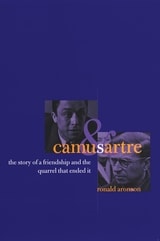
cover of Camus and Sartre: The Story of a Friendship and the Quarrel that Ended It

Camus and Sartre

The Story of a Friendship and the Quarrel that Ended It

Ronald Aronson

University of Chicago Press, 2003

Until now it has been impossible to read the full story of the relationship between Albert Camus and Jean-Paul Sartre. Their dramatic rupture at the height of the Cold War, like that conflict itself, demanded those caught in its wake to take sides rather than to appreciate its tragic complexity. Now, using newly available sources, Ronald Aronson offers the first book-length account of the twentieth century's most famous friendship and its end.

Albert Camus and Jean-Paul Sartre first met in 1943, during the German occupation of France. The two became fast friends. Intellectual as well as political allies, they grew famous overnight after Paris was liberated. As playwrights, novelists, philosophers, journalists, and editors, the two seemed to be everywhere and in command of every medium in post-war France. East-West tensions would put a strain on their friendship, however, as they evolved in opposing directions and began to disagree over philosophy, the responsibilities of intellectuals, and what sorts of political changes were necessary or possible.

As Camus, then Sartre adopted the mantle of public spokesperson for his side, a historic showdown seemed inevitable. Sartre embraced violence as a path to change and Camus sharply opposed it, leading to a bitter and very public falling out in 1952. They never spoke again, although they continued to disagree, in code, until Camus's death in 1960.

In a remarkably nuanced and balanced account, Aronson chronicles this riveting story while demonstrating how Camus and Sartre developed first in connection with and then against each other, each keeping the other in his sights long after their break. Combining biography and intellectual history, philosophical and political passion, Camus and Sartre will fascinate anyone interested in these great writers or the world-historical issues that tore them apart.
[more]
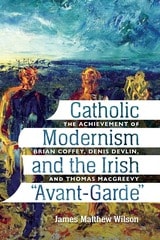
cover of Catholic Modernism and the Irish "Avant-Garde:" The Achievement of Brian Coffey, Denis Devlin, and Thomas MacGreevey

Catholic Modernism and the Irish "Avant-Garde

" The Achievement of Brian Coffey, Denis Devlin, and Thomas MacGreevey

James Matthew Wilson

Catholic University of America Press, 2023
This study constitutes the first-ever definitive account of the life and work of Irish modernist poets Thomas MacGreevy, Brian Coffey, and Denis Devlin. Apprenticed to the likes of W.B. Yeats, T.S. Eliot, James Joyce, and Samuel Beckett, all three writers worked at the center of modernist letters in England, France, and the United States, but did so from a distinctive perspective. All three writers wrote with a deep commitment to the intellectual life of Catholicism and saw the new movement in the arts as making possible for the first time a rich sacramental expression of the divine beauty in aesthetic form. MacGreevy spent his life trying to voice the Augustinian vision he found in The City of God. Coffey, a student of neo-Thomist philosopher Jacques Maritain, married scholastic thought and a densely wrought poetics to give form and solution to the alienation of modern life. Devlin contemplated the world with the eyes of Montaigne and the heart of Pascal as he searched for a poetry that could realize the divine presence in the experience of the modern person. Taken together, MacGreevy, Coffey, and Devlin exemplify the modern Catholic intellectual seeking to engage the modern world on its own terms while drawing the age toward fulfillment within the mystery and splendor of the Church. They stand apart from their Irish contemporaries for their religious seriousness and cosmopolitan openness of European modernism. They lay bare the theological potencies of modern art and do so with a sophistication and insight distinctive to themselves. Although MacGreevy, Coffey, and Devlin have received considerable critical attention in the past, this is the first book to study their work comprehensively, from MacGreevy’s early poems and essays on Joyce and Eliot to Coffey’s essays in the neo-scholastic philosophy of science, and on to Devlin’s late poetic attempts to realize Dante’s divine vision in a Europe shattered by war and modern doubt.
[more]
cover of Hope Now: The 1980 Interviews

Hope Now

The 1980 Interviews

Jean-Paul Sartre and Benny Lévy

University of Chicago Press, 1996

In March of 1980, just a month before Sartre's death, Le Nouvel Observateur published a series of interviews, the last ever given, between the blind and debilitated philosopher and his young assistant, Benny Levy. Readers were scandalized and denounced the interviews as distorted, inauthentic, even fraudulent. They seemed to portray a Sartre who had abandoned his leftist convictions and rejected his most intimate friends, including Simone de Beauvoir. This man had cast aside his own fundamental beliefs in the primacy of individual consciousness, the inevitability of violence, and Marxism, embracing instead a messianic Judaism. No, Sartre's supporters argued, it was his interlocutor, the ex-radical, the orthodox, ultra-right-wing activist who had twisted the words and thought of an ailing Sartre to his own ends. Or had he?

Shortly before his death, Sartre confirmed the authenticity of the interviews and their puzzling content. Over the past fifteen years, it has become the task of Sartre scholars to unravel and understand them. Presented in this fresh, meticulous translation, the interviews are framed by two provocative essays from Benny Levy himself, accompanied by a comprehensive introduction from noted Sartre authority Ronald Aronson. Placing the interviews in proper biographical and philosophical perspective, Aronson demonstrates that the thought of both Sartre and Levy reveals multiple intentions that taken together nevertheless confirm and add to Sartre's overall philosophy. This absorbing volume at last contextualizes and elucidates the final thoughts of a brilliant and influential mind.

Jean-Paul Sartre (1906-1980) was offered, but declined, the Nobel Prize for literature in 1964. His many works of fiction, drama, and philosophy include the monumental study of Flaubert, The Family Idiot, and The Freud Scenario, both published in translation by the University of Chicago Press.
[more]
cover of Livin' the Blues: Memoirs of a Black Journalist and Poet

Livin' the Blues

Memoirs of a Black Journalist and Poet

Frank Marshall Davis

University of Wisconsin Press, 1993

Frank Marshall Davis was a prominent poet, journalist, jazz critic, and civil rights activist on the Chicago and Atlanta scene from the 1920s through 1940s. He was an intimate of Langston Hughes and Richard Wright and an influential editor at the Chicago Evening Bulletin, the Chicago Whip, the Chicago Star, and the Atlanta World. He renounced his writing career in 1948 and moved to Hawaii, forgotten until the Black Arts Movement rediscovered him in the 1960s.

Because of his early self-exile from the literary limelight, Davis's life and work have been shrouded in mystery. Livin' the Blues offers us a chance to rediscover this talented poet and writer and stands as an important example of black autobiography, similar in form, style, and message to those of Langston Hughes and Richard Wright.

"Both a social commentary and intellectual exploration into African American life in the twentieth century."—Charles Vincent, Atlanta History
[more]
cover of Minding the Store: A Memoir

Minding the Store

A Memoir

Stanley Marcus

University of North Texas Press, 1997
[more]
cover of Reassessing Reform

Reassessing Reform

Christopher M. Bellitto

Catholic University of America Press, 2012
Now, in celebration of the fiftieth anniversaries of the publication of The Idea of Reform and the Second Vatican Council, Reassessing Reform explores and critiques the enduring significance of Ladner's study, surveying new avenues and insights of more recent reform scholarship, especially concerning the long Middle Ages.
[more]
cover of Rediscovering Nancy Drew

Rediscovering Nancy Drew

Carolyn Stewart Dyer

University of Iowa Press, 1995
"Rediscovering Nancy Drew is a rich collection of literary memories and insightful cultural comments."--Journal of Children's Literature "Nancy, especially the Nancy of the original story, is our bright heroine, chasing down the shadows, conquering our worst fears, giving us a glimpse of our brave and better selves, proving to everybody exactly how admirable and wonderful a thing it is to be a girl. Thank you, Nancy Drew."--Nancy Pickard "Nancy Drew belongs to a moment in feminist history; it is a moment, I suggest, that we celebrate, allowing ourselves the satisfaction of praising her for what she dared and forgiving her for what she failed to undertake or understand."--Carolyn G. Heilbrun "Rediscovering Nancy Drew lights up the territory. It informs, delights, and acknowledges through love and scholarship a debt long overdue."--Dale H. Ross In 1991, women staff and faculty at the University of Iowa discovered that the pseudonymous author of the original Nancy Drew books, Carolyn Keene, was none other than Mildred Wirt Benson, the first person to earn a master's degree in journalism at Iowa. The excitement caused by their discovery led to the 1993 Nancy Drew Conference, which explored the remarkable passion for Nancy Drew that spans a wide spectrum of American society. The result: a lively collaboration of essays by and interviews with mystery writers, collectors, publishers, librarians, scholars, journalists, and fans which presents a spirited, informative, totally enjoyable tribute to the driver of that blue roadster so many readers have coveted.
[more]
cover of Sartre and Marxist Existentialism: The Test Case of Collective Responsibility

Sartre and Marxist Existentialism

The Test Case of Collective Responsibility

Thomas R. Flynn

University of Chicago Press, 1986

In this important book, Thomas R. Flynn reinterprets and evaluates Sartre's social and political philosophy, arguing that the existential ethics of Sartre's early phase is consistent with the Marxist-inspired views of his later writings. Displaying his mastery of Sartre's entire corpus, Flynn reconstructs Sartre's social ontology with its sensitive balance of the existentialist's respect for moral responsibility and the Marxist's sense of social causation. Flynn focuses on the issue of collective responsibility as a particularly apt test-case for assessing any proposed union of existentialist and Marxist perspectives.

The study begins with an examination of the uses of "responsibility" in Being and Nothingness and in several postwar essays. Flynn then concentrates on the Critique of Dialectical Reason, offering a thorough analysis of the remarkable social theory Sartre constructs there. A masterful contribution to Sartre scholarship, Sartre and Marxist Existentialism will be of great interest to social and political philosophers involved in the debate over collective responsibility.
[more]
cover of Sartre, Foucault, and Historical Reason, Volume One: Toward an Existentialist Theory of History

Sartre, Foucault, and Historical Reason, Volume One

Toward an Existentialist Theory of History

Thomas R. Flynn

University of Chicago Press, 1997

Sartre and Foucault were two of the most prominent and at times mutually antagonistic philosophical figures of the twentieth century. And nowhere are the antithetical natures of their existentialist and poststructuralist philosophies more apparent than in their disparate approaches to historical understanding.

A history, thought Foucault, should be a kind of map, a comparative charting of structural transformations and displacements. But for Sartre, authentic historical understanding demanded a much more personal and committed narrative, a kind of interpretive diary of moral choices and risks compelled by critical necessity and an exacting reality. Sartre's history, a rational history of individual lives and their intrinsic social worlds, was in essence immersed in biography.

In Volume One of this authoritative two-volume work, Thomas R. Flynn conducts a pivotal and comprehensive reconstruction of Sartrean historical theory, and provocatively anticipates the Foucauldian counterpoint to come in Volume Two.

[more]
cover of Tell Me a Story, Sing Me a Song: A Texas Chronicle

Tell Me a Story, Sing Me a Song

A Texas Chronicle

By William A. Owens

University of Texas Press, 1983

Texas, the 1930s—the years of the Great Depression. It was the Texas of great men: Dobie, Bedichek, Webb, the young Américo Paredes. And it was the Texas of May McCord and "Cocky" Thompson, the Reverend I. B. Loud, the Cajun Marcelle Comeaux, the black man they called "Grey Ghost," and all the other extraordinary "ordinary" people whom William A. Owens met in his travels.

"Up and down and sideways" across Texas, Owens traveled. His goal: to learn for himself what the diverse peoples of the state "believed in, yearned for, laughed at, fought over, as revealed in story and song." Tell me a story, sing me a song brings together both the songs he gathered—many accompanied by music—and Owens' warm reminiscences of his travels in the Texas of the Thirties and early Forties.
[more]
cover of The Writings of Jean-Paul Sartre Volume 2: Selected Prose

The Writings of Jean-Paul Sartre Volume 2

Selected Prose

Jean-Paul Sartre

Northwestern University Press, 1974

The writings published here are not so much an epitome as episodes. But most do not digress. They mark the turns and turning points of a human style, the tropes of an expressive life embodying the changing tempos of an age. Until we fall silent, all of us are trying to say. These fragmentary efforts to speak to, rejoin, and help create a new community of liberated human beings constitute the epigraphs of Sartre's historical inscription. 
[more]