Results by title

7 books match the query '1906-2001'

cover of Correction of Drift: A Novel in Stories

Correction of Drift

A Novel in Stories

Pamela Ryder

University of Alabama Press, 2008
Explores the lives behind the headlines of the Lindbergh baby kidnapping, evoking anew the scope of tragedy through the vision of literary fiction.
 
It was called the crime of the century, and it was front-page news: the Lindbergh baby kidnapping. Correction of Drift: A Novel in Stories imagines the private lives behind the headlines of the case, and examines the endurance—and demise—of those consumed by the tragedy.

Every character brings a different past life to the event, be it a life of celebrity, or of misfortune and obscurity. There is Anne Morrow Lindbergh—daughter of a millionaire, the shy poet who married a national hero; Charles Lindbergh—the rough-and-tumble Minnesota barnstormer, who at age twenty-five made the first transatlantic flight, bringing him world-wide prestige; Violet—the skittish family maid with a curious attachment to the boy and a secret life that lapses into hysteria and self-destruction; and the kidnappers—an assembly of misfits with their own histories of misery. All are bound by the violence, turmoil, and mystery of the child’s disappearance as it becomes evident that each life has been irrevocably changed. Patterns of bereavement and loss illuminate these stories: despair at the death of a child; the retreat into seclusion; the comfort and the desolation of a marriage. But the heart of this novel is the far-reaching nature of tragedy, and the ways the characters go on to live—or end—their lives.
[more]
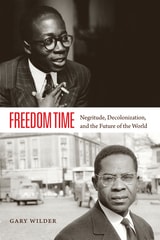
cover of Freedom Time: Negritude, Decolonization, and the Future of the World

Freedom Time

Negritude, Decolonization, and the Future of the World

Gary Wilder

Duke University Press, 2015

Freedom Time reconsiders decolonization from the perspectives of Aimé Césaire (Martinique) and Léopold Sédar Senghor (Senegal) who, beginning in 1945, promoted self-determination without state sovereignty. As politicians, public intellectuals, and poets they struggled to transform imperial France into a democratic federation, with former colonies as autonomous members of a transcontinental polity. In so doing, they revitalized past but unrealized political projects and anticipated impossible futures by acting as if they had already arrived. Refusing to reduce colonial emancipation to national independence, they regarded decolonization as an opportunity to remake the world, reconcile peoples, and realize humanity’s potential. Emphasizing the link between politics and aesthetics, Gary Wilder reads Césaire and Senghor as pragmatic utopians, situated humanists, and concrete cosmopolitans whose postwar insights can illuminate current debates about self-management, postnational politics, and planetary solidarity. Freedom Time invites scholars to decolonize intellectual history and globalize critical theory, to analyze the temporal dimensions of political life, and to question the territorialist assumptions of contemporary historiography.
[more]
cover of In Senghor's Shadow: Art, Politics, and the Avant-Garde in Senegal, 1960–1995

In Senghor's Shadow

Art, Politics, and the Avant-Garde in Senegal, 1960–1995

Elizabeth Harney

Duke University Press, 2004

In Senghor’s Shadow is a unique study of modern art in postindependence Senegal. Elizabeth Harney examines the art that flourished during the administration of Léopold Sédar Senghor, Senegal’s first president, and in the decades since he stepped down in 1980. As a major philosopher and poet of Negritude, Senghor envisioned an active and revolutionary role for modern artists, and he created a well-funded system for nurturing their work. In questioning the canon of art produced under his aegis—known as the Ecole de Dakar—Harney reconsiders Senghor’s Negritude philosophy, his desire to express Senegal’s postcolonial national identity through art, and the system of art schools and exhibits he developed. She expands scholarship on global modernisms by highlighting the distinctive cultural history that shaped Senegalese modernism and the complex and often contradictory choices made by its early artists.

Heavily illustrated with nearly one hundred images, including some in color, In Senghor’s Shadow surveys the work of a range of Senegalese artists, including painters, muralists, sculptors, and performance-based groups—from those who worked at the height of Senghor’s patronage system to those who graduated from art school in the early 1990s. Harney reveals how, in the 1970s, avant-gardists contested Negritude beliefs by breaking out of established artistic forms. During the 1980s and 1990s, artists such as Moustapha Dimé, Germaine Anta Gaye, and Kan-Si engaged with avant-garde methods and local artistic forms to challenge both Senghor’s legacy and the broader art world’s understandings of cultural syncretism. Ultimately, Harney’s work illuminates the production and reception of modern Senegalese art within the global arena.

[more]
cover of Navigating the African Diaspora: The Anthropology of Invisibility

Navigating the African Diaspora

The Anthropology of Invisibility

Donald Martin Carter

University of Minnesota Press, 2010

Investigating how the fraught political economy of migration impacts people around the world, Donald Martin Carter raises important issues about contemporary African diasporic movements. Developing the notion of the anthropology of invisibility, he explores the trope of navigation in social theory intent on understanding the lived experiences of transnational migrants.
 
Carter examines invisibility in its various forms, from social rejection and residential segregation to war memorials and the inability of some groups to represent themselves through popular culture, scholarship, or art. The pervasiveness of invisibility is not limited to symbolic actions, Carter shows, but may have dramatic and at times catastrophic consequences for people subjected to its force. The geographic span of his analysis is global, encompassing Senegalese Muslims in Italy and the United States and concluding with practical questions about the future of European societies. Carter also considers both contemporary and historical constellations of displacement, from Darfurian refugees to French West African colonial soldiers.
 
Whether focusing on historical photographs, television, print media, and graffiti scrawled across urban walls or identifying the critique of colonialism implicit in African films and literature, Carter reveals a protean and peopled world in motion.
[more]
cover of R. K. Narayan: A Critical Appreciation

R. K. Narayan

A Critical Appreciation

William Walsh

University of Chicago Press, 1982

R. K. Narayan, author of more than a dozen novels and numerous short stories, is a writer of international stature. Only recently, however, has he received the critical attention that is his due.

This lucid and often eloquent study provides both new and devoted Narayan readers with an introduction to his life and work. William Walsh, who makes generous and apt use of quotations from Narayan's work, traces Narayan's artistic development and brings into clear relief the qualities that characterize his fiction: gentle irony, humor, and a tolerance of human foibles. Both a criticism and an appreciation, this work will prove valuable to those already acquainted with this delightful and important novelist and will lead others to his work for the first time.
[more]
cover of R. K. Narayan: Contemporary Critical Essays

R. K. Narayan

Contemporary Critical Essays

Geoffrey Kain

Michigan State University Press, 1993
[more]
cover of Return to the Kingdom of Childhood: Re-envisioning the Legacy and Philosophical Relevance of Negritude

Return to the Kingdom of Childhood

Re-envisioning the Legacy and Philosophical Relevance of Negritude

Cheikh Thiam

The Ohio State University Press, 2014

Return to the Kingdom of Childhood: Re-envisioning the Legacy and Philosophical Relevance of Negritude examines the philosophy of Negritude through an innovative analysis of Léopold Sédar Senghor’s oeuvre. In the first book-length study of Senghorian philosophy, Cheikh Thiam argues that Senghor’s work expresses an Afri-centered conception of the human while simultaneously offering a critique of the Western universalization of “man.” Senghor’s corrective, descriptive, and prescriptive theory of humanness is developed through a conception of race as a cultural manifestation of being.
 
Thiam contends that Senghor’s conception of race entails an innovative Afri-centered epistemology and ontology. For Senghor, races are the effects of particular groups’ relations to the world. The so-called “Negroes,” for example, are determined by their epistemology based on their fluid understanding of the ontological manifestations of being. The examination of this ontology and its ensuing epistemology, which is constitutive of the foundation of Senghor’s entire oeuvre, indicates that Negritude is a postcolonial philosophy that stands on its own.
 
The hermeneutics of Senghor’s race theory show that the Senegalese thinker’s pioneering postcolonial philosophy remains relevant in the postcolonial era. In fact, it questions and expands the works of major contemporary African-descended scholars such as Paul Gilroy, Edouard Glissant, and Molefi Asante. Thiam’s approach is thoroughly interdisciplinary, combining perspectives from philosophy, literary analysis, anthropology, and postcolonial, African, and cultural studies.
[more]