Results by title
12 books match the query '1908-'
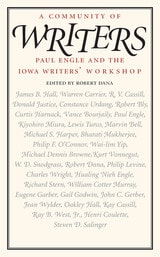
A Community of Writers
Paul Engle and the Iowa Writers' WorkshopDana, Robert
University of Iowa Press, 1999
With these words, written long before his Iowa Writers' Workshop became world famous, much imitated, and academically rich, Paul Engle captured the spirit behind his beloved workshop. Now, in this collection of essays by and about those writers who shared the energetic early years, Robert Dana presents a dynamic, informative tribute to Engle and his world.
The book's three sections mingle myth and history with style and grace and no small amount of humor. The beginning essays are given over to memories of Paul Engle in his heyday. The second group focuses particularly on those teachers—Robert Lowell, John Berryman, Kurt Vonnegut, for example—who made the workshop hum on a day-to-day basis. Finally, the third section is devoted to storytelling: tall tales, vignettes, surprises, sober and not-so-sober moments. Engle's own essay, "The Writer and the Place," describes his "simple, and yet how reckless" conviction that "the creative imagination in all of the arts is as important, as congenial, and as necessary, as the historical study of all the arts."
Today, of course, there are hundreds of writers' workshops, many of them founded and directed by graduates of the original Iowa workshop. But when Paul Engle arrived in Iowa there were exactly two. His indomitable nature and great persuasive powers, combined with his distinguished reputation as a poet, loomed large behind the enhancement of the Iowa Writers' Workshop. This volume of fine and witty essays reveals the enthusiasm and drive and sheer pleasure that went into Iowa's renowned workshop.
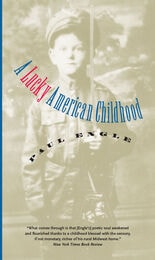
A Lucky American Childhood
Paul Engle
University of Iowa Press, 1996
A Lucky American Childhood will appeal to people with memories of the small-town America that Paul Engle describes with such affectionate realism and to all those interested in the roots of this renowned man of letters.
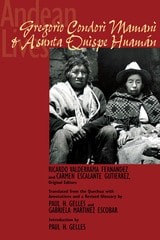
Andean Lives
Gregorio Condori Mamani and Asunta Quispe HuamánRicardo Valderrama Fernández and Carmen Escalante Gutiérrez, Original Editors
University of Texas Press, 1996
Gregorio Condori Mamani and Asunta Quispe Huamán were runakuna, a Quechua word that means "people" and refers to the millions of indigenous inhabitants neglected, reviled, and silenced by the dominant society in Peru and other Andean countries. For Gregorio and Asunta, however, that silence was broken when Peruvian anthropologists Ricardo Valderrama Fernández and Carmen Escalante Gutiérrez recorded their life stories. The resulting Spanish-Quechua narrative, published in the mid-1970s and since translated into many languages, has become a classic introduction to the lives and struggles of the "people" of the Andes.
Andean Lives is the first English translation of this important book. Working directly from the Quechua, Paul H. Gelles and Gabriela Martínez Escobar have produced an English version that will be easily accessible to general readers and students, while retaining the poetic intensity of the original Quechua. It brings to vivid life the words of Gregorio and Asunta, giving readers fascinating and sometimes troubling glimpses of life among Cuzco's urban poor, with reflections on rural village life, factory work, haciendas, indigenous religion, and marriage and family relationships.
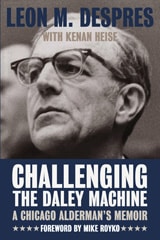
Challenging the Daley Machine
A Chicago Alderman's MemoirLeon M. Despres
Northwestern University Press, 2005
Winner, 2007 The Hyde Park Historical Society Paul Cornell Award
Political war stories from a thorn in the side of Chicago's famous Boss
In 1955, south-sider Leon Despres was elected to the Chicago City Council-the same year that Paddy Bauler famously uttered that "Chicago ain't ready for reform." Ready or not, Chicago got twenty years of reform efforts from Despres, one of the few independents in the council and the most liberal alderman in the city. His demand to cut out the corrupt sale of city driveway permits made him enemies from the very beginning. Over the years his crusades to ban discrimination, preserve Chicago landmark buildings, and gain equality for African-Americans-when Daley-beholden African-American council members refused to help-threw wrench after wrench into the Machine. And, not incidentally, changed the city.
But Challenging the Daley Machine is more than a memoir. It's a historical portrait of the way things were done under the Boss, when changing times and a changing city forced the Machine to confront the problems Despres championed. His battles against the seemingly monolithic Machine are also an inspiration to anyone who is facing long odds, but is convinced he/she is on the side of right.
Come Walk with Me
The Art of Dorris CurtisDorris Curtis
University of Arkansas Press, 2004
Edgar and Brigitte
A German Jewish Passage to AmericaRosemarie Bodenheimer
University of Alabama Press, 2016
The couple’s encounters with the strange new dynamics of race, religion, and the workplace in their new American home offer a compelling account of the struggles that faced many immigrants with deep German roots. It is also an intimate portrait of a now-vanished German Jewish culture as it played out in the lives of Bodenheimer’s parents and her grandparents from the 1920s to the late 1960s, a story of emigration, assimilation, and the private struggles that accompany those forced shifts in orientation.
The Bodenheimers’ letters and journals offer engaging perspectives into their personal lives that retrospective memories cannot match. Braiding intimate biography together with history and memoir, Edgar and Brigitte will appeal both to historians of the European Jewish diaspora and to readers interested in the struggles and resilience of people whose lives were upended by Hitler.
Harriette Simpson Arnow
Critical Essays on Her WorkHaeja K. Chung
Michigan State University Press, 1995
At her death in 1986, Harriette Simpson Arnow left a modest collection of published work: ten short stories, five novels, two non-fiction books, a short autobiography, and nineteen essays and book reviews. Although the sum is small, her writing has been examined from regionalist, Marxist, feminist, and other critical perspectives.
The 1970s saw the first serious attempts to revive interest in Arnow. In 1971, Tillie Olsen identified her as a writer whose "books of great worth suffer the death of being unknown, or at best, a peculiar eclipsing." Joyse Carol Oates wrote in The New York Times Book Review that Arnow's The Dollmaker is "our most unpretentious American masterpiece."
In the 1990s, it is appropriate to take stock of her earlier work and to prompt reexamination of this powerful yet poorly understood writer. This collection of critical essays examines traditional as well as new interpretations of Arnow and her work. It also suggests future directions for Arnow scholarship and includes studies of all of Arnow's writing, fiction and non-fiction, published and unpublished.
Jean Paton and the Struggle to Reform American Adoption
E. Wayne Carp
University of Michigan Press, 2013
Jean Paton (1908–2002) fought tirelessly to reform American adoption and to overcome prejudice against adult adoptees and women who give birth out of wedlock. Paton wrote widely and passionately about the adoption experience, corresponded with policymakers as well as individual adoptees, promoted the psychological well-being of adoptees, and facilitated reunions between adoptees and their birth parents. E. Wayne Carp's masterful biography brings to light the accomplishments of this neglected civil-rights pioneer, who paved the way for the explosive emergence of the adoption reform movement in the 1970s. Her unflagging efforts over five decades helped reverse harmful policies, practices, and laws concerning adoption and closed records, struggles that continue to this day.
La Partera
Story of a MidwifeFran Leeper Buss
University of Michigan Press, 2001
This is Jesusita's story, told in her own words. She describes her early training as a midwife, her forced departure from home due to two unmarried pregnancies, and her solitary struggle to support her children. La Partera tells how she gradually emerged as a leader in her community, painstakingly building by hand a small maternity center for her patients while gaining the respect of the Anglo medical community.
As Jesusita's story unfolds, so too does the story of the women of the region. Supplemental sections by the author illuminate Jesusita's culture and past, along with a historical account of the network of medical care provided by Hispanic and Anglo female healers. Illustrated with photographs of both people and places, La Partera reflects the culture of an era through the prism of Jesusita's hard and useful life.
Fran Leeper Buss lives and teaches in Tucson, Arizona.
La Partera
Story of a MidwifeFran Leeper Buss
University of Michigan Press, 1980

Lost in the Rentharpian Hills
Spanning the Decades with Carl JacobiR. Dixon Smith
University of Wisconsin Press, 1985
R. Dixon Smith has captured the enchanting story of the well known pulp writer Carl Jacobi. Jacobi wrote many fantasy and weird tales, while leading a somewhat bizarre yet magical life.
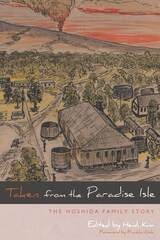
Taken from the Paradise Isle
The Hoshida Family StoryHeidi Kim
University Press of Colorado, 2015
Crafted from George Hoshida’s diary and memoir, as well as letters faithfully exchanged with his wife Tamae, Taken from the Paradise Isle is an intimate account of the anger, resignation, philosophy, optimism, and love with which the Hoshida family endured their separation and incarceration during World War II.
George and Tamae Hoshida and their children were a Japanese American family who lived in Hawai‘i. In 1942, George was arrested as a “potentially dangerous alien” and interned in a series of camps over the next two years. Meanwhile, forced to leave her handicapped eldest daughter behind in a nursing home in Hawai‘i, Tamae and three daughters, including a newborn, were incarcerated at the Jerome Relocation Center in Arkansas. George and Tamae regularly exchanged letters during this time, and George maintained a diary including personal thoughts, watercolors, and sketches. In Taken from the Paradise Isle these sources are bolstered by extensive archival documents and editor Heidi Kim’s historical contextualization, providing a new and important perspective on the tragedy of the incarceration as it affected Japanese American families in Hawai‘i.
This personal narrative of the Japanese American experience adds to the growing testimony of memoirs and oral histories that illuminate the emotional, psychological, physical, and economic toll suffered by Nikkei as the result of the violation of their civil rights during World War II.