Results by title
3 books match the query '1908-1976'
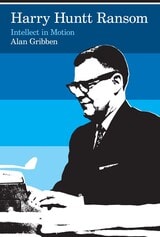
Harry Huntt Ransom
Intellect in MotionBy Alan Gribben
University of Texas Press, 2008
Both a life story and a portrait of public higher education during the twentieth century, Harry Huntt Ransom captures the spirit of a dynamic individual who dedicated his talents to nurturing intellectual life in Texas and beyond. Tracing the details of Ransom's youth in Galveston and Tennessee and his education at Yale, where he earned a doctorate, Alan Gribben provides new insight into the factors that shaped Ransom's future as a renowned administrator and defender of the humanities.
Ransom's career at the University of Texas began in 1935, when he was hired as an instructor of English. He rose through the ranks to become chancellor, stepping down in 1971 during a volatile period when debates about the University's central mission raged—particularly over the question of commercializing higher education. The development of Ransom's lasting legacy, the Humanities Research Center bearing his name, is explored in depth as well. Bringing to life a legendary figure, Harry Huntt Ransom is a colorful testament to a singular man of letters who had the audacity to propose "that there be established somewhere in Texas—let's say in the capital city—a center of our cultural compass, a research center to be the Bibliothèque Nationale of the only state that started out as an independent nation."
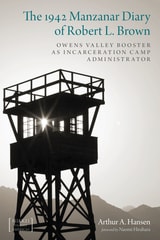
The 1942 Manzanar Diary of Robert L. Brown
Owens Valley Booster as Incarceration Camp AdministratorArthur A. Hansen
University Press of Colorado, 2026
This transcribed and edited wartime diary of Robert L. Brown—a trained journalist who served as public relations staff and assistant director at the Manzanar concentration camp—reveals the thoughts and perspective of the jailer, providing a window into the views of the local population around the presence and experience of a concentration camp for Japanese Americans in their community. In addition to the heavily footnoted diary, the book includes a prologue, introduction, and epilogue from Arthur A. Hansen, providing context for the journal as well as how Hansen came to transcribe the work with Brown’s blessing.
A departure from the typical recovered narratives from incarcerees, Brown’s diary is a historically significant primary source that provides insight into camp administration and local community relationships with Manzanar and a rich primary source for specialists in the field of Japanese American incarceration.
The Conscience of the University, and Other Essays
By Harry Huntt Ransom
University of Texas Press, 1982
In 1982, a century after the laying of the cornerstone of its first building, the University of Texas was ranked by the New York Times among the best in the nation. No one had more to do with that extraordinary achievement than Harry Huntt Ransom. From 1935 to his death in 1976, he served the University in positions ranging from instructor in English to chancellor of The University of Texas System. In the fifties, sixties, and seventies, he held a succession of administrative posts requiring him to face a myriad of perplexing problems. Among the critical issues calling for analysis and decision in those years were the post-Sputnik pressure for greater emphasis on science and technology, the student revolts during the 1960s, and the defection of growing numbers of university faculty to industry and government.
Harry Huntt Ransom did not merely respond to the problems of the times. He had his own large ambitions for the University of Texas, in particular the improvement of student programs, the development of a vigorous faculty, and—the achievement for which he is best remembered—the building of a world-renowned library.
He was concerned with the role of the university in society, what the university should do and do well, and what it should not do. Always he viewed these matters in broad perspective, and his approach to them was far-sighted and deeply philosophical.
As dean, vice-president, president, and chancellor, Ransom wrote and spoke often on these and other important subjects. Aside from the books that he wrote and edited, he left a prodigious amount of material, some of which had been published in various journals and some of which had been delivered as lectures and addresses and never made available in printed form.
For the last twenty-five years of Ransom's life his wife, Hazel, was his closest companion and confidant. At the urging of Harry's friends, colleagues, and admirers, she undertook the task of sifting through her late husband's papers in an effort to organize and preserve some of the important contributions he had made to the thought and planning that were so instrumental in shaping the University of Texas and higher education in general. In these essays we see the force of reasoning and grace of style for which Ransom was so widely admired. It was he who reminded us that books last longer than buildings. This is a book of lasting importance that Harry Ransom himself might have given us had he lived longer.