Results by title
13 books match the query '1909-'
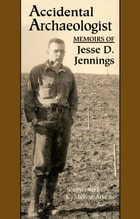
Accidental archaeologist
memoirs of Jesse D. JenningsJesse David Jennings
University of Utah Press, 1994
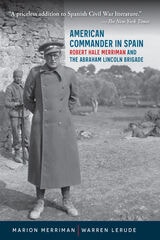
American Commander in Spain
Robert Hale Merriman and the Abraham Lincoln BrigadeMarion Merriman
University of Nevada Press, 1986
Among the Americans was Robert Hale Merriman, a scholar who had been studying international economics in Europe. He and his wife, Marion, joined volunteers from fifty-four countries in International Brigades. Merriman became the first commander of the Americans; Abraham Lincoln Battalion and a leader among the International Brigades. Now available in a new paperback edition, American Commander in Spain is based on Merriman and Marion's diaries and personal correspondence, Marion's own service at his side in Spain, as well as Warren Lerude's extensive research and interviews with people who knew Merriman and Marion, government records, and contemporary news reports. This critically acclaimed work is both the biography of a remarkable man who combined his idealism with life-risking action to fight fascism threatening Europe and Marion's vivid first-hand account of life in Spain during the civil war that became a prologue to the Second World War.
At Home in Diaspora
Black International WritingWendy Walters
University of Minnesota Press, 2005
In At Home in Diaspora, Wendy Walters investigates the work of Himes, Cliff, and three other twentieth-century black international writers—Caryl Phillips, Simon Njami, and Richard Wright—who have lived in and written from countries they do not call home. Unlike other authors in exile, those of the African diaspora are doubly displaced, first by the discrimination they faced at home and again by their life abroad. Throughout, Walters suggests that in the absence of a recoverable land of origin, the idea of diaspora comes to represent a home that is not singular or exclusionary. In this way, writing in exile is much more than a literary performance; it is a profound political act.
Wendy W. Walters is assistant professor of literature at Emerson College.
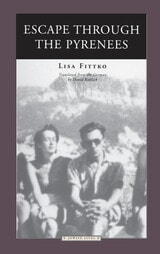
Escape Through the Pyrenees
Lisa Fittko
Northwestern University Press, 2000
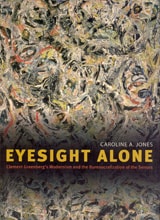
Eyesight Alone
Clement Greenberg's Modernism and the Bureaucratization of the SensesCaroline A. Jones
University of Chicago Press, 2006
Caroline Jones's magisterial study widens Greenberg's fundamental tenet of "opticality"-the idea that modernist art is apprehended through "eyesight alone"-to a broader arena, examining how the critic's emphasis on the specular resonated with a society increasingly invested in positivist approaches to the world. Greenberg's modernist discourse, Jones argues, developed in relation to the rationalized procedures that gained wide currency in the United States at midcentury, in fields ranging from the sense-data protocols theorized by scientific philosophy to the development of cultural forms, such as hi-fi, that targeted specific senses, one by one. Greenberg's attempt to isolate and celebrate the visual was one manifestation of a large-scale segmentation-or bureaucratization-of the body's senses. Working through these historical developments, Jones brings Greenberg's theories into contemporary philosophical debates about agency and subjectivity.
Eyesight Alone offers artists, art historians, philosophers, and all those interested in the arts a critical history of this generative figure, bringing his work fully into dialogue with the ideas that shape contemporary critical discourse and shedding light not only on Clement Greenberg but also on the contested history of modernism itself.
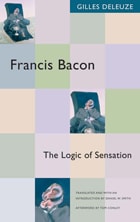
Francis Bacon
The Logic of SensationGilles Deleuze
University of Minnesota Press, 2005
Afterword by Tom Conley
Gilles Deleuze had several paintings by Francis Bacon hanging in his Paris apartment, and the painter’s method and style as well as his motifs of seriality, difference, and repetition influenced Deleuze’s work. This first English translation shows us one of the most original and important French philosophers of the twentieth century in intimate confrontation with one of that century’s most original and important painters.
In considering Bacon, Deleuze offers implicit and explicit insights into the origins and development of his own philosophical and aesthetic ideas, ideas that represent a turning point in his intellectual trajectory. First published in French in 1981, Francis Bacon has come to be recognized as one of Deleuze’s most significant texts in aesthetics. Anticipating his work on cinema, the baroque, and literary criticism, the book can be read not only as a study of Bacon’s paintings but also as a crucial text within Deleuze’s broader philosophy of art.
In it, Deleuze creates a series of philosophical concepts, each of which relates to a particular aspect of Bacon’s paintings but at the same time finds a place in the “general logic of sensation.” Illuminating Bacon’s paintings, the nonrational logic of sensation, and the act of painting itself, this work—presented in lucid and nuanced translation—also points beyond painting toward connections with other arts such as music, cinema, and literature. Francis Bacon is an indispensable entry point into the conceptual proliferation of Deleuze’s philosophy as a whole.
Gilles Deleuze (1925–1995) was professor of philosophy at the University of Paris, Vincennes–St. Denis. He coauthored Anti-Oedipus and A Thousand Plateaus with Félix Guattari. These works, as well as Cinema 1, Cinema 2, The Fold, Proust and Signs, and others, are published in English by Minnesota.
Daniel W. Smith teaches in the Department of Philosophy at Purdue University.
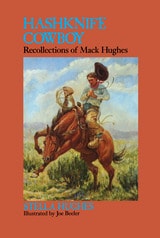
Hashknife Cowboy
Recollections of Mack HughesStella Hughes; Illustrated by Joe Beeler
University of Arizona Press, 1984
Stella Hughes, author of the best-selling Chuck Wagon Cookin' and a cowhand in her own right, has compiled from her husband's reminiscences an authentic look both at Arizona history and at cowboying as it really was. Illustrated by Joe Beeler, founding member of the Cowboy Artists of America.
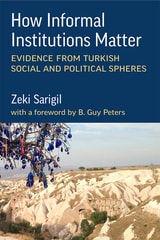
How Informal Institutions Matter
Evidence from Turkish Social and Political SpheresZeki Sarigil
University of Michigan Press, 2023
In How Informal Institutions Matter, Zeki Sarigil examines the role of informal institutions in sociopolitical life and addresses the following questions: Why and how do informal institutions emerge? To ask this differently, why do agents still create or resort to informal institutions despite the presence of formal institutional rules and regulations? How do informal institutions matter? What roles do they play in sociopolitical life? How can we classify informal institutions? What novel types of informal institutions can we identify and explain? How do informal institutions interact with formal institutions? How do they shape formal institutional rules, mechanisms, and outcomes? Finally, how do existing informal institutions change? What factors might trigger informal institutional change? In order to answer these questions, Sarigil examines several empirical cases of informal institution as derived from various issue areas in the Turkish sociopolitical context (i.e., civil law, conflict resolution, minority rights, and local governance) and from multiple levels (i.e., national and local).
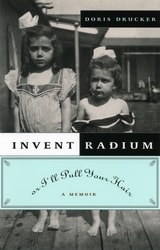
Invent Radium or I'll Pull Your Hair
A MemoirDoris Drucker
University of Chicago Press, 2004
Rothschilds and radium were the horizons of Doris's childhood. Born in Germany in the early twentieth century, she came of age in an upper-middle-class family that struggled to maintain its bourgeois respectability between the two World Wars. Doris Drucker (she met her husband Peter—of management fame—in the 1930s) has penned a lively and charming memoir that brings to life the Germany of her childhood. Rather than focusing on the rise of Hitler, Drucker weaves history into her story of the day-to-day life of a relatively apolitical family. She chronicles here the crowds that gathered to see the Zeppelin, her attempts to negotiate her Prussian mother's plans for her (like marrying well and becoming a famous scientist), ski trips and hikes, the schools she attended, her father's struggles to support the family, and all the stuff and drama that make up a childhood. Drucker's energetic storytelling, eye for the telling detail, and sly humor draw the reader into her portrait of a way of life made forever poignant by its place in history so close to the brutalities of World War II.
From the boarding school that forbade girls to look at their own legs while they bathed to the unfortunate confusion that resulted from Doris's misinterpretation of "Warsaw has fallen" as "The Waschfrau [washerwoman] has fallen," the tales recounted in Invent Radium or I'll Pull Your Hair give dimension and depth to a milieu that has been flattened by the historical events around it.
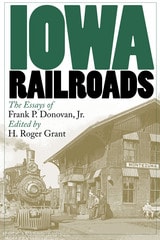
Iowa Railroads
The Essays of Frank P. Donovan, Jr.H. Roger Grant
University of Iowa Press, 2000
What began as a study of the Minneapolis & St. Louis Railway stretched into more than a dozen contributions on Hawkeye state railroad topics. By 1969 Donovan had examined Iowa's “Little Three”: Chicago Great Western, Illinois Central, and Minneapolis & St. Paul as well as the state's “Big Four”: Chicago & North Western; Chicago, Burlington & Quincy; Chicago, Milwaukee, St. Paul & Pacific; and Chicago, Rock Island & Pacific. In addition to these seven core carriers, Donovan covered the state's less prominent railroads: Atchison, Topeka & Santa Fe; Great Northern; and Union Pacific and Wabash. Moreover, he contributed an issue on Iowa's principal interurbans, most of which survived into the 1950s as electric-powered freight-only short lines. In uniting Donovan's articles into a single volume, Iowa Railroads provides the most complete history of Iowa's rail heritage.
Science, Curriculum, and Liberal Education
Selected EssaysJoseph J. Schwab
University of Chicago Press, 1982
Schwab participated in what Daniel Bell has described as the "most thoroughgoing experiment in general education in any college in the United States," the College of the University of Chicago during the thirties, forties, and fifties. He played a central role in the curriculum reform movement of the sixties, and his extraordinary command of science, the philosophy of science, and traditional and modern views of liberal education found expression in these exceptionally thoughtful essays.
Self-Financing Genocide
The Gold Train, the Becher Case and the Wealth of Hungarian JewsGábor Kádár
Central European University Press, 2004
Discusses the process of the economic annihilation of the Jews in Hungary, who– from the economic point of view – were more influential than any other Jewish community in Europe. Following the German occupation in March 1944 the collaborating Hungarian government attempted to assert its claim concerning the complete confiscation of Jewish assets at all stages of the road leading to the extermination camps. The cooperation with the Germans proved to be the most problematic in this area.
The story of the Jewish Gold Train is a relatively small but all the more emblematic chapter of the economic annihilation. The circumstances of the freight’s assembling, the German-Hungarian conflicts concerning the train, the looting attempts, the fate of the assets seized by the Allies (double victimization of the survivors) provide the reader with an insight into the history of the repeated looting of the Hungarian Jewry
The book analyzes the role played by SS-Obersturmbannführer Kurt Becher, one of the most controversial and mysterious figures in the Hungarian and universal history of the Holocaust. Becher, delegated to Hungary by Himmler, administered and benefited from the confiscation of an enormous amount of Jewish assets.
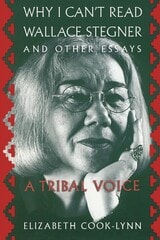
Why I Can't Read Wallace Stegner and Other Essays
A Tribal VoiceElizabeth Cook-Lynn
University of Wisconsin Press, 1996
This provocative collection of essays reveals the passionate voice of a Native American feminist intellectual. Elizabeth Cook-Lynn, a poet and literary scholar, grapples with issues she encountered as a Native American in academia. She asks questions of critical importance to tribal people: who is telling their stories, where does cultural authority lie, and most important, how is it possible to develop an authentic tribal literary voice within the academic community?
In the title essay, “Why I Can’t Read Wallace Stegner,” Cook-Lynn objects to Stegner’s portrayal of the American West in his fiction, contending that no other author has been more successful in serving the interests of the nation’s fantasy about itself. When Stegner writes that “Western history sort of stopped at 1890,” and when he claims the American West as his native land, Cook-Lynn argues, he negates the whole past, present, and future of the native peoples of the continent. Her other essays include discussion of such Native American writers as Michael Dorris, Ray Young Bear, and N. Scott Momaday; the importance of a tribal voice in academia, the risks to American Indian women in current law practices, the future of Indian Nationalism, and the defense of the land.
Cook-Lynn emphasizes that her essays move beyond the narrowly autobiographical, not just about gender and power, not just focused on multiculturalism and diversity, but are about intellectual and political issues that engage readers and writers in Native American studies. Studying the “Indian,” Cook-Lynn reminds us, is not just an academic exercise but a matter of survival for the lifeways of tribal peoples. Her goal in these essays is to open conversations that can make tribal life and academic life more responsive to one another.