Results by title
3 books match the query '1909-1918'
Haim Nahum
A Sephardic Chief Rabbi in Politics, 1892-1923Esther Benbassa
University of Alabama Press, 1995
A collection of rare writings and correspondence by a rabbi and diplomat active at the end of the Ottoman Empire
Rabbi, diplomat, linguist, fixer of delicate problems, Haim Nahum moved through the last years of the Ottoman world and the birth of the modern Middle East with uncommon dexterity. He left behind a rich trove of letters and writing, the best of which are collected in this volume. For contemporary readers, his story feels surprisingly current. He inhabited an age crowded with competing identities, clashing nationalisms, and endless political improvisations. In other words, he would feel perfectly at home today.
The most intriguing feature of Nahum is not that he occupied important positions, but that he seemed constitutionally incapable of belonging to only one world. Equally at ease among statesmen, clerics, scholars, and bureaucrats, he functioned as a human connecting flight between cultures. In this fascinating biography first edited and published in French in 1990, Esther Benbassa captures this cosmopolitan figure without embalming him in reverence, allowing readers to encounter a subtle, resourceful, and occasionally elusive man whose métier was negotiation and whose natural habitat was complexity.
This book will delight readers of Ottoman history, Jewish history, Middle Eastern affairs, diplomatic history, biography, religious studies, and Mediterranean culture. It will also appeal to polyglots, antiquarians, devotees of vanished empires, and anyone attracted to those liminal figures who stand at the crossroads of civilizations, translating not merely languages but entire ways of seeing the world.
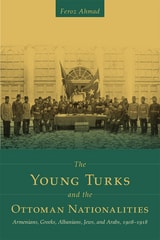
The Young Turks and the Ottoman Nationalities
Armenians, Greeks, Albanians, Jews, and Arabs, 1908–1918Feroz Ahmad
University of Utah Press, 2014
Ahmad holds that nationalism was introduced into the Ottoman Empire during the French Revolution, providing kindling for the struggles that later emerged. Setting the stage with this nineteenth-century background, Ahmad then examines each Ottoman nationality in the wake of the restoration of the Ottoman constitution in 1908. Officially known as the Committee of Union and Progress (CUP), the Young Turks made up a nationalist political party that ruled the Ottoman Empire from 1908 until the end of World War I. Ahmad illuminates the relationships and conflicts between the Young Turks and the Greek, Armenian, Albanian, Jewish, and Arab ethnic groups during this period. Placing these nationalities in their historical context, he shows their relationships not only to the Young Turks but also to one anotherno other single book has attempted to look closely at all of these connections.
Anyone interested in understanding the roots of current-day relations in the Balkans and Middle East will find this book very informative. Clearly organized and written, the book will enlighten both readers and scholars.
War and Collapse
World War I and the Ottoman StateEdited by M. Hakan Yavuz with Feroz Ahmad
University of Utah Press, 2015