Results by title
3 books match the query '1911-1985'
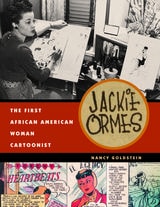
Jackie Ormes
The First African American Woman CartoonistNancy Goldstein
University of Michigan Press, 2008
At a time of few opportunities for women in general and even fewer for African American women, Jackie Ormes (1911–85) blazed a trail as a popular cartoonist with the major black newspapers of the day. Her cartoon characters (including Torchy Brown, Candy, Patty-Jo, and Ginger) delighted readers and spawned other products, including an elegant doll with a stylish wardrobe and “Torchy Togs” paper dolls. Ormes was a member of Chicago’s black elite, with a social circle that included the leading political figures and entertainers of the day. Her cartoons and comic strips provide an invaluable glimpse into American culture and history, with topics that include racial segregation, U.S. foreign policy, educational equality, the atom bomb, and environmental pollution, among other pressing issues of the times—and of today’s world as well. This celebrated biography features a large sampling of Ormes’s cartoons and comic strips, and a new preface.
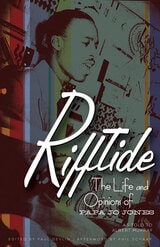
Rifftide
The Life and Opinions of Papa Jo JonesPapa Jo Jones
University of Minnesota Press, 2011
Finalist for Best Jazz Book of the Year Award from the Jazz Journalists Association
The things that I have, I’ll give to you. This is my legacy with you, Albert. This is my last hoo-rah. So begins the autobiography of Jonathan David Samuel Jones—or as the world better knows him, Papa Jo Jones. Playing with Count Basie and his orchestra when they exploded out of Kansas City in 1936 and took the world by storm, Jones went on to inspire generations of jazz drummers, but until now few have had access to his own remarkable story.
Rifftide presents Jones’s inimitable life and opinions, as originally told by Jones to the prominent jazz historian and novelist Albert Murray and now transcribed, arranged, and introduced by Paul Devlin. Drawn from fourteen tapes recorded over eight years beginning in 1977, Rifftide is an impressionistic series of riffs and tales by Jones: his life as a musician on the road in segregated America, his outstanding solo career following his years with the Basie band, and his interactions with iconic artists and cultural figures of the time, including Ralph Ellison, James Baldwin, Langston Hughes, Duke Ellington, Louis Armstrong, Bill “Bojangles” Robinson, and Satchell Paige.
A true American original and jazz luminary, Papa Jo Jones bedazzled and intrigued many with his outrageous, volatile personality and his innovative drumming—and nowhere does his fierce intellect and humor shine more marvelously than in his life’s telling. With a fascinating introduction and annotations by Paul Devlin and an afterword by Phil Schaap, jazz historian and longtime friend of Jones, Rifftide reveals a man at the forefront of both a whole new form of music and a country in the midst of incredible turmoil and opportunity. As Jones himself puts it: Listen man, I’ve had a hell of a time . . .
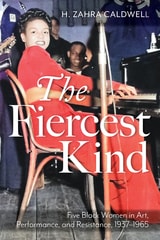
The Fiercest Kind
Five Black Women in Art, Performance, and Resistance, 1937–1965H. Zahra Caldwell
University of Massachusetts Press, 2026
Artists fighting racism and sexism from the end of the Great Depression through the Civil Rights era
In 1943, the production of the Columbia Pictures film The Heat’s On halted for three days due to an on-set protest by featured performer Hazel Scott. Appalled by the racially demeaning and stereotypical depictions of Black women extras and dancers, Scott—one of the top African American performers of the era—forced the studio to relent. But her protest of Hollywood racism angered powerful white men in the industry, and despite her rising career, she was soon banished from American film.
Scott was far from the only Black woman in a creative field to use her professional success as leverage against prejudice. In The Fiercest Kind, cultural historian H. Zahra Caldwell explores the biographical narratives of five Black women at the top of their artistic crafts in the mid-20th century to understand how they pushed back against racism and sexism. From 1937–1965, pianist Hazel Scott, dancer Katherine Dunham, cartoonist Jackie Ormes, multihyphenate fine artist (graphic artist, painter, and sculptor) Elizabeth Catlett, and singer Lena Horne were among the most popular and nationally known Black women in their respective fields, spanning film, television, print media, and fine art. Generating creative works at the end of the Great Depression through the Civil Rights era, they used their professional and personal lives to confront seemingly insurmountable repression through what Caldwell defines as “layered resistance.”
A Black feminist practice, layered resistance consists of four tactics: claiming and adapting cultural spaces for Black women; strategically crafting positive images of Black womanhood that directly challenge white supremacy; combining performance and/or visual representation with social and political activism; and choosing unconventional lifestyles that defy rigid gender and racial norms. These artists also lived in, worked in, and supported important Black spaces such as Harlem and Black Chicago. Using a methodology that combines textual analysis, archival research, and oral history, Caldwell understands this strategy within larger movements for Black freedom and equality that spanned the twentieth century and continue to the present day.