Results by title

4 books match the query '1912-1945'
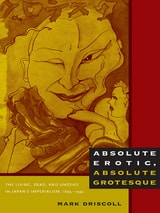
cover of Absolute Erotic, Absolute Grotesque: The Living, Dead, and Undead in Japan's Imperialism, 1895-1945

Absolute Erotic, Absolute Grotesque

The Living, Dead, and Undead in Japan's Imperialism, 1895-1945

Mark Driscoll

Duke University Press, 2010
In this major reassessment of Japanese imperialism in Asia, Mark Driscoll foregrounds the role of human life and labor. Drawing on subaltern postcolonial studies and Marxism, he directs critical attention to the peripheries, where figures including Chinese coolies, Japanese pimps, trafficked Japanese women, and Korean tenant farmers supplied the vital energy that drove Japan's empire. He identifies three phases of Japan's capitalist expansion, each powered by distinct modes of capturing and expropriating life and labor: biopolitics (1895–1914), neuropolitics (1920–32), and necropolitics (1935-45). During the first phase, Japanese elites harnessed the labor of marginalized subjects as Japan colonized Taiwan, Korea, and south Manchuria, and sent hustlers and sex workers into China to expand its market hegemony. Linking the deformed bodies laboring in the peripheries with the "erotic-grotesque" media in the metropole, Driscoll centers the second phase on commercial sexology, pornography, and detective stories in Tokyo to argue that by 1930, capitalism had colonized all aspects of human life: not just labor practices but also consumers’ attention and leisure time. Focusing on Japan's Manchukuo colony in the third phase, he shows what happens to the central figures of biopolitics as they are subsumed under necropolitical capitalism: coolies become forced laborers, pimps turn into state officials and authorized narcotraffickers, and sex workers become "comfort women". Driscoll concludes by discussing Chinese fiction written inside Manchukuo, describing the everyday violence unleashed by necropolitics.
[more]
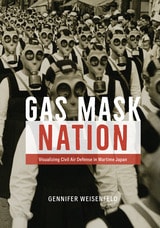
cover of Gas Mask Nation: Visualizing Civil Air Defense in Wartime Japan

Gas Mask Nation

Visualizing Civil Air Defense in Wartime Japan

Gennifer Weisenfeld

University of Chicago Press, 2023

A fascinating look at the anxious pleasures of Japanese visual culture during World War II.
 
Airplanes, gas masks, and bombs were common images in wartime Japan. Yet amid these emblems of anxiety, tasty caramels were offered to children with paper gas masks as promotional giveaways, and magazines featured everything from attractive models in the latest civil defense fashion to futuristic weapons.
 
Gas Mask Nation
explores the multilayered construction of an anxious yet perversely pleasurable visual culture of Japanese civil air defense—or bōkū—through a diverse range of artworks, photographs, films and newsreels, magazine illustrations, postcards, cartoons, advertising, fashion, everyday goods, government posters, and state propaganda. Gennifer Weisenfeld reveals the immersive aspects of this culture, in which Japan’s imperial subjects were mobilized to regularly perform highly orchestrated civil air defense drills throughout the country.
 
The war years in Japan are often portrayed as a landscape of privation and suppression under the censorship of the war machine. But alongside the horrors, pleasure, desire, wonder, creativity, and humor were all still abundantly present in a period before air raids went from being a fearful specter to a deadly reality.
 
[more]
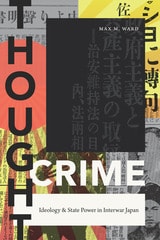
cover of Thought Crime: Ideology and State Power in Interwar Japan

Thought Crime

Ideology and State Power in Interwar Japan

Max M. Ward

Duke University Press, 2019
In Thought Crime Max M. Ward explores the Japanese state's efforts to suppress political radicalism in the 1920s and 1930s. Ward traces the evolution of an antiradical law called the Peace Preservation Law, from its initial application to suppress communism and anticolonial nationalism—what authorities deemed thought crime—to its expansion into an elaborate system to reform and ideologically convert thousands of thought criminals throughout the Japanese Empire. To enforce the law, the government enlisted a number of nonstate actors, who included monks, family members, and community leaders. Throughout, Ward illuminates the complex processes through which the law articulated imperial ideology and how this ideology was transformed and disseminated through the law's application over its twenty-year history. In so doing, he shows how the Peace Preservation Law provides a window into understanding how modern states develop ideological apparatuses to subject their respective populations.
[more]
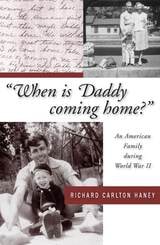
cover of When is Daddy Coming Home?: An American Family during World War II

When is Daddy Coming Home?

An American Family during World War II

Richard Carlton Haney

Wisconsin Historical Society Press, 2024

Now in paperback, a bestselling memoir of a family on the home front during World War II

World War II was coming to a close in Europe and Richard Haney was only four years old when the telegram arrived at his family's home in Janesville, Wisconsin. That moment, when Haney learned of his father's death in the final months of fighting, changed his and his mother's lives forever.

In this powerful book, Haney explores the impact of war on an American family. He skillfully weaves together those memories with his parents' wartime letters and his mother's recollections to create a unique blend of history and memoir. Through his father's letters he reveals the war's effect on a man who fought in the Battle of the Bulge with the 17th Airborne but wanted nothing more than to return home. Haney illuminates life on the home front in small-town America as well, describing how profoundly the war changed such communities.

With When Is Daddy Coming Home?, Richard Haney makes an exceptional contribution to the literature on the Greatest Generation—one that is both devastatingly personal and representative of what families all over America endured during that testing time.

[more]