Results by title

5 books match the query '1912-1949'
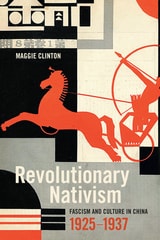
cover of Revolutionary Nativism: Fascism and Culture in China, 1925-1937

Revolutionary Nativism

Fascism and Culture in China, 1925-1937

Maggie Clinton

Duke University Press, 2017
In Revolutionary Nativism Maggie Clinton traces the history and cultural politics of fascist organizations that operated under the umbrella of the Chinese Nationalist Party (GMD) during the 1920s and 1930s. Clinton argues that fascism was not imported to China from Europe or Japan; rather it emerged from the charged social conditions that prevailed in the country's southern and coastal regions during the interwar period. These fascist groups were led by young militants who believed that reviving China's Confucian "national spirit" could foster the discipline and social cohesion necessary to defend China against imperialism and Communism and to develop formidable industrial and military capacities, thereby securing national strength in a competitive international arena. Fascists within the GMD deployed modernist aesthetics in their literature and art while justifying their anti-Communist violence with nativist discourse. Showing how the GMD's fascist factions popularized a virulently nationalist rhetoric that linked Confucianism with a specific path of industrial development, Clinton sheds new light on the complex dynamics of Chinese nationalism and modernity.
[more]
cover of Saving the Nation: Economic Modernity in Republican China

Saving the Nation

Economic Modernity in Republican China

Margherita Zanasi

University of Chicago Press, 2006

Economic modernity is so closely associated with nationhood that it is impossible to imagine a modern state without an equally modern economy. Even so, most people would have difficulty defining a modern economy and its connection to nationhood. In Saving the Nation, Margherita Zanasi explores this connection by examining the first nation-building attempt in China after the fall of the empire in 1911.

Challenging the assumption that nations are products of technological and socioeconomic forces, Zanasi argues that it was notions of what constituted a modern nation that led the Nationalist nation-builders to shape China’s institutions and economy. In their reform effort, they confronted several questions: What characterized a modern economy? What role would a modern economy play in the overall nation-building effort? And how could China pursue economic modernization while maintaining its distinctive identity? Zanasi expertly shows how these questions were negotiated and contested within the Nationalist Party. Silenced in the Mao years, these dilemmas are reemerging today as a new leadership once again redefines the economic foundation of the nation.
[more]
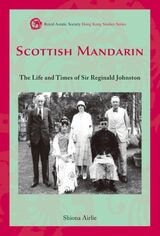
cover of Scottish Mandarin: The Life and Times of Sir Reginald Johnston

Scottish Mandarin

The Life and Times of Sir Reginald Johnston

Shiona Airlie

Hong Kong University Press, 2012
Colonial administrator, writer, explorer, Buddhist, and friend to China's last emperor, Sir Reginald Johnston (1874–1938) was a distinguished sinologist with a tangled love and family life that he kept secret even from his closest friends. Born and educated in Edinburgh, he began his career in the colony of Hong Kong and eventually became Commissioner of the remote British leased territory of Weihai in northern China. He travelled widely and, during a break from colonial service, served as tutor and advisor to Puyi, the deposed emperor. As the only foreigner allowed to work in the Forbidden City, he wrote the classic account of the last days of the Qing Dynasty—Twilight in the Forbidden City. Granted unique access to Johnston's extensive personal papers, once thought to be lost, Shiona Airlie tells the life of a complex and sensitive character whose career made a deep impression on 20th-century China.
[more]
cover of Swallows and Settlers: The Great Migration from North China to Manchuria

Swallows and Settlers

The Great Migration from North China to Manchuria

Thomas R. Gottschang and Diana Lary

University of Michigan Press, 2000
Between the 1890s and the Second World War, twenty-five million people traveled from the densely populated North China provinces of Shandong and Hebei to seek employment in the growing economy of China's three northeastern provinces, the area known as Manchuria. This was the greatest population movement in modern Chinese history and ranks among the largest migrations in the world.
Swallows and Settlers is the first comprehensive study of that migration. Drawing methods from their respective fields of economics and history, the coauthors focus on both the broad quantitative outlines of the movement and on the decisions and experiences of individual migrants and their families. In readable narrative prose, the book lays out the historical relationship between North China and the Northeast (Manchuria) and concludes with an examination of ongoing population movement between these regions since the founding of the People's Republic in 1949.
[more]
cover of The Magic of Concepts: History and the Economic in Twentieth-Century China

The Magic of Concepts

History and the Economic in Twentieth-Century China

Rebecca E. Karl

Duke University Press, 2017

In The Magic of Concepts Rebecca E. Karl interrogates "the economic" as concept and practice as it was construed historically in China in the 1930s and again in the 1980s and 1990s. Separated by the Chinese Revolution and Mao's socialist experiments, each era witnessed urgent discussions about how to think about economic concepts derived from capitalism in modern China. Both eras were highly cosmopolitan and each faced its own global crisis in economic and historical philosophy: in the 1930s, capitalism's failures suggested that socialism offered a plausible solution, while the abandonment of socialism five decades later provoked a rethinking of the relationship between history and the economic as social practice. Interweaving a critical historiography of modern China with the work of the Marxist-trained economist Wang Yanan, Karl shows how "magical concepts" based on dehistoricized Eurocentric and capitalist conceptions of historical activity that purport to exist outside lived experiences have erased much of the critical import of China's twentieth-century history. In this volume, Karl retrieves the economic to argue for a more nuanced and critical account of twentieth-century Chinese and global historical practice.
[more]