Results by title

8 books match the query '1913-1921'

cover of AMBASSADORIAL DIARIES: THE COURT OF ST. JAMES'S 1918-1921

AMBASSADORIAL DIARIES

THE COURT OF ST. JAMES'S 1918-1921

JULIA DAVIS

West Virginia University Press, 1993

John W. Davis (1873-1955) was the most important national politician to call West Virginia home. Nominated for president by the Democratic Party in 1924, Davis lost to the incumbent Calvin Coolidge. This diary is an engaging day-by-day account of Davis's service as U.S. ambassador to England at a pivotal point in modern history. The recent World War and Russian Revolution, the new thirst for oil, the old strife in Ireland, and the final days of the Wilson presidency fill this diary with enduring significance. Davis also offers a look at the personalities which shaped the post-war world and describes the pageantry and social life of America's most coveted ambassadorial assignment.

[more]
cover of Herbert Hoover: Great War And Its Aftermath

Herbert Hoover

Great War And Its Aftermath

Lawrence E. Gelfand

University of Iowa Press, 1979
[more]
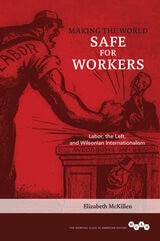
cover of Making the World Safe for Workers: Labor, the Left, and Wilsonian Internationalism

Making the World Safe for Workers

Labor, the Left, and Wilsonian Internationalism

Elizabeth McKillen

University of Illinois Press, 2018
 
In this intellectually ambitious study, Elizabeth McKillen explores the significance of Wilsonian internationalism for workers and the influence of American labor in both shaping and undermining the foreign policies and war mobilization efforts of Woodrow Wilson's administration. McKillen highlights the major fault lines and conflicts that emerged within labor circles as Wilson pursued his agenda in the context of Mexican and European revolutions, World War I, and the Versailles Peace Conference. As McKillen shows, the choice to collaborate with or resist U.S. foreign policy remained an important one for labor throughout the twentieth century. In fact, it continues to resonate today in debates over the global economy, wars in Iraq and Afghanistan, and the impact of U.S. policies on workers at home and abroad.

[more]
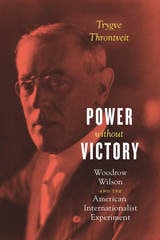
cover of Power without Victory: Woodrow Wilson and the American Internationalist Experiment

Power without Victory

Woodrow Wilson and the American Internationalist Experiment

Trygve Throntveit

University of Chicago Press, 2017

For decades, Woodrow Wilson has been remembered as either a paternalistic liberal or reactionary conservative at home and as a naïve idealist or cynical imperialist abroad. Historians’ harsh judgments of Wilson are understandable. He won two elections by promising a deliberative democratic process that would ensure justice and political empowerment for all. Yet under Wilson, Jim Crow persisted, interventions in Latin America increased, and a humiliating peace settlement was forced upon Germany. A generation after Wilson, stark inequalities and injustices still plagued the nation, myopic nationalism hindered its responsible engagement in world affairs, and a second vastly destructive global conflict threatened the survival of democracy worldwide—leaving some Americans today to wonder what, exactly, the buildings and programs bearing his name are commemorating.

In Power without Victory, Trygve Throntveit argues that there is more to the story of Wilson than these sad truths. Throntveit makes the case that Wilson was not a “Wilsonian,” as that term has come to be understood, but a principled pragmatist in the tradition of William James. He did not seek to stamp American-style democracy on other peoples, but to enable the gradual development of a genuinely global system of governance that would maintain justice and facilitate peaceful change—a goal that, contrary to historical tradition, the American people embraced. In this brilliant intellectual, cultural, and political history, Throntveit gives us a new vision of Wilson, as well as a model of how to think about the complex relationship between the world of ideas and the worlds of policy and diplomacy.
[more]
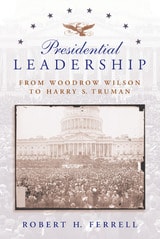
cover of Presidential Leadership: From Woodrow Wilson to Harry S. Truman

Presidential Leadership

From Woodrow Wilson to Harry S. Truman

Robert H. Ferrell

University of Missouri Press, 2005
Ever since the presidency of Richard M. Nixon, scholars have been in a quandary over how much they really know about our country’s presidents. Nixon, as is now understood, was unstable in personality. The signs appeared well before the discovery of the infamous Watergate tapes, an appalling example of what the presidency could come to. Many Americans have difficulty penetrating the public persona of their leaders. But to know the private side of such figures—the cores of their being—is important, because this side often governs what they do publicly.
In Presidential Leadership, Robert H. Ferrell examines four sometimes maligned, sometimes misunderstood presidents: Woodrow Wilson, Warren G. Harding, Calvin Coolidge, and Harry S. Truman. Along with these portraits, Ferrell incorporates comments on Hoover and Franklin Delano Roosevelt as well as key figures in each president’s administration. Also included in this volume is historian John A. Garraty’s interview with Ferrell on American foreign policy from 1919 to 1945.
As is his style, Ferrell draws from many sources previously untapped. In the case of Wilson, Ferrell relies on the diary of Colonel Edward M. House, who served under Wilson during his presidency. Ferrell uses White House physician Joel T. Boone’s diary to provide an insider’s look at Harding, Coolidge, and Hoover. In dealing with these presidents, Ferrell debunks long-held myths and approaches the presidencies with fresh insights into what drove them to make the decisions they made.
Throughout the book, Ferrell emphasizes the personal styles of each president. He not only shows how they made their own determinations but also evaluates those whom they appointed to important positions. Scholars of American history will welcome this insightful look at the men who saw the United States through the first half of the twentieth century.
[more]
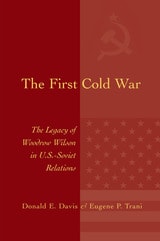
cover of The First Cold War: The Legacy of Woodrow Wilson in U.S. - Soviet Relations

The First Cold War

The Legacy of Woodrow Wilson in U.S. - Soviet Relations

Donald E. Davis & Eugene P. Trani

University of Missouri Press, 2002
In The First Cold War, Donald E. Davis and Eugene P. Trani review the Wilson administration’s attitudes toward Russia before, during, and after the Bolshevik seizure of power. They argue that before the Russian Revolution, Woodrow Wilson had little understanding of Russia and made poor appointments that cost the United States Russian goodwill. Wilson later reversed those negative impressions by being the first to recognize Russia’s Provisional Government, resulting in positive U.S.–Russian relations until Lenin gained power in 1917.
Wilson at first seemed unsure whether to recognize or repudiate Lenin and the Bolsheviks. His vacillation finally ended in a firm repudiation when he opted for a diplomatic quarantine having almost all of the ingredients of the later Cold War. Davis and Trani argue that Wilson deserves mild criticism for his early indecision and inability to form a coherent policy toward what would become the Soviet Union. But they believe Wilson rightly came to the conclusion that until the regime became more moderate, it was useless for America to engage it diplomatically.
The authors see in Wilson’s approach the foundations for the “first Cold War”—meaning not simply a refusal to recognize the Soviet Union, but a strong belief that its influence was harmful and would spread if not contained or quarantined. Wilson’s Soviet policy in essence lasted until Roosevelt extended diplomatic recognition in the 1930s. But The First Cold War suggests that Wilson’s impact extended beyond Roosevelt to Truman, showing that the policies of Wilson and Truman closely resemble each other with the exception of an arms race. Wilson’s intellectual reputation lent credibility to U.S. Cold War policy from Truman to Reagan, and the reader can draw a direct connection from Wilson to the collapse of the USSR. Wilsonians were the first Cold War warriors, and in the era of President Woodrow Wilson, the first Cold War began.
[more]
cover of The Rise of the Ku Klux Klan: Right-Wing Movements and National Politics

The Rise of the Ku Klux Klan

Right-Wing Movements and National Politics

Rory McVeigh

University of Minnesota Press, 2009
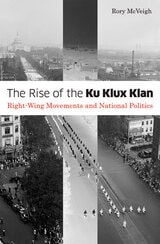
In 1915, forty years after the original Ku Klux Klan disbanded, a former farmer, circuit preacher, and university lecturer named Colonel William Joseph Simmons revived the secret society. By the early 1920s the KKK had been transformed into a national movement with millions of dues-paying members and chapters in all of the nation’s forty-eight states. And unlike the Reconstruction-era society, the Klan in the 1920s exerted its influence far beyond the South. In The Rise of the Ku Klux Klan, Rory McVeigh provides a revealing analysis of the broad social agenda of 1920s-era KKK, showing that although the organization continued to promote white supremacy, it also addressed a surprisingly wide range of social and economic issues, targeting immigrants and, particularly, Catholics, as well as African Americans, as dangers to American society. In sharp contrast to earlier studies of the KKK, which focus on the local or regional level, McVeigh treats the Klan as it saw itself—as a national organization concerned with national issues. Drawing on extensive research into the Klan’s national publication, the Imperial Night-Hawk, he traces the ways in which Klan leaders interpreted national issues and how they attempted—and finally failed—to influence national politics. More broadly, in detailing the Klan’s expansion in the early 1920s and its collapse by the end of the decade, McVeigh ultimately sheds light on the dynamics that fuel contemporary right-wing social movements that similarly blur the line between race, religion, and values. 
[more]
cover of York's Ride: A Novel of Old California

York's Ride

A Novel of Old California

Michael Dennis Cassity

University of Nevada Press, 2025

In 1914, most of the world is focused on The Great War, but a much quieter story is taking place in a remote mountain region in northern California and western Nevada with the tale of two twelve-year-old boys and a legendary, wild horse from the desert. The stallion, Meshuga—part mustang and part giant Percheron draft —is a stallion so strong that he becomes a mythical, inspirational fable. Meshuga is destined to compete in a long-distance race through the mountains and valleys against the nation’s best Arabian horses.

Jim, an orphan, has moved to the West to live on his Uncle Martin and Aunt Hanna’s ranch in the small, post-Gold Rush town of Taylorsville where the Sierra Nevada meets the Cascades. Mostly, Jim doesn’t miss his family farm in Missouri, and when he’s not doing ranch chores, he spends his time fly-fishing on nearby Indian Creek. This is where he first encounters York, a local boy from the Maidu tribe, and the two become fast friends. Jim and York soon meet up with Blind Charlie, a famous Maidu elder storyteller, who fills their heads with ancestral myths and legends.

After the untimely death of York, Meshuga’s caretaker, Jim is suddenly moved to take responsibility for the great black mustang and become part of Blind Charlie’s prophecies. With York gone, Jim must fulfill what his friend knew all along—that he and Meshuga would learn to conquer the challenge of the race of the century. A romantic novel of the Old West imbued with rich historical details, York’s Ride is a complex and beautiful tale about family relationships and coming-of-age in early twentieth-century California.
 
[more]