Results by title
2 books match the query '1914-1996'
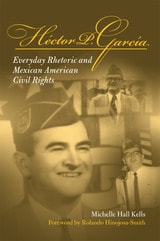
Hector P Garcia
Everyday Rhetoric and Mexican American Civil RightsMichelle Hall Kells. Foreword by Rolando Hinojosa-Smith
Southern Illinois University Press, 2006
Examining the Mexican American civil rights movement through the public rhetoric of a veteran activist
Héctor P. García: Everyday Rhetoric and Mexican American Civil Rights examines the transition of Mexican Americans from political and social marginalization to civic inclusion after World War II. Focusing on the public rhetoric of veteran rights activist and physician Dr. Héctor P. García, a Mexican immigrant who achieved unprecedented influence within the U.S. political system, author Michelle Hall Kells provides an important case study in the exercise of influence, the formation of civic identity, and the acquisition of social power among this underrepresented group.
As a major influence in national twentieth-century civil rights reform, García effectively operated between Anglo and Mexican American sociopolitical structures. The volume illustrates how García, a decorated World War II veteran and founder of the American GI Forum in Texas in 1948, successfully engendered a discourse that crossed geographical, political, and cultural borders, forming associations with the working poor as well as with prominent national figures such as John F. Kennedy and Lyndon B. Johnson. Through his rhetoric and action, García publicly revealed the plight of Mexican Americans, crossing class, regional, and racial lines to improve socioeconomic conditions for his people.
Héctor P. García, which is enhanced by sixteen illustrations, contributes to rhetorical, cultural, and historical studies and offers new scholarship establishing García’s role on the national front, effectively tracing Garcia’s legacy of resistance, the process of achieving enfranchisement, and the role of racism in the evolution from social marginalization to national influence.
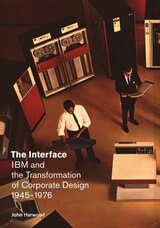
The Interface
IBM and the Transformation of Corporate Design, 1945–1976John Harwood
University of Minnesota Press, 2016
In February 1956 the president of IBM, Thomas Watson Jr., hired the industrial designer and architect Eliot F. Noyes, charging him with reinventing IBM’s corporate image, from stationery and curtains to products such as typewriters and computers and to laboratory and administration buildings. What followed—a story told in full for the first time in John Harwood’s The Interface—remade IBM in a way that would also transform the relationships between design, computer science, and corporate culture.
IBM’s program assembled a cast of leading figures in American design: Noyes, Charles Eames, Paul Rand, George Nelson, and Edgar Kaufmann Jr. The Interface offers a detailed account of the key role these designers played in shaping both the computer and the multinational corporation. Harwood describes a surprising inverse effect: the influence of computer and corporation on the theory and practice of design. Here we see how, in the period stretching from the “invention” of the computer during World War II to the appearance of the personal computer in the mid-1970s, disciplines once well outside the realm of architectural design—information and management theory, cybernetics, ergonomics, computer science—became integral aspects of design.
As the first critical history of the industrial design of the computer, of Eliot Noyes’s career, and of some of the most important work of the Office of Charles and Ray Eames, The Interface supplies a crucial chapter in the story of architecture and design in postwar America—and an invaluable perspective on the computer and corporate cultures of today.