Results by title
14 books match the query '1917-1948'
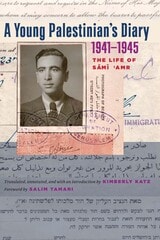
A Young Palestinian's Diary, 1941–1945
The Life of Sami 'AmrTranslated, annotated, and with an introduction by Kimberly Katz
University of Texas Press, 2009
Writing in his late teens and early twenties, Sāmī ‘Amr gave his diary an apt subtitle: The Battle of Life, encapsulating both the political climate of Palestine in the waning years of the British Mandate as well as the contrasting joys and troubles of family life. Now translated from the Arabic, Sāmī's diary represents a rare artifact of turbulent change in the Middle East.
Written over four years, these ruminations of a young man from Hebron brim with revelations about daily life against a backdrop of tremendous transition. Describing the public and the private, the modern and the traditional, Sāmī muses on relationships, his station in life, and other universal experiences while sharing numerous details about a pivotal moment in Palestine's modern history. Making these never-before-published reflections available in translation, Kimberly Katz also provides illuminating context for Sāmī's words, laying out biographical details of Sāmī, who kept his diary private for close to sixty years. One of a limited number of Palestinian diaries available to English-language readers, the diary of Sāmī ‘Amr bridges significant chasms in our understanding of Middle Eastern, and particularly Palestinian, history.
An Aesthetic Occupation
The Immediacy of Architecture and the Palestine ConflictDaniel Bertrand Monk
Duke University Press, 2002
In An Aesthetic Occupation Daniel Bertrand Monk unearths the history of the unquestioned political immediacy of “sacred” architecture in the conflict between Palestinians and Israelis. Monk combines groundbreaking archival research with theoretical insights to examine in particular the Mandate era—the period in the first half of the twentieth century when Britain held sovereignty over Palestine. While examining the relation between monuments and mass violence in this context, he documents Palestinian, Zionist, and British attempts to advance competing arguments concerning architecture’s utility to politics.
Succumbing neither to the view that monuments are autonomous figures onto which political meaning has been projected, nor to the obverse claim that in Jerusalem shrines are immediate manifestations of the political, Monk traces the reciprocal history of both these positions as well as describes how opponents in the conflict debated and theorized their own participation in its self-representation. Analyzing controversies over the authenticity of holy sites, the restorations of the Dome of the Rock, and the discourse of accusation following the Buraq, or Wailing Wall, riots of 1929, Monk discloses for the first time that, as combatants looked to architecture and invoked the transparency of their own historical situation, they simultaneously advanced—and normalized—the conflict’s inability to account for itself.
This balanced and unique study will appeal to anyone interested in Israel or Zionism, the Palestinians, the Middle East conflict, Jerusalem, or its monuments. Scholars of architecture, political theory, and religion, as well as cultural and critical studies will also be informed by its arguments.
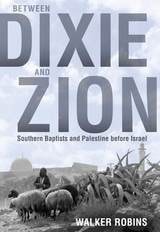
Between Dixie and Zion
Southern Baptists and Palestine before IsraelWalker Robins
University of Alabama Press, 2020
Explores the roots of evangelical Christian support for Israel through an examination of the Southern Baptist Convention
One week after the establishment of the State of Israel in 1948, delegates to the Southern Baptist Convention (SBC) repeatedly and overwhelmingly voted down resolutions congratulating fellow Southern Baptist Harry Truman on his role in Israel’s creation. From today’s perspective, this seems like a shocking result. After all, Christians—particularly the white evangelical Protestants who populate the SBC—are now the largest pro-Israel constituency in the United States. How could conservative evangelicals have been so hesitant in celebrating Israel’s birth in 1948? How did they then come to be so supportive?
Between Dixie and Zion: Southern Baptists and Palestine before Israel addresses these issues by exploring how Southern Baptists engaged what was called the “Palestine question”: whether Jews or Arabs would, or should, control the Holy Land after World War I. Walker Robins argues that, in the decades leading up to the creation of Israel, most Southern Baptists did not directly engage the Palestine question politically. Rather, they engaged it indirectly through a variety of encounters with the land, the peoples, and the politics of Palestine. Among the instrumental figures featured by Robins are tourists, foreign missionaries, Arab pastors, converts from Judaism, biblical interpreters, fundamentalist rebels, editorialists, and, of course, even a president. While all revered Palestine as the Holy Land, each approached and encountered the region according to their own priorities.
Nevertheless, Robins shows that Baptists consistently looked at the region through an Orientalist framework, broadly associating the Zionist movement with Western civilization, modernity, and progress over and against the Arabs, whom they viewed as uncivilized, premodern, and backward. He argues that such impressions were not idle—they suggested that the Zionists were bringing to fruition Baptists’ long-expressed hopes that Israel would regain the prosperity it had held in the biblical era, the Holy Land would one day be revived, and biblical prophecies preceding the return of Christ would be fulfilled.
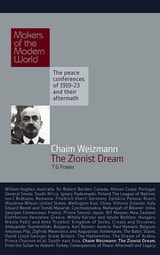
Chaim Weizmann
The Zionist DreamTom Fraser
Haus Publishing, 2009
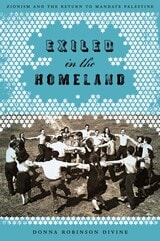
Exiled in the Homeland
Zionism and the Return to Mandate PalestineBy Donna Robinson Divine
University of Texas Press, 2009
Offering a new perspective on Zionism, Exiled in the Homeland draws on memoirs, newspaper accounts, and archival material to examine closely the lives of the men and women who immigrated to Palestine in the early twentieth century. Rather than reducing these historic settlements to a single, unified theme, Donna Robinson Divine's research reveals an extraordinary spectrum of motivations and experiences among these populations.
Though British rule and the yearning for a Jewish national home contributed to a foundation of solidarity, Exiled in the Homeland presents the many ways in which the message of emigration settled into the consciousness of the settlers. Considering the benefits and costs of their Zionist commitments, Divine explores a variety of motivations and outcomes, ranging from those newly arrived immigrants who harnessed their ambition for the goal of radical transformation to those who simply dreamed of living a better life. Also capturing the day-to-day experiences in families that faced scarce resources, as well as the British policies that shaped a variety of personal decisions on the part of the newcomers, Exiled in the Homeland provides new keys to understanding this pivotal chapter in Jewish history.

From Coexistence to Conquest
International Law and the Origins of the Arab-Israeli Conflict, 1891-1949Victor Kattan
Pluto Press, 2009
From Coexistence to Conquest seeks to explain how the Arab-Israeli conflict developed by looking beyond strict legalism to the men behind the policies adopted by the Great Powers at the dawn of the twentieth century. It controversially argues that Zionism was adopted by the British Government in its 1917 Balfour Declaration primarily as an immigration device and that it can be traced back to the 1903 Royal Commission on Alien Immigration and the Alien’s Act 1905.
The book places the violent reaction of the Palestine Arabs to mass Jewish immigration in the context of Zionism, highlighting the findings of several British commissions of inquiry which recommended that Britain abandon its policy. The book also revisits the controversies over the question of self-determination, and the partition of Palestine.
The Chapter on the 1948 conflict seeks to update international lawyers on the scholarship of Israel’s ‘new’ historians and reproduces some of the horrific accounts of the atrocities that took place. The penultimate chapter argues that Israel was created through an act of conquest or subjugation. The book concludes with a sobering analysis of the conflict arguing that neither Jews nor Arabs were to blame for starting it.
Girls of Liberty
The Struggle for Suffrage in Mandatory PalestineMargalit Shilo
Brandeis University Press, 2016
Israel
A HistoryAnita Shapira
Brandeis University Press, 2014
Land and Desire in Early Zionism
Boaz Neumann
Brandeis University Press, 2011
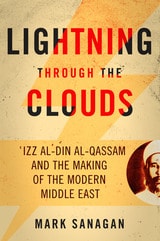
Lightning through the Clouds
?Izz al-Din al-Qassam and the Making of the Modern Middle EastBy Mark Sanagan
University of Texas Press, 2020
Lightning through the Clouds is the first English-language life-and-times biography of ‘Izz al-Din al-Qassam, a preeminent figure who helped to reshape the political and religious landscape of the region. A Syrian-born, Egyptian-educated cleric, he went from the battlefields of World War I to join the anticolonialist fight against the French in Syria. Sentenced to be executed by the French military, he managed to escape to Palestine, where he became an increasingly popular presence, moved by the plight of the poor and disenfranchised. Outraged by British rule and the encroachment of Zionism, he formed a secret society to resist the colonization of Palestine first by the British and then by Jewish immigrants from Europe, once again taking up arms and advocating for a moral, political, and military jihad as the only solution. His death at the hands of Palestine Police in 1935 drew thousands to his funeral and sparked the 1936–1939 Arab Revolt.
His influence continues to be felt in the region; for example, the military wing of the Palestinian Hamas organization is named the ‘Izz al-Din al-Qassam Brigades. Al-Qassam is either revered or reviled, depending on the observers’ perspective, but he is without doubt a fascinating and historically significant individual whose influence on the past, and our present, makes this examination of his life both important and timely.
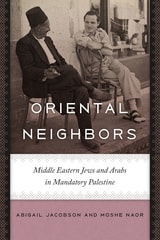
Oriental Neighbors
Middle Eastern Jews and Arabs in Mandatory PalestineAbigail Jacobson and Moshe Naor
Brandeis University Press, 2016
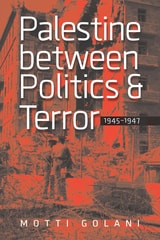
Palestine between Politics and Terror, 1945–1947
Motti Golani
Brandeis University Press, 2013
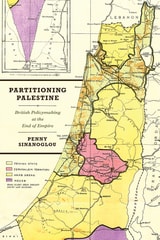
Partitioning Palestine
British Policymaking at the End of EmpirePenny Sinanoglou
University of Chicago Press, 2019
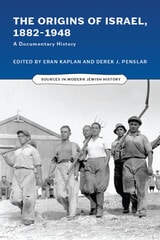
The Origins of Israel, 1882–1948
A Documentary HistoryEran Kaplan
University of Wisconsin Press, 2011
In 1880 the Jewish community in Palestine encompassed some 20,000 Orthodox Jews; within sixty-five years it was transformed into a secular proto-state with well-developed political, military, and economic institutions, a vigorous Hebrew-language culture, and some 600,000 inhabitants. The Origins of Israel, 1882–1948: A Documentary History chronicles the making of modern Israel before statehood, providing in English the texts of original sources (many translated from Hebrew and other languages) accompanied by extensive introductions and commentaries from the volume editors.
This sourcebook assembles a diverse array of 62 documents, many of them unabridged, to convey the ferment, dissent, energy, and anxiety that permeated the Zionist project from its inception to the creation of the modern nation of Israel. Focusing primarily on social, economic, and cultural history rather than Zionist thought and diplomacy, the texts are organized in themed chapters. They present the views of Zionists from many political and religious camps, factory workers, farm women, militants, intellectuals promoting the Hebrew language and arts—as well as views of ultra-Orthodox anti-Zionists. The volume includes important unabridged documents from the origins of the Arab-Israeli conflict that are often cited but are rarely read in full. The editors, Eran Kaplan and Derek J. Penslar, provide both primary texts and informative notes and commentary, giving readers the opportunity to encounter voices from history and make judgments for themselves about matters of world-historical significance.
Best Special Interest Books, selected by the Public Library Reviewers
Best Books for General Audiences, selected by the American Association of School Librarians