Results by title

4 books match the query '1919-1947'
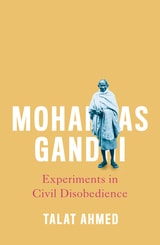
cover of Mohandas Gandhi: Experiments in Civil Disobedience

Mohandas Gandhi

Experiments in Civil Disobedience

Talat Ahmed

Pluto Press, 2016

Mohandas Gandhi, icon of Indian liberation, remains an inspiration for anti-capitalists and peace activists globally. His campaigns for national liberation based on non-violence and mass civil disobedience were critical to defeating the power of the British Empire.

This biography examines his campaigns from South Africa to India to evaluate the successes and failures of non-violent resistance. Seventy years after his death, his legacy remains contested: was he a saint, revolutionary, class conciliator, or self-obsessed spiritual zealot?

The contradictions of Gandhi’s politics are unpicked through an analysis of the social forces at play in the mass movement around him. Entrusted to liberate the oppressed of India, his key support base were industrialists, landlords and the rich peasantry. Gandhi’s moral imperatives often clashed with these vested material interests, as well as with more radical currents to his left.

Today, our world is scarred by permanent wars, racism and violence, environmental destruction and economic crisis. Can non-violent resistance win against state and corporate power? This book explores Gandhi’s experiments in civil disobedience to assess their relevance for struggles today.
[more]
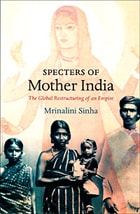
cover of Specters of Mother India: The Global Restructuring of an Empire

Specters of Mother India

The Global Restructuring of an Empire

Mrinalini Sinha

Duke University Press, 2006

Specters of Mother India tells the complex story of one episode that became the tipping point for an important historical transformation. The event at the center of the book is the massive international controversy that followed the 1927 publication of Mother India, an exposé written by the American journalist Katherine Mayo. Mother India provided graphic details of a variety of social ills in India, especially those related to the status of women and to the particular plight of the country’s child wives. According to Mayo, the roots of the social problems she chronicled lay in an irredeemable Hindu culture that rendered India unfit for political self-government. Mother India was reprinted many times in the United States, Great Britain, and India; it was translated into more than a dozen languages; and it was reviewed in virtually every major publication on five continents.

Sinha provides a rich historical narrative of the controversy surrounding Mother India, from the book’s publication through the passage in India of the Child Marriage Restraint Act in the closing months of 1929. She traces the unexpected trajectory of the controversy as critics acknowledged many of the book’s facts only to overturn its central premise. Where Mayo located blame for India’s social backwardness within the beliefs and practices of Hinduism, the critics laid it at the feet of the colonial state, which they charged with impeding necessary social reforms. As Sinha shows, the controversy became a catalyst for some far-reaching changes, including a reconfiguration of the relationship between the political and social spheres in colonial India and the coalescence of a collective identity for women.
[more]
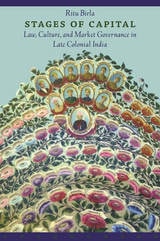
cover of Stages of Capital: Law, Culture, and Market Governance in Late Colonial India

Stages of Capital

Law, Culture, and Market Governance in Late Colonial India

Ritu Birla

Duke University Press, 2009

In Stages of Capital, Ritu Birla brings research on nonwestern capitalisms into conversation with postcolonial studies to illuminate the historical roots of India’s market society. Between 1870 and 1930, the British regime in India implemented a barrage of commercial and contract laws directed at the “free” circulation of capital, including measures regulating companies, income tax, charitable gifting, and pension funds, and procedures distinguishing gambling from speculation and futures trading. Birla argues that this understudied legal infrastructure institutionalized a new object of sovereign management, the market, and along with it, a colonial concept of the public. In jurisprudence, case law, and statutes, colonial market governance enforced an abstract vision of modern society as a public of exchanging, contracting actors free from the anachronistic constraints of indigenous culture.

Birla reveals how the categories of public and private infiltrated colonial commercial law, establishing distinct worlds for economic and cultural practice. This bifurcation was especially apparent in legal dilemmas concerning indigenous or “vernacular” capitalists, crucial engines of credit and production that operated through networks of extended kinship. Focusing on the story of the Marwaris, a powerful business group renowned as a key sector of India’s capitalist class, Birla demonstrates how colonial law governed vernacular capitalists as rarefied cultural actors, so rendering them illegitimate as economic agents. Birla’s innovative attention to the negotiations between vernacular and colonial systems of valuation illustrates how kinship-based commercial groups asserted their legitimacy by challenging and inhabiting the public/private mapping. Highlighting the cultural politics of market governance, Stages of Capital is an unprecedented history of colonial commercial law, its legal fictions, and the formation of the modern economic subject in India.

[more]
cover of The Politics of Preference: Democratic Institutions and Affirmative Action in the United States and India

The Politics of Preference

Democratic Institutions and Affirmative Action in the United States and India

Sunita Parikh

University of Michigan Press, 1997

Sunita Parikh examines the history and fate of affirmative action programs in two ethnically heterogeneous democracies, the United States and India. Affirmative action programs in the United States represent a controversial policy about which the American public feel at best ambivalence and at worst hostility, while in India the expansion of reservation policies in recent years has led to riots and contributed to the fall of governments. And yet these policies were not particularly controversial when they were introduced. How the policy traveled from these auspicious beginnings to its current predicament can best be understood, according to Parikh, by exploring the changing political conditions under which it was introduced, expanded, and then challenged.
Although they are in many respects very different countries, India and the United States are important countries in which to study the implementation of ascriptive policies like affirmative action, according to Parikh. They are both large, heterogeneous societies with democratic political systems in which previously excluded groups were granted benefits by the majorities that had historically oppressed them. Parikh argues that these policies were the product of democratic politics--which required political parties to mobilize existing groups as voters--and the ethnically heterogeneous nature of Indian and U.S. society--where ethnic markers are particularly salient sources of identification as groups. Affirmative action in both countries was introduced because it could be used to solidify and expand electoral coalitions by giving benefits to defined minority groups, according to Parikh. As the policy became better known, it became more disliked by non-targeted groups, and it was no longer an appeal which was cost free for politicians.
This book will be of interest to social scientists concerned with race and ethnic relations and with the comparative study of political and social systems.
Sunita Parikh is Assistant Professor of Political Science, Columbia University.
[more]