Results by title
3 books match the query '1919-1998'
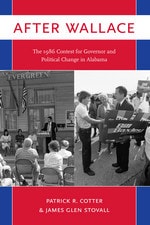
After Wallace
The 1986 Contest for Governor and Political Change in AlabamaPatrick R. Cotter
University of Alabama Press, 2009
With the retirement of an aging and ill George Wallace, both the issues and candidates contending for the office were able to set the course of Alabama politics for generations to follow. Whereas the Wallace regimes were particular to Alabama, and the gubernatorial campaign was conducted in a partial vacuum with his absence, Alabama also experienced a wave of partisan realignment. A once solidly Democratic South was undergoing a tectonic political shift as white voters in large numbers abandoned their traditional Democratic political home for the revived Republicans, a party shaped in many respects by the Wallace presidential bids of 1968 and 1972 and the Reagan revolution of the 1980s.
Alabama's own Democratic Party contributed to this massive shift with self-destructive campaign behavior that disgusted many of its traditional voters who wound up staying home or voting for a little-known Republican. From the gubernatorial election of 1986 came the shaky balance between the two parties that exists today.
After Wallace recollects and analyzes how these shifts occurred, citing extensive newspaper coverage from the time as well as personal observations and poll data collected by the authors. This volume is certain to be a valuable work for any political scientist, especially those with an interest in Alabama or southern politics.
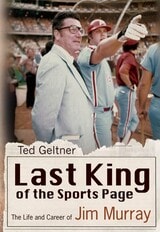
Last King of the Sports Page
The Life and Career of Jim MurrayTed Geltner
University of Missouri Press, 2012
Part crusader, part comedian, Jim Murray was a once-in-a-generation literary talent who just happened to ply his trade on newsprint, right near the box scores and race results. During his lifetime, Murray rose through the ranks of journalism, from hard-bitten 1940s crime reporter, to national Hollywood correspondent, to the top sports columnist in the United States. In Last King of the Sports Page: The Life and Career of Jim Murray, Ted Geltner chronicles Jim Murray’s experiences with twentieth-century American sports, culture, and journalism.
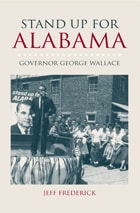
Stand Up for Alabama
Governor George WallaceJeffrey Frederick
University of Alabama Press, 2007
Reassessing the Political Legacy of Alabama's Most Influential Governor.
Whereas other studies have focused on George Wallace’s career as a national figure, Stand Up for Alabama provides a detailed, comprehensive, and analytical study of Wallace’s political life that emphasizes his activities and their impact within the state of Alabama. Jeff Frederick answers two fundamental questions: What was George Wallace’s impact on the state of Alabama? Why did Alabamians continue to embrace him over a twenty-five year period? Using a variety of sources to document the state’s performance in areas including mental health, education, conservation, prisons, and industrial development, Frederick answers question number one. He cites comparisons between Alabama and both peer states in the South and national averages. Wallace’s policies improved the state, but only in relation to Alabama’s past, not in relation to peer states in the region or national averages. As a result, energy was expended but little progress was made.
To answer the second question, Frederick uses the words of Alabamians themselves through oral history, correspondence, letters to the editor, and other sources. Alabamians, white and eventually black, supported Wallace because race was but one of his appeals. Stand Up for Alabama shows that Wallace connected to Alabamians at a gut level, reminding them of their history and memory, championing their causes on the stump, and soothing their concerns about their place in the region and the nation.
Jeff Frederick examines the development of policy during the Wallace administrations and documents relationships with his constituents in ways that go beyond racial politics. He also analyzes the connections between Wallace’s career and Alabamians’ understanding of their history, sense of morality, and class system. “Stand up for Alabama” was the governor’s campaign slogan.