Results by title
14 books match the query '1920-'
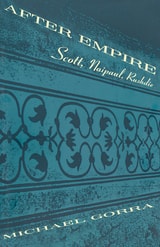
After Empire
Scott, Naipaul, RushdieMichael Gorra
University of Chicago Press, 1997
Arguing against a model of cultural identity based on race, Gorra begins with Scott's portrait, in The Raj Quartet, of the character Hari Kumar—a seeming oxymoron, an "English boy with a dark brown skin," whose very existence undercuts the belief in an absolute distinction between England and India. He then turns to the opposed figures of Naipaul and Rushdie, the two great novelists of the Indian diaspora. Whereas Naipaul's long and controversial career maps the "deep disorder" spread by both imperialism and its passing, Rushdie demonstrates that certain consequences of that disorder, such as migrancy and mimicry, have themselves become creative forces.
After Empire provides engaging and enlightening readings of postcolonial fiction, showing how imperialism helped shape British national identity—and how, after the end of empire, that identity must now be reconfigured.
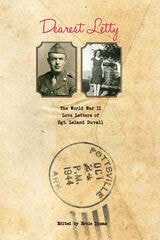
Dearest Letty
The World War II Love Letters of Sgt. Leland DuvallLeland Duvall
University of Arkansas Press, 2011
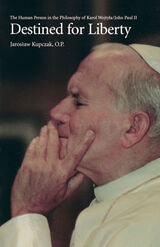
Destined for Liberty
The Human Person in the Philosophy of Karol Wojtyla/John Paul IIJaroslaw Kupczak, O.P.
Catholic University of America Press, 2000

Encounters with Rauschenberg
(A Lavishly Illustrated Lecture)Leo Steinberg
University of Chicago Press, 2000
With the sharpness and confidence that can only come from a critic who has long been involved with Rauschenberg's work, Steinberg offers an in-depth discussion of such major pieces as the Erased DeKooning Drawing, Bed, and Monogram. He explains the subtle differences between his interpretations and those of other critics, such as Clement Greenberg and Hilton Kramer. He candidly reflects on how he has changed his mind over the years, and defends his new ideas about Rauschenberg's work with precise, fresh arguments. He critically evaluates Rauschenberg's more recent work and addresses how it falls short from the artist's earlier work.
From Rauschenberg's silk-screen prints of the 1960s to the vegetable dye transfer prints of the 1990s, Steinberg warns against the dangers of overinterpretation and iconographic enthusiasm. He argues that the unifying strand through this great artist's work is his drive to appropriate, to take objects and images from the world and make them his own by making them become a part of his art.
Provocative, intelligent, and beautifully articulated, Steinberg's words shed light on one remarkable artist and on the post-war New York art scene, on Steinberg's particular appreciation of Rauschenberg and on his life's work as an art critic.
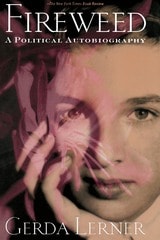
Fireweed
A Political AutobiographyGerda Lerner
Temple University Press, 2003
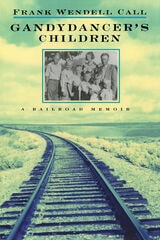
Gandydancer's Children
A Railroad MemoirFrank Wendell Call
University of Nevada Press, 2000
The late Frank Wendell Call is very much alive in these pages as he relates the fascinating tale of the rich, adventuresome existence he lived as a child in the Nevada desert along the Southern Pacific railroad line. In November 1928, Frank E. Call moved his young family from a comfortable home in Ogden, Utah to a tiny two-room shanty in an isolated railroad station in northeastern Nevada. He went to work as a gandydancer, a track laborer.
Meanwhile, Frank and Johanne Call's six lively children adapted to living alongside the tracks in primitive houses without electricity or indoor plumbing. The colorful narrative by the family's oldest child includes commentaries on railroading and the railroaders' language and describes social conditions and customs existing in tiny-town Nevada in the early twentieth century, from the viewpoint of the children themselves.
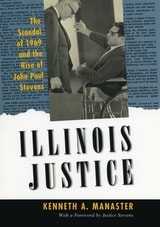
Illinois Justice
The Scandal of 1969 and the Rise of John Paul StevensKenneth A. Manaster
University of Chicago Press, 2001
In 1969, citizen gadfly Sherman Skolnick accused two Illinois Supreme Court justices of accepting valuable bank stock from an influential Chicago lawyer in exchange for deciding an important case in the lawyer’s favor. The resulting feverish media coverage prompted the state supreme court to appoint a special commission to investigate. Within six weeks and on a shoestring budget, the commission mobilized a small volunteer staff to reveal the facts. Stevens, then a relatively unknown Chicago lawyer, served as chief counsel. His work on this investigation would launch him into the public spotlight and onto the bench.
Manaster, who served on the commission, tells the real story of the investigation, detailing the dead ends, tactics, and triumphs. Manaster expertly traces Stevens’s masterful courtroom strategies and vividly portrays the high-profile personalities involved, as well as the subtleties of judicial corruption. A reflective foreword by Justice Stevens himself looks back at the case and how it influenced his career.
Now the subject of the documentary Unexpected Justice: The Rise of John Paul Stevens, Manaster’s book is both a fascinating chapter of political history and a revealing portrait of the early career of a Supreme Court justice.
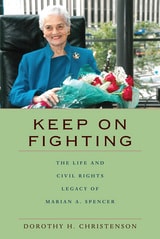
Keep On Fighting
The Life and Civil Rights Legacy of Marian A. SpencerDorothy H. Christenson
Ohio University Press, 2015
Marian Alexander Spencer was born in 1920 in the Ohio River town of Gallipolis, Ohio, one year after the “Red Summer” of 1919 that saw an upsurge in race riots and lynchings. Following the example of her grandfather, an ex-slave and community leader, Marian joined the NAACP at thirteen and grew up to achieve not only a number of civic leadership firsts in her adopted home city of Cincinnati, but a legacy of lasting civil rights victories.
Of these, the best known is the desegregation of Cincinnati’s Coney Island amusement park. She also fought to desegregate Cincinnati schools and to stop the introduction of observers in black voting precincts in Ohio. Her campaign to raise awareness of industrial toxic-waste practices in minority neighborhoods was later adapted into national Superfund legislation.
In 2012, Marian’s friend and colleague Dot Christenson sat down with her to record her memories. The resulting biography not only gives us the life story of remarkable leader but encapsulates many of the twentieth century’s greatest struggles and advances. Spencer’s story will prove inspirational and instructive to citizens and students alike.
Lost in a Labyrinth of Red Tape
The Story of an Immigration that FailedArmin Schmid and Renate Schmid
Northwestern University Press, 1996
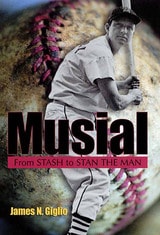
Musial
From Stash to Stan the ManJames N. Giglio
University of Missouri Press, 2001
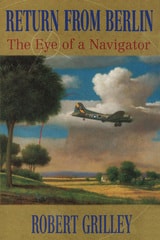
Return from Berlin
The Eye of a NavigatorRobert Grilley
University of Wisconsin Press, 2003
Wakened with flashlights on their faces in the predawn hours, he and his crew repeatedly face the Luftwaffe in battles five miles high, flying through flak "so thick you could get out and walk on it." Stretching their stamina to the limits, they succeed time after time in their missions to bomb munitions works, railyards, the Leüna synthetic oil plant at Merseburg in eastern Germany, the V2 rocket research center at Peenemünde on the distant Baltic Coast, and even to strike Hitler’s capital city, Berlin.
But Grilley finds interludes of unexpected grace and restoration on his days off, making serious drawings from nature at the neighboring Yokehill Farm. There he slowly cultivates a friendship with a curious eight-year-old, the lively child Elizabeth, who becomes for the combat flyer a symbol of survival.
Ronald Searle in Le Monde
Ronald Searle
University of Chicago Press, 2002
Since 1995, Searle has plied his sardonic trade on the coveted op-ed pages of the French daily newspaper Le Monde. This book presents more than a hundred of the best of these cartoons, ranging across politics, the new Europe, the nature of the contemporary economy, social games, and various "angels," both benign and mischievous. Whether skewering the greed of the rich with images of men in suits padding each other's pockets with cash or conducting business under the table, or making a poignant comment about how much harder peace has to work than war to stay in the same place, Searle displays the same pungent, incisive, yet infinitely humane wit. The deceptive simplicity of his lines and shadings combine with meticulously observed details of dress, background, and facial expression to produce arresting images that convey his messages powerfully and beautifully.
By turns delightful, amusing, and disturbing, but always deeply thought provoking, Searle's work reaches well beyond the specific occasion that inspired a given cartoon to illuminate key aspects of public life in the West at the end of the millennium. This book contains twenty-five illustrations not found in the French edition, together with a new preface for English-speaking readers written by Searle himself.
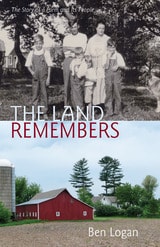
The Land Remembers
The Story of a Farm and Its PeopleBen Logan, with an introduction by Curt Meine
University of Wisconsin Press, 2017
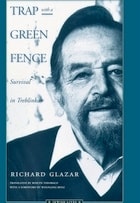
Trap with a Green Fence
Survival in TreblinkaRichard Glazar
Northwestern University Press, 1995