Results by title

3 books match the query '1921-1923'
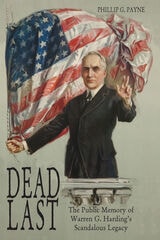
cover of Dead Last: The Public Memory of Warren G. Harding’s Scandalous Legacy

Dead Last

The Public Memory of Warren G. Harding’s Scandalous Legacy

Phillip G. Payne

Ohio University Press, 2008

If George Washington and Abraham Lincoln are the saints in America’s civil religion, then the twenty-ninth president, Warren G. Harding, is our sinner. Prior to the Nixon administration, the Harding scandals were the most infamous of the twentieth century. Harding is consistently judged a failure, ranking dead last among his peers.

By examining the public memory of Harding, Phillip G. Payne offers the first significant reinterpretation of his presidency in a generation. Rather than repeating the old stories, Payne examines the contexts and continued meaning of the Harding scandals for various constituencies. Payne explores such topics as Harding’s importance as a midwestern small-town booster, his rumored black ancestry, the role of various biographers in shaping his early image, the tension between public memory and academic history, and, finally, his status as an icon of presidential failure in contemporary political debates. Harding was a popular president and was widely mourned when he died in office in 1923; but with his death began the construction of his public memory and his fall from political grace.

In Dead Last, Payne explores how Harding’s name became synonymous with corruption, cronyism, and incompetence and how it is used to this day as an example of what a president should not be.
[more]
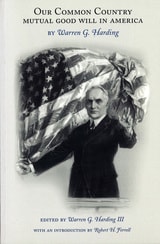
cover of Our Common Country: Mutual Good Will in America

Our Common Country

Mutual Good Will in America

Warren G. Harding, Edited by Warren G. Harding, III, & Intro by Robert H. Ferrell

University of Missouri Press, 2003
Our Common Country is a collection of informal addresses, eighteen in all, given by Warren G. Harding as president-elect that defined his vision for the United States. What makes these addresses as relevant today as they were in 1921 is the unsettled mood of the country. Even though World War I is now a distant memory, today’s Americans have suffered through similar conflicts.
In 1917 when Americans went off to war, the red, white, and blue flew everywhere. Two million American soldiers went to France and fifty thousand of them died; the battle of the Meuse-Argonne was one of the costliest in American history. With the announcement by America’s allies that the United States’s contributions to the war were insignificant compared to their own, President Wilson’s leadership began to collapse. Also, the domestic economy’s boom was turning to a bust and the national debt was expanding. The general consensus of Americans was that “things had gone to hell in a handbasket.”
            In an effort to ease the minds of troubled and confused Americans, President Harding tried to provide them with inspiration. Addressing different groups of the population—mothers, veterans, patriots, farmers, businessmen, the press—he sought to send a consistent personal message of reassurance. During his administration, he would bring a formal end to the war by signing the Treaty of Berlin and would limit strategic armaments through the treaties of the Washington Conference. He would also establish the Bureau of the Budget, thereby bringing order to the departmental and bureaucratic requests that had disgraced budget making for decades. He planted the seeds for a department of health, education, and welfare, which was finally realized thirty years later. Although the former president was much maligned after his death, his good works during his term of office speak for themselves and show concern for his fellow Americans. His warmth, strength of character, and intelligence are demonstrated throughout these addresses. Harding spoke to his own time, yet these addresses speak to our own confusing times as well.
[more]
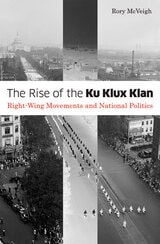
cover of The Rise of the Ku Klux Klan: Right-Wing Movements and National Politics

The Rise of the Ku Klux Klan

Right-Wing Movements and National Politics

Rory McVeigh

University of Minnesota Press, 2009

In 1915, forty years after the original Ku Klux Klan disbanded, a former farmer, circuit preacher, and university lecturer named Colonel William Joseph Simmons revived the secret society. By the early 1920s the KKK had been transformed into a national movement with millions of dues-paying members and chapters in all of the nation’s forty-eight states. And unlike the Reconstruction-era society, the Klan in the 1920s exerted its influence far beyond the South. In The Rise of the Ku Klux Klan, Rory McVeigh provides a revealing analysis of the broad social agenda of 1920s-era KKK, showing that although the organization continued to promote white supremacy, it also addressed a surprisingly wide range of social and economic issues, targeting immigrants and, particularly, Catholics, as well as African Americans, as dangers to American society. In sharp contrast to earlier studies of the KKK, which focus on the local or regional level, McVeigh treats the Klan as it saw itself—as a national organization concerned with national issues. Drawing on extensive research into the Klan’s national publication, the Imperial Night-Hawk, he traces the ways in which Klan leaders interpreted national issues and how they attempted—and finally failed—to influence national politics. More broadly, in detailing the Klan’s expansion in the early 1920s and its collapse by the end of the decade, McVeigh ultimately sheds light on the dynamics that fuel contemporary right-wing social movements that similarly blur the line between race, religion, and values. 
[more]